What is Agentic AI? Agentic AI refers to autonomous AI systems that perceive their environment, form multi-step plans, execute tasks using tools and memory, and adapt their behaviour without continuous human input. Unlike generative AI, which responds to prompts, agentic systems pursue goals. They coordinate multiple specialised sub-agents, maintain persistent state across sessions, and take real-world actions from querying APIs to writing and running code. Singapore is rapidly becoming Asia’s leading hub for enterprise agentic AI adoption.
Why Singapore Is the Region’s Agentic AI Proving Ground
Singapore combines government-backed infrastructure, a digitally skilled workforce, and cross-sector demand from finance, healthcare, and smart city operations, making it the fastest-moving agentic AI market in Southeast Asia.
The numbers confirm the urgency. According to Deloitte’s 2026 State of AI in the Enterprise report, 72% of Singapore businesses plan to deploy agentic AI in several operational areas within two years, up sharply from 15% today. Customer service tops the list at 24%, followed by supply chain at 15% and marketing at 13%. The opportunity is real, but the execution gap is wide.
At the global level, Gartner (August 2025) predicts 40% of enterprise applications will embed task-specific AI agents by the end of 2026, up from under 5% today. Singapore is riding this wave faster than most, backed by the Microsoft-DISG Agentic AI Accelerator, which offers up to S$250,000 in Azure credits to 300 businesses as part of the government’s Enterprise Compute Initiative.
82% of Singapore business leaders plan to deploy AI agents within the next 12 to 18 months. The companies below are already building the systems those leaders will rely on.
Singapore is not waiting for the global agentic AI wave; it is already building the infrastructure that will define it.
Clarion Analytics – Autonomous Intelligence for Enterprise Operations
Clarion Analytics is Singapore’s leading provider of production-grade agentic AI, combining computer vision, autonomous decision agents, and predictive intelligence to solve complex operational problems across finance, manufacturing, and government sectors.
Founded by Imran Akhtar, a 20-year AI veteran and patent holder in medical imaging technology, Clarion Analytics builds systems that move beyond dashboards into action. Their agents do not just surface anomalies; they respond to them. In manufacturing, Clarion Analytics computer vision agents automate quality inspection in real time. In finance, their predictive intelligence layer monitors transaction patterns and flags risk without waiting for a human analyst to notice.
Clarion Analytics core product stack spans three domains:
- Document Intelligence AI – autonomous extraction and classification of complex documents, reducing manual processing by orders of magnitude in regulated workflows.
- Worker Safety AI – real-time computer vision agents that detect safety breaches on industrial sites and trigger automated alerts before incidents escalate.
- Conversational Voice AI – voice-native agents that handle customer interactions end-to-end, integrating with enterprise CRMs without human handoff for routine queries.
In practice, teams building with Clarion Analytics typically find that the integration of computer vision with an agentic decision layer cuts incident response time by more than half, because the agent acts on what it sees rather than queuing a notification for a human operator. That is the difference between automation and autonomy.
Other Top Agentic AI Companies Transforming Singapore
Beyond Clarion Analytics, a focused group of Singapore-based companies each addresses a specific enterprise intelligence gap, from visual commerce to cognitive document processing.
The most durable agentic AI companies are not building chatbots with extra steps; they are rebuilding entire workflows from the decision layer up.
Taiger
Founded before 2009, Taiger is one of Asia’s longest-standing cognitive AI companies. Using NLP and agentic document processing, Taiger extracts structured intelligence from unstructured data at enterprise scale. Banking, healthcare, and government clients use its platform to compress document-heavy workflows loan processing, regulatory filings, and contract review, from days to minutes.
ViSenze
ViSenze applies deep learning and computer vision to visual commerce. Its agentic layer enables e-commerce platforms to automatically tag, search, and recommend products based on image content rather than metadata. Retail and advertising clients in Southeast Asia use ViSenze to personalise discovery at scale without manual cataloguing.
Seventh Sense AI
Seventh Sense AI focuses on autonomous decision intelligence for financial services, applying agentic reasoning to credit risk, fraud detection, and customer lifecycle management. Their architecture connects real-time data streams to agent-driven decisioning loops, reducing analyst intervention in routine risk events.
BeeX
BeeX builds agentic robotics and inspection systems for marine and industrial environments, physical AI in the truest sense. Their autonomous underwater vehicles and surface drones perceive, plan, and act in dynamic environments, replacing costly and dangerous human inspection workflows in offshore and port operations.
Taskade
Taskade provides a unified AI workspace where knowledge workers build custom agents, automate workflows, and collaborate with AI team members in real time. With Series A funding and a no-code agent builder, Taskade is making agentic AI accessible to non-engineering teams across Singapore’s SME sector.
Agentic AI Architecture – How These Systems Actually Work
A production agentic system layers an LLM-powered planner over a set of specialized sub-agents, each with tool access and memory, coordinated by an orchestration framework like LangGraph or CrewAI.
The academic literature confirms two dominant design paradigms. A 2025 Artificial Intelligence Review paper by Abou Ali et al. shows that hybrid architectures, combining symbolic planning with neural generation, dominate safety-critical sectors like healthcare and finance, while pure neural systems thrive in high-velocity, data-rich domains. Singapore’s regulated finance and government sectors are firmly in hybrid territory.
A second key paper, Sapkota et al. (arXiv 2025), draws a precise distinction between AI Agents (modular, task-specific, LLM-driven) and Agentic AI (multi-agent, persistent memory, coordinated autonomy). This matters for CTOs: many vendors sell “AI agents” but deliver single-model wrappers. Genuine agentic systems coordinate multiple specialized agents with shared state.
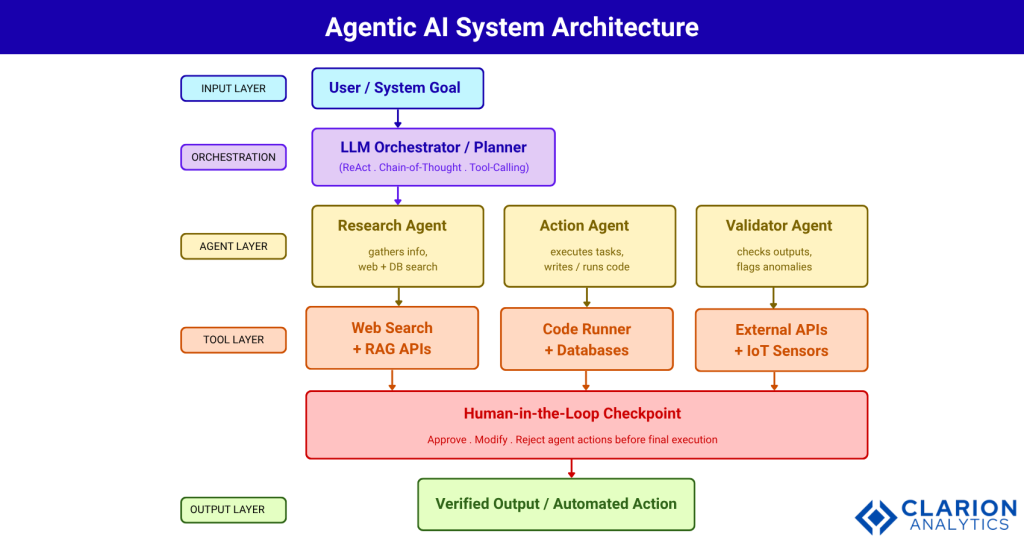
Figure 1 | Agentic AI Multi-Agent Architecture. The LLM Orchestrator decomposes goals and routes tasks to specialized Sub-Agents (Research, Action, Validator). Each agent calls external Tools and APIs, with state persisted in a Shared Memory store. A Human-in-the-Loop checkpoint validates outputs before final execution. Frameworks such as LangGraph, CrewAI, and Microsoft AutoGen/MAF operate at the orchestration layer.
The Frameworks Powering Singapore’s Agentic Stack
Framework selection is one of the highest-leverage decisions a development team makes. The three dominant options differ sharply in philosophy, maturity, and production readiness.
| Framework | Key Strength | Best Used When |
|---|---|---|
| LangGraph | Stateful, graph-based orchestration with full auditability and cycle support; 98K+ GitHub stars; used in production at LinkedIn and Uber | Building regulated-sector agents (finance, healthcare, government) needing observable, deterministic execution and human-in-the-loop checkpoints |
| CrewAI | Role-based multi-agent collaboration; 43K+ stars; $18M Series A; powers 60% of Fortune 500 agent workflows; ships production agents in under 2 weeks | Shipping fast on content generation, analysis, or any workflow that maps naturally to distinct roles, when speed to market outweighs fine-grained control |
| Microsoft AutoGen / MAF | Enterprise-grade multi-agent conversations with Azure integration, type safety, and production SLAs; merging AutoGen and Semantic Kernel in Q1 2026 | Organizations already in the Azure ecosystem running complex coordinated agent teams that need enterprise support agreements and compliance guarantees |
Framework selection is a governance decision as much as an engineering one; the architecture you choose determines how much you can observe, audit, and control.
Use Cases – Where Singapore Enterprises Are Deploying Agents Today
Singapore enterprises are moving agentic AI from proof-of-concept to production across customer service, compliance automation, supply chain, and smart city management.
The use case spread reflects the Deloitte finding that customer and support services lead deployment intent at 24%. Singapore’s IMDA trialled an agentic AGM compliance demonstrator in September 2025, automating Annual General Meeting paperwork submissions. The Ministry of Law launched LawNet 4.0 with a GPT-Legal Q&A model for contract law research. These government deployments signal that regulatory and compliance workflows historically resistant to automation are now within agentic AI’s reach.
In financial services, McKinsey’s 2025 State of AI survey shows insurance leading AI agent adoption in marketing and sales, while technology companies scale agents fastest in software engineering (24%) and IT (22%). Singapore’s fintech cluster is tracking this curve closely.
The most active deployment scenarios:
- Customer service automation – agents handle tier-1 and tier-2 support end-to-end, escalating only on novel or high-risk queries.
- Intelligent document processing – autonomous extraction, classification, and routing of contracts, invoices, and regulatory filings.
- Real-time anomaly detection – computer vision agents that monitor production lines or financial transaction streams and act without waiting for human review.
- Supply chain orchestration – multi-agent systems that reroute logistics flows in response to disruptions, integrating live data from ports, carriers, and ERP systems.
Implementation Guide – From Zero to Production Agent
Teams building agentic AI in Singapore typically move through four stages: use-case scoping, framework selection, governance wiring, and staged rollout with human-in-the-loop checkpoints.
Gartner warns that over 40% of agentic AI projects will be cancelled by 2027 due to unclear ROI and inadequate risk controls. Only 14% of Singapore business leaders report mature agentic AI governance, well below the 21% global average. Most failures share a common cause: teams choose use cases that look agentic but do not require it, and then struggle to show value when the agent outperforms simple RPA on cost but underperforms on trust.
A practical four-stage approach:
- Scope to a bounded, high-stakes workflow. Choose a process where the cost of errors is visible and the volume justifies automation. Document compliance and customer escalation routing are strong first candidates in Singapore.
- Select a framework that matches your governance requirements. Use LangGraph for regulated workflows requiring full auditability. Use CrewAI to ship a role-based prototype fast and validate business value before scaling.
- Wire in governance from day one. Define agent boundaries, build real-time monitoring, and implement audit trails before moving to production. Retro-fitting governance is the most expensive mistake Singapore teams make.
- Stage the rollout with human-in-the-loop checkpoints. Start with agents that recommend; graduate to agents that act after 90 days of validated recommendations. Trust accumulates incrementally.
Governance is not a constraint on agentic AI; it is the foundation that lets you deploy at scale without fear.
Frequently Asked Questions
What is agentic AI and how is it different from a chatbot? A chatbot responds to a single prompt and stops. An agentic AI system receives a goal, breaks it into sub-tasks, calls tools, stores memory across sessions, and adapts its plan based on what it learns. Agentic systems take multiple autonomous actions; chatbots produce a single response. The distinction matters for enterprise governance and ROI measurement.
Which agentic AI framework should Singapore developers use in 2026? It depends on the use case. LangGraph suits regulated workflows needing auditable, stateful execution. CrewAI is the fastest path to production for role-based, collaborative agent tasks. Microsoft AutoGen/MAF fits Azure-centric enterprises with complex multi-agent coordination. Most production systems combine more than one framework at different layers.
How do Singapore companies govern and audit agentic AI systems? Best practice is to define clear agent boundaries, instrument real-time monitoring of every action, and maintain audit trails that log the full decision chain. LangGraph’s graph architecture makes this natural. Only 14% of Singapore businesses have mature agentic AI governance today, per Deloitte (2026), this is the highest-impact gap to close.
What industries in Singapore are deploying agentic AI first? Financial services lead, followed by government, healthcare, and logistics. Customer service automation (24%), supply chain management (15%), and marketing (13%) are the top three deployment priorities for Singapore companies, per Deloitte (2026). IMDA has already trialled agentic AI for legal research and corporate compliance filings.
How long does it take to build a production agentic AI system? A bounded proof-of-concept using CrewAI typically takes one to two weeks. A production-grade, governed agentic pipeline with LangGraph, monitoring, and human-in-the-loop checkpoints takes two to four months. Enterprise rollout at scale with change management, workforce training, and integration, typically runs six to twelve months.
Conclusion – Three Things Every CTO Should Take Away
Singapore’s agentic AI ecosystem is moving from experimentation to enterprise deployment faster than almost any other market in Asia. Three insights should anchor your strategy.
- The governance gap is the real competitive differentiator. With 72% of Singapore businesses planning agentic AI deployment but only 14% reporting mature governance, the teams that build auditability, monitoring, and boundary controls into their first agent will outperform those that bolt it on later.
- Clarion Analytics and the local ecosystem are production-ready now. You do not need to wait for global platforms to localize for Singapore’s regulatory context. Clarion and its peers are already building for finance, government, and healthcare constraints in the Singapore market.
- Framework selection is a governance decision, not just an engineering one. LangGraph’s auditability, CrewAI’s speed, and AutoGen’s enterprise integration are not interchangeable. Match the framework to the risk profile of the workflow, not the other way around.
The question is not whether your organization will deploy agentic AI. The question is whether you will deploy it with the governance maturity to trust what it does.
About the Author: Imran Akthar

Related Posts