Enterprise AI in Indonesia refers to the deployment of artificial intelligence systems, including machine learning models, large language models, and automated decision engines, within Indonesian business operations. In 2026, this spans five government-priority sectors: healthcare, government services, education, food security, and smart cities. These deployments are governed by the UU PDP personal data law (enforceable since October 2024), OJK banking AI guidelines (published April 2025), and a pending Presidential Regulation on AI ethics and safety that will introduce mandatory governance for high-risk systems.
Why Indonesia’s AI Market Can No Longer Be Called Emerging
Indonesia’s enterprise AI market has crossed a threshold that changes how foreign companies should think about it. Between 2020 and 2024, the country attracted an estimated $4.6 billion in AI-related investment, ranking first in Southeast Asia for AI investment attraction according to market analysis published by DigitalInAsia (2026). The AI market itself is projected to reach $10.88 billion by 2030, according to Statista Market Insights. Enterprise leaders who still classify Indonesia as an emerging opportunity are already behind.
A McKinsey, EDB Singapore, and Tech in Asia survey (February 2026) found that 51% of Indonesian companies report progress toward scaled AI adoption, second only to Singapore’s 56% in Southeast Asia. The survey, covering 330 companies across six SEA markets, also found that only 6% of companies globally qualify as AI high performers, achieving 11% or more EBIT impact. The same research points to a thriving ecosystem of AI centers of excellence and a government strategy that treats AI as a pillar of the national development plan through 2045. By 2026, Indonesian enterprises are moving beyond experimental deployments toward full-scale operational integration, though most still report less than 5% EBIT impact from AI investments.
The infrastructure behind that shift is substantial. Indonesia’s hyperscale data center market reached $3.49 billion in 2025 and is projected to climb to $7.96 billion by 2031, advancing at a 14.71% compound annual growth rate, according to Mordor Intelligence. Jakarta leads national data center capacity with a 57% market share in 2025, with Batam emerging as a secondary hub. McKinsey research (June 2026) shows that top Western hyperscalers committed over $160 billion from January 2024 to May 2026 to build AI infrastructure across APAC, with Southeast Asia named as a primary growth corridor.
The caveat that matters: McKinsey (2026) found that 60% of Southeast Asian companies report that AI adoption has had less than 5% impact on EBIT. Investment signals are strong. Execution discipline is what separates early winners from expensive failures.
Indonesia’s AI market is not emerging. It is accelerating. The question is no longer whether to enter, but how to enter without repeating the governance mistakes that stalled pilots elsewhere in the region.
The Regulatory Stack Every Enterprise Must Understand
Indonesia’s AI regulatory environment is arriving in layers. Enterprises that wait for a single consolidated AI law before acting will miss the window. Three instruments are already binding or imminent in 2026.
Layer 1: UU PDP (Personal Data Protection Law)
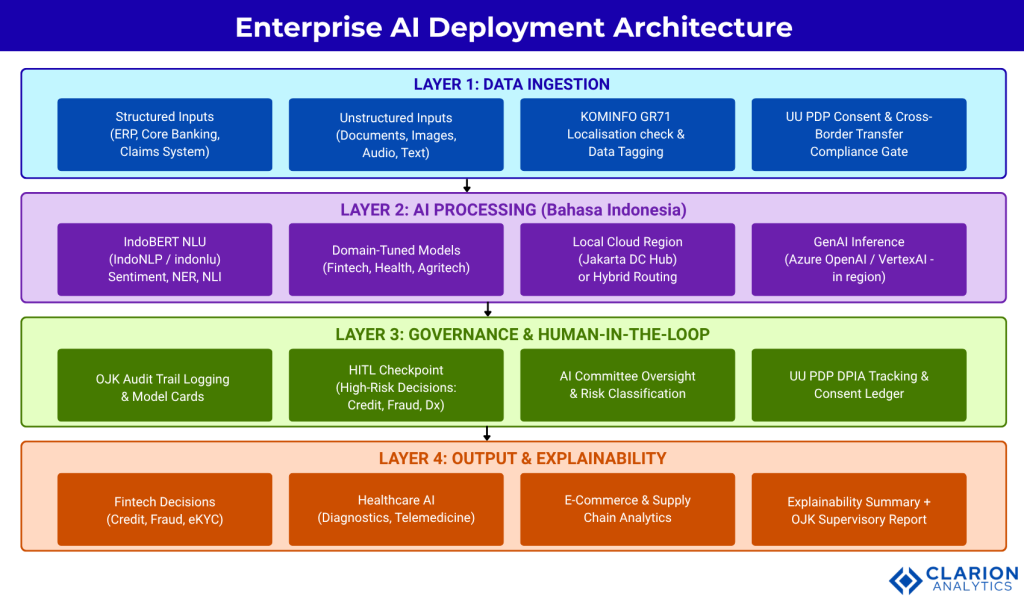
Indonesia’s Personal Data Protection Law (Law No. 27 of 2022) became fully enforceable in October 2024 when its two-year transition period expired. As of mid-2026, the dedicated Personal Data Protection Agency (Lembaga PDP) is still being established, with a draft Presidential Regulation governing the agency in harmonisation at the Ministry of Law. For AI deployments, organisations must obtain explicit consent for using personal data in training and operations, conduct data protection impact assessments for high-risk processing (which includes algorithmic profiling and automated credit decisions), and comply with cross-border transfer requirements. Administrative penalties reach up to 2% of annual revenue; criminal sanctions for serious violations include fines of IDR 4 to 6 billion and imprisonment of 4 to 6 years.
Layer 2: OJK Banking AI Governance Guide
On 29 April 2025, Indonesia’s Financial Services Authority (OJK) published the Buku Panduan Tata Kelola Kecerdasan Artifisial Perbankan, a minimum lifecycle framework for AI in Indonesian banks. It requires banks to establish internal AI committees, maintain audit trails for all algorithmic decisions, implement human-in-the-loop controls for high-risk applications such as credit decisioning and fraud detection, and produce model cards. The framework covers a six-stage AI lifecycle: initiation, design, model development, testing, implementation, and evaluation with periodic audit. The guide is framed around three core principles: reliability, accountability, and human oversight.
Layer 3: Presidential Regulation on AI Ethics and Safety
Indonesia’s Minister of Communication and Digital Affairs (Komdigi) confirmed in January 2026 that the Presidential Regulation on the National AI Roadmap is a 2026 presidential priority. As of June 2026, the regulation draft has been submitted to the Ministry of Law for harmonisation but is awaiting presidential signature. Once signed, every ministry and agency must issue derivative regulations for their sectors. The regulation will introduce governance requirements for high-risk AI systems, mandatory labelling of AI-generated content, and standards for model transparency disclosures. Critically, the Presidential Regulation itself cannot impose penalties; enforcement relies on existing UU PDP and UU ITE provisions.
Data localisation is a live constraint throughout. Government Regulation No. 71 of 2019 (PP PSE) requires certain personal data processed by Electronic System Operators to be stored within Indonesia. Healthcare data must stay within Indonesian jurisdiction under GR 28/2024. Banking primary and disaster recovery data centers must both be in-country under OJK Reg 11/2022. Enterprises running AI on cloud infrastructure must use local cloud regions, partner with domestic data center operators, or implement hybrid architectures.
The fintech compliance matrix alone involves three overlapping frameworks: OJK fintech rules, Bank Indonesia payment oversight, and UU PDP data protection. Teams that map these intersections now avoid duplicative remediation work later.
The Five Sectors Where AI Is Already Delivering
Indonesia’s National AI Strategy (Stranas KA) designates five priority sectors: healthcare, government services, education, food security, and smart cities. Enterprise AI adoption is also thriving in fintech, which sits outside the five designated sectors but leads commercial deployment. Each is at a different stage of maturity.
Fintech and Digital Banking
Fintech is the most commercially mature AI sector. Indonesia accounts for approximately 20% of ASEAN’s tech startups, with fintech among the most AI-active. Machine learning models improve loan underwriting accuracy while reducing document review costs. Fraud detection, alternative credit scoring, and AI-driven eKYC are in production at scale. Bank Rakyat Indonesia has deployed multiple generative AI applications, including chatbot “Sabrina” serving millions of customers. DANA, the digital wallet platform reaching 83% urban usage, uses AI to analyze financial behaviors and tailor products for underserved communities. Indonesia’s total fintech services market reached $19.15 billion in 2025, growing at 9.3% CAGR.
Healthcare
Indonesia’s digital health transformation now holds records for 270 million patients through the SatuSehat national health platform. As of January 2026, 91% of primary care facilities and 95% of hospitals are integrated with the platform, operating on HL7 FHIR interoperability standards. The Ministry of Health’s priority AI use cases include stroke detection, cardiovascular diagnostics, tuberculosis screening, and stunting surveillance. The country ran its first national AI healthcare hackathon in 2025, drawing 278 teams from ten countries.
E-Commerce, Supply Chain, and Smart Cities
E-commerce AI operates at meaningful scale: Indonesia’s digital economy is approaching $100 billion in GMV by 2025 per the e-Conomy SEA 2025 report by Google, Temasek, and Bain. Populix, Indonesia’s leading consumer insights platform with one million respondents, built an AI research assistant using Vertex AI to automate survey creation. GoTo’s platform embeds AI across logistics, payments, and merchant analytics. Nodeflux deploys AI-powered video analytics across smart city infrastructure on Java, including traffic management and security systems. Nusantara, the new capital under construction in East Kalimantan, integrates AI from inception across healthcare, transport, and public administration.
Across all five sectors, the companies gaining traction follow the same pattern: domain-specific models, Bahasa Indonesia language capability, and governance structures aligned to OJK or Ministry-level expectations before launch.
The Indonesian NLP Stack for Enterprise Teams
Any enterprise deploying customer-facing or document-processing AI in Indonesia needs language models that handle Bahasa Indonesia natively. Multilingual models underperform on Indonesian text. IndoBERT, developed by a consortium including Institut Teknologi Bandung, Universitas Indonesia, Gojek, and Prosa.AI, is the canonical pre-trained language model for Indonesian NLP. Trained on 4 billion words across a 23GB corpus, it achieves state-of-the-art performance on 12 NLU tasks including sentiment analysis, named entity recognition, and natural language inference.
In practice, enterprise teams building customer service chatbots or document classification systems typically find that a fine-tuned IndoBERT model outperforms general-purpose multilingual models on Indonesian-specific vocabulary. The gain is most pronounced on formal legal and financial language, which diverges significantly from the colloquial Indonesian present in most multilingual training corpora.
Enterprise AI Deployment Approaches: A Comparison
| Deployment Approach | Key Strength | Best Used When |
|---|---|---|
| Cloud-native (AWS, Azure, GCP local region) | Fastest time to value; hyperscaler compliance frameworks reduce OJK audit prep; Microsoft Indonesia Central Region launched in 2025 | Enterprise has existing cloud contracts; small team; speed to production is the priority |
| Hybrid (local DC + cloud inference) | Satisfies PP PSE and OJK data localisation for personal data; keeps sensitive data in-country; uses cloud compute for training | Regulated industries (banking, health) where primary data must stay within Indonesian jurisdiction |
| On-premise with sovereign stack | Maximum data control; meets strictest OJK and UU PDP requirements; supports Pancasila-aligned AI governance | Government agencies, SOEs, or financial institutions with highest regulatory exposure |
Building the Implementation Roadmap: From Pilot to Production
McKinsey (2026) found that only 6% of organizations globally qualify as AI high performers, while 60% of SEA companies report less than 5% EBIT impact from AI. Most pursue too many experiments with too little depth. Indonesia adds additional friction: regulatory ambiguity, data infrastructure gaps, and a significant digital talent shortfall that the national AI roadmap identifies as a key constraint to address before 2030.
Teams that succeed in Indonesia follow five disciplined steps:
- Data audit against UU PDP. Map every dataset the AI system will touch. Identify personal data, confirm lawful basis for processing, check cross-border transfer requirements, and document consent mechanisms. This is the input to every subsequent governance decision.
- OJK risk classification. If the use case touches financial services, classify it as low, medium, or high risk under OJK’s banking AI governance guide. High-risk applications require human-in-the-loop controls and independent validation before deployment.
- Model localisation. Select or fine-tune models for Bahasa Indonesia. Evaluate IndoBERT variants against your domain-specific vocabulary. Document model choices and training data lineage in model cards, which OJK examiners may request.
- Governance documentation. Build the audit trail before go-live. This means automated logging of algorithmic decisions, rollback mechanisms, and plain-language model cards for customer-facing systems.
- Phased rollout with HITL. Deploy to a controlled user cohort, measure against pre-defined metrics, validate explainability, then expand. Indonesian regulators are watching for teams that treat go-live as a governance checkpoint, not a finish line.
The companies that will dominate Indonesian enterprise AI by 2028 are not those that pilot the most use cases. They are the ones that find a single high-value domain, redesign the workflow around it, and build the governance infrastructure to scale it.
Frequently Asked Questions
Is Indonesia ready for enterprise AI in 2026?
Yes, with sector-specific nuance. Fintech and digital banking have the most mature AI governance and the highest deployment density. Healthcare and e-commerce are scaling fast. All sectors benefit from 284 million people (per BPS 2025), 80.66% internet penetration (APJII 2025), and a government AI roadmap through 2045. However, most enterprises still report limited EBIT impact from AI, and the PDP Agency has not yet been formally established.
What data localisation rules apply to AI systems in Indonesia?
Government Regulation No. 71 of 2019 (PP PSE), GR 28/2024 for healthcare data, and OJK Reg 11/2022 for banking each impose in-country storage requirements for personal and sensitive data. Foreign AI providers serving Indonesian users typically need a Jakarta cloud region or domestic data center partner to comply. UU PDP additionally requires organisations to ensure adequate protection for cross-border personal data transfers.
How does OJK regulate AI in Indonesian banks and fintechs?
OJK’s April 2025 Banking AI Governance Guide provides a minimum framework covering a six-stage AI lifecycle: initiation, design, model development, testing, implementation, and evaluation with periodic audit. The guide requires an AI committee or integration into an existing technology committee, audit trails for algorithmic decisions, and human-in-the-loop controls for high-risk applications including credit decisioning. The guide is built on three core principles: reliability, accountability, and human oversight.
What is the best AI model for processing Bahasa Indonesia text?
IndoBERT (indobenchmark/indobert-base-p1), trained on a 4-billion-word, 23GB corpus by a consortium including ITB, Universitas Indonesia, Gojek, and Prosa.AI, is the production benchmark for Indonesian NLU. Load it via HuggingFace. Domain fine-tuning for legal or financial Indonesian text typically yields further gains over the base model. IndoLEM provides benchmarks to evaluate any custom fine-tuning against standardised Indonesian NLP tasks.
How long does it take to scale an AI pilot to production in Indonesia?
Six to eighteen months is the realistic range for regulated-sector deployments. The variables are data audit complexity, OJK risk classification tier, and whether localised models are available for the use case. Teams that complete governance documentation before launch, rather than retrofitting it, consistently compress the timeline by two to four months.
The Bottom Line
Three facts define the Indonesia AI opportunity in 2026. First, the market is real: an estimated $4.6 billion in AI-related investment since 2020, a clear government mandate through Golden Indonesia 2045, and hyperscaler infrastructure commitment exceeding $160 billion across APAC that makes Jakarta a genuine compute hub. Second, the regulation is already active: UU PDP has been enforceable since October 2024, OJK banking AI governance is in force, and a Presidential Regulation will extend mandatory framework governance to all high-risk AI sectors once signed. Third, localisation is non-negotiable: data must stay in-country, models must work in Bahasa Indonesia, and governance must satisfy both domestic regulators and international audit standards simultaneously.
Enterprises that treat these three facts as a checklist will build compliant but unremarkable AI products. Those that treat them as design constraints will build something harder to copy: AI systems tuned to 284 million users, deployed in a regulatory environment they helped shape, and supported by infrastructure anchored to Southeast Asia’s largest digital economy.
The question worth sitting with: if your AI product is identical in Jakarta and Singapore, are you actually building for Indonesia, or just shipping to it?
About the Author: Shivi

Related Posts