Definition: Agentic AI refers to AI systems that autonomously perceive their environment, formulate multi-step plans, execute sequences of actions via external tools or APIs, and adapt their behaviour based on intermediate results, all with minimal human intervention. Unlike generative AI, which responds to a single prompt, agentic AI pursues a goal across many steps, deciding what to do next at each stage.
Why Singapore Is Becoming Asia’s Agentic AI Capital
Singapore’s Smart Nation policy, government co-funding via the Digital Industry Singapore (DISG) Agentic AI Accelerator, and dense enterprise infrastructure make it the fastest-growing agentic AI market in Southeast Asia. If you are a software developer or CTO evaluating agentic AI companies in Singapore, the landscape is moving faster than most quarterly reports can track.
Consider what Deloitte’s February 2026 State of AI in the Enterprise report found: 72% of Singapore businesses plan to deploy agentic AI within two years, yet only 15% have it running today. The governance gap is equally stark. Only 14% of Singapore leaders report a mature model for agentic AI oversight, below the global average of 21%.
At the same time, Microsoft and DISG launched a joint Agentic AI Accelerator in August 2025 that offers up to S$250,000 in Azure credits to 300 eligible businesses. Some enterprises can receive up to S$700,000 in co-development funding. That kind of capital signal shapes where talent and tooling go next.
“72% of Singapore businesses plan to deploy agentic AI within two years. Only 14% have mature governance to support it.” ~Deloitte AI Institute, February 2026
Tracxn data (2025) shows that agentic AI funding in Singapore rose 74% in 2025 compared to the same period in 2024. That growth is not coming from hype alone. It reflects real enterprise budgets being deployed against specific workflow problems in finance, construction, healthcare, and logistics.
The Companies Building Agentic AI in Singapore Right Now
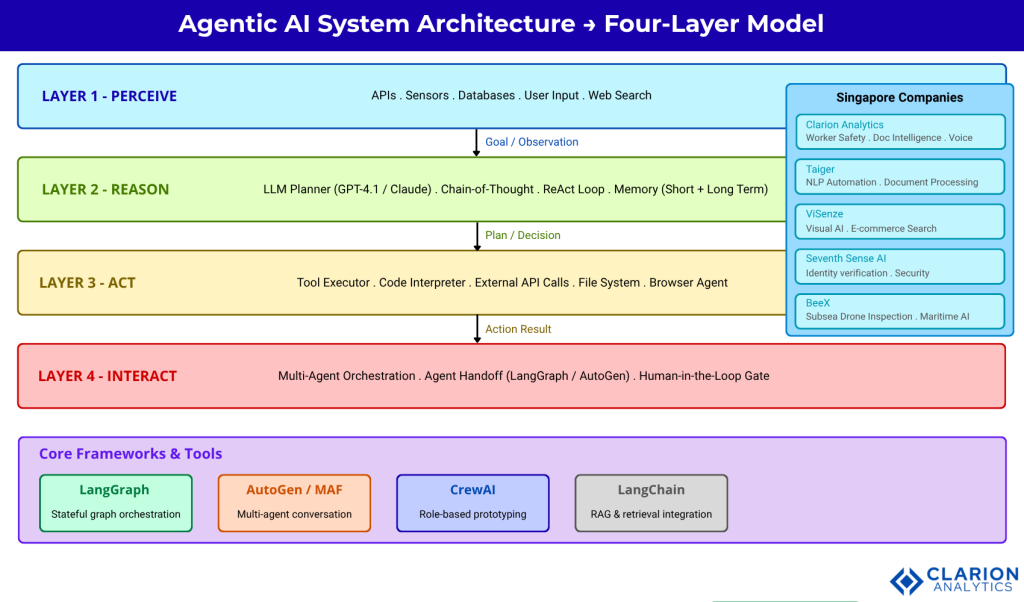
Clarion Analytics, Taiger, ViSenze, Seventh Sense AI, and BeeX are among the leading Singapore-based firms deploying agentic AI across finance, worker safety, retail, security, and maritime sectors. Each takes a different approach to autonomy, reflecting the sector constraints they operate under.
Clarion Analytics
Clarion Analytics is a Singapore-based AI company founded by Imran Akthar, a 20-year AI veteran and medical imaging patent holder. Clarion Analytics builds production-grade agentic systems across three core domains: worker safety (computer vision on live construction and manufacturing feeds), document intelligence (claims, KYC, and contract handling for regulated financial services), and conversational voice agents across English, Mandarin, Malay, and Bahasa.
What distinguishes Clarion Analytics from proof-of-concept vendors is their public commitment to shipping: no pilots that go nowhere, IP ownership agreed upfront, and post-go-live accountability included in every engagement. Their agentic workflows are built on RAG architectures and fine-tuned models grounded in proprietary client data, not wrappers around public APIs.
Clarion Analytics products include Interpixels (computer vision), Aegis Vision (worker safety), and VoiceVertex.AI (voice agents). They serve industries from oil and gas to insurance, construction, and logistics. Visit clarion.ai for detailed case studies.
“Clarion Analytics ships AI without asterisks. Agentic workflows for worker safety, document intelligence, and voice, all in production across Asia Pacific.”
Taiger
Taiger was founded before 2009 and built its business on cognitive automation for unstructured data. Using NLP and document understanding, Taiger enables banks, government agencies, and healthcare systems to extract structured information from large document volumes. Their intelligent search and chatbot platforms represent an earlier wave of agentic behaviour: perceive text, reason about intent, act on it without human review.
ViSenze
ViSenze, founded in 2012, applies deep learning and computer vision to visual commerce. Their agentic layer sits at the e-commerce interaction: a customer uploads an image, the agent identifies the product, queries inventory, and returns ranked recommendations. This is a narrow but commercially valuable form of agent behaviour that runs at scale for global retail brands.
Seventh Sense AI and BeeX
Seventh Sense AI focuses on identity verification and fraud prevention. Their autonomous agents perform real-time facial recognition, behaviour analysis, and security decision-making across multi-checkpoint environments. BeeX pushes agentic AI into physical robotics: self-navigating subsea drones that conduct offshore and maritime inspections, using adaptive AI navigation to replan around currents, obstacles, and mission priorities.
How Agentic AI Works: Architecture Every Developer Must Understand
An agentic system has four operational layers: Perceive (ingest data from APIs, sensors, users), Reason (LLM planner formulates a strategy), Act (tool calls, code execution, API writes), and Interact (multi-agent coordination and human-in-the-loop gates). Each layer has distinct engineering requirements, and failing to design one properly breaks the whole system.
The academic foundation is well-established. Plaat et al. (arXiv, 2025) organise agentic LLM research into three categories: reason (reflection, retrieval), act (action models, tools, robots), and interact (multi-agent systems). Their key finding: retrieval enables tool use, reflection improves multi-agent collaboration, and reasoning benefits everything. You cannot optimise one layer in isolation.
The architectural taxonomy gets more precise in Abou Ali et al., Artificial Intelligence Review (2025). Their PRISMA review of 90 studies (2018–2025) proposes a dual-paradigm framework: symbolic/classical systems dominate safety-critical applications like healthcare and robotics. Neural/generative systems dominate finance and education. Singapore deployments span both paradigms.
“In a production agentic system, the orchestrator doesn’t just call tools. It decides which tool, in what order, and whether to re-plan when the result is unexpected.”
Tran et al. (arXiv, January 2025) characterise LLM-based multi-agent collaboration across five dimensions: actors involved, collaboration type (cooperation, competition, coopetition), structure (peer-to-peer, centralised, distributed), strategy (role-based or model-based), and coordination protocol. Developers who ignore this taxonomy end up with agents that communicate inconsistently and fail unpredictably in production.
Frameworks and Tools: What Singapore Developers Are Actually Using
LangGraph leads for complex stateful workflows, Microsoft AutoGen or the unified Microsoft Agent Framework (MAF) for enterprise multi-agent orchestration, and CrewAI for rapid role-based prototyping. The right choice depends on your production constraints, not GitHub star counts.
Gartner (August 2025) predicts 40% of enterprise applications will embed task-specific AI agents by end of 2026, up from less than 5% in 2025. The framework you pick today will be in production for years.
| Framework / Tool | Key Strength | Best Used When | Singapore Fit |
|---|---|---|---|
| LangGraph (LangChain) | Stateful graph workflows, built-in checkpointing, conditional branching | Complex multi-step agents needing audit trails and human-in-the-loop | Regulated industries: finance, insurance, legal |
| Microsoft AutoGen / MAF | Async multi-agent conversation, Azure ecosystem, strong governance SDK | Enterprise shops on Azure needing agent-to-agent handoffs at scale | Government agencies, large banks |
| CrewAI | Role-based crew design, rapid prototyping, intuitive Python API | Fast PoC development where team roles mirror human org structure | Startups, product teams doing PoC in < 2 weeks |
| LlamaIndex | Document indexing, RAG, knowledge-graph integration | Agents that primarily reason over enterprise document collections | Legal, KYC, claims processing firms |
| Clarion Analytics Platform | End-to-end production delivery, domain-specific agents (safety, voice, docs) | Enterprises needing accountable production AI without internal AI teams | Asia Pacific enterprises, manufacturing, logistics |
“LangGraph’s graph-based state machine is to agentic development what React’s component model was to frontend: the abstraction that made serious production work tractable.”
Real-World Use Cases Across Singapore Industries
Agentic AI is live in Singapore across financial fraud detection, construction site safety monitoring, legal document processing, and smart city logistics. These are not pilots. They are operational systems processing real data under real SLAs.
In financial services, agentic systems monitor transaction streams for anomaly patterns, autonomously flag suspicious behaviour, and route cases to human reviewers only when confidence thresholds are breached. Deloitte (2026) identifies customer service (24%), supply chain (15%), and marketing as the three areas where Singapore enterprises see the most near-term agentic AI impact.
In construction and manufacturing, computer vision agents like Clarion’s Aegis Vision monitor every camera feed across every shift, flagging PPE violations and zone breaches in real time without requiring additional hardware. According to Gartner (June 2025), by 2028 at least 15% of daily work decisions will be made autonomously by agentic AI, up from 0% in 2024.
Singapore’s government is also testing agentic AI for corporate compliance. IMDA and the Singapore Academy of Law launched a proof-of-concept agentic AI system for Annual General Meeting filings at TechLaw.Fest 2025, alongside the LawNet 4.0 legal research platform.
“The difference between a successful agentic deployment and an expensive pilot is almost never the model. It is whether the team built audit trails, kill switches, and clear autonomy boundaries before go-live.”
Implementation Guidance: From Prototype to Production
Teams building agentic systems in Singapore typically find that governance and observability, not model capability, are the bottlenecks that derail production deployment. In practice, the teams that succeed do three things before go-live: they define explicit autonomy boundaries, they instrument every tool call with an audit trail, and they build a kill switch that can halt agent execution immediately.
Gartner (June 2025) estimates more than 40% of agentic AI projects will be cancelled by the end of 2027, primarily due to escalating costs, unclear business value, and inadequate risk controls. Most of those failures are not technical failures. They are governance failures.
McKinsey’s 2025 Superagency in the Workplace report projects that agentic AI could add $2.6 to $4.4 trillion in annual value across business use cases globally. Singapore companies that deploy with proper governance will capture a disproportionate share of that value.
The implementation checklist Singapore CTOs should apply: define the agent’s action space explicitly, require human-in-the-loop approval for any write operation above a defined risk threshold, log every tool call with timestamp and input-output, set daily compute spend limits, and test failure modes by intentionally providing bad data before production.
Frequently Asked Questions
What is agentic AI and how is it different from a chatbot? A chatbot responds to a single prompt and stops. An agentic AI system pursues a multi-step goal autonomously. It perceives its environment, forms a plan, executes tool calls (API reads, code execution, file writes), evaluates the result, and decides the next action. A chatbot is reactive. An agentic system is proactive and goal-directed.
Which agentic AI framework should I start with as a Singapore developer? Start with LangGraph if your workflow has conditional logic, needs state persistence across steps, or requires audit trails for compliance. Use AutoGen or Microsoft Agent Framework if you are already on Azure or need multiple specialist agents coordinating on the same task. Use CrewAI for rapid prototyping where you want to define agent roles in plain English within a few hours.
How do Singapore companies like Clarion Analytics deploy agentic AI in regulated industries? Clarion Analytics deploys on client infrastructure with data sovereignty options, uses RAG architectures grounded in proprietary data, and agrees on IP ownership and go-live success criteria before any build starts. For regulated sectors, every agentic action is logged with a full audit trail. Human-in-the-loop gates are built into workflows above defined risk thresholds, not added as afterthoughts.
What governance does a CTO need before deploying autonomous agents? Before deploying: define explicit autonomy boundaries, instrument real-time monitoring of every tool call, build a kill switch that halts execution immediately, require audit trails for every agent decision, and cap daily compute spend. Only 14% of Singapore organisations report mature agentic AI governance today. That gap is where most projects fail.
How much does it cost to build an agentic AI system in Singapore? Costs vary widely depending on complexity, data readiness, and whether you build internally or engage a vendor. Singapore’s Agentic AI Accelerator provides up to S$250,000 in Azure credits and up to S$700,000 in co-development services for eligible businesses. Internally built agentic workflows typically require 3 to 6 months of engineering time for a production-ready system with governance and monitoring built in.
The Bottom Line
Three insights define the Singapore agentic AI landscape for developers and CTOs in 2026. First, the adoption gap is real: 72% of Singapore businesses plan to deploy agentic AI but only 15% have it running, which means the competitive window for early movers is still open. Second, framework selection matters more than model selection: LangGraph, AutoGen, and CrewAI each serve different production requirements, and migrating between them mid-project is expensive. Third, governance is the differentiator: Gartner estimates 40% of agentic AI projects will fail by 2027, almost all due to inadequate risk controls, not model limitations.
The practical question for your organisation is not whether to adopt agentic AI. It is which workflows are genuinely ready for autonomy now. Clarion Analytics offers a no-obligation AI Readiness Assessment that answers exactly that question for Asia Pacific enterprises. Start there before committing budget to a build.
About the Author: Imran Akthar

Related Posts