DEFINITION: A deep learning outsourcing partner is a third-party firm contracted to design, train, deploy, and maintain neural network models on behalf of your organisation. Unlike general software vendors, a qualified deep learning partner must demonstrate end-to-end MLOps capability, covering data pipelines, model versioning, production monitoring, and retraining cycles, not just model building. In Singapore, this distinction separates firms that ship production systems from those that deliver proofs-of-concept that stall before go-live.
The Outsourcing Decision That Most Teams Get Wrong
According to McKinsey (2025), 88 per cent of enterprises are already using AI, yet nearly two-thirds cannot scale it into any single business function. The failure rarely traces back to the technology. It traces back to choosing the wrong deep learning outsourcing partner.
Gartner projects that 30 percent of generative AI proof-of-concept projects will be abandoned after the pilot phase. Most of those failures have a common cause: vendors who deliver impressive demos but cannot translate them into production-grade systems. When you are evaluating a deep learning outsourcing partner in Singapore, the most expensive mistake is selecting on demo quality rather than deployment depth.
Singapore’s government committed over S$1 billion in 2024 alone toward AI compute, talent, and industry development, with a target of 15,000 skilled AI professionals by 2029. That investment shapes the quality of firms operating here. But talent density does not guarantee that every vendor is production-ready. This guide gives you the framework to find the ones that are.
“The gap between a working demo and a production-grade deep learning system is where most outsourcing relationships break down.”
Why the Singapore AI Ecosystem Changes Your Outsourcing Options
Singapore hosts 80 of the world’s top 100 technology firms and ranks among the most AI-ready economies globally, according to Singapore EDB (2025). OpenAI, Google, Microsoft, TCS, and HEINEKEN have all established AI operations here in 2024 and 2025. That concentration matters when choosing a deep learning outsourcing partner because it creates a talent pool that has worked on production systems at international scale.
The Asia-Pacific generative AI market is expanding at a 37.5 percent CAGR through 2030, with a forecasted USD 3.4 billion in regional investment. Singapore captures a disproportionate share of that activity. Sixty-eight percent of ASEAN deal value flowed through Singapore in the first nine months of 2024, according to Second Talent’s regional data report.
Practically, this means Singapore-based AI firms operate under competitive pressure from genuinely world-class neighbours. They cannot survive on slides and pilots. The accountability mechanisms, Personal Data Protection Act (PDPA) compliance, enforceable contracts, and English-first communication also reduce the legal and operational risks that offshore-first engagements often carry.
Five Criteria That Separate Deep Learning Partners From AI Vendors
A deep learning outsourcing partner is not a software development shop that has added a machine learning service line. The distinction is operational. Here are the five criteria that reveal which category a vendor belongs to.
1. Production Deployment Track Record
Ask every vendor to show a deployment architecture, not a model accuracy chart. A production deployment means a live endpoint, serving real traffic, with observable performance metrics. If a vendor cannot produce this from a prior engagement, they have never shipped a deep learning system to production.
2. MLOps Toolchain Maturity
The MLOps research literature (Nogare et al., 2024) identifies model transparency, bias monitoring, and automated lifecycle management as baseline production requirements, not advanced features. Ask your shortlisted vendors which MLOps tools they use by default. MLflow, Kubeflow Pipelines, or AWS SageMaker should appear without prompting.
3. Data Governance Practices
Singapore’s PDPA requires organisations to control how personal data is used in AI systems. A qualified deep learning outsourcing partner will be able to describe their data residency approach, anonymisation strategy, and access controls before you share a single data file. If a vendor asks for raw production data before completing a scoping document, end the conversation.
4. IP Ownership Clarity
Trained model weights are intellectual property. The contract must specify who owns them, and in what form you can extract them if the engagement ends. This is not a legal formality. A vendor who built your model on a proprietary platform you cannot access owns leverage over your production system indefinitely.
5. Domain-Specific Experience
Deep learning models embed domain assumptions. A computer vision model for retail shelf monitoring requires different architecture choices than one for industrial defect detection. Ask vendors to walk through a project in your domain specifically, not their most impressive case study. Domain depth is revealed in the questions they ask you, not the answers they give.
“A vendor who cannot explain their model retraining strategy before the engagement starts is not a production partner – they are a prototype shop.”
Architecture of a Production Deep Learning Engagement
A production-grade deep learning engagement follows five stages: discovery and data assessment, model architecture design, training pipeline build, MLOps-enabled deployment, and continuous monitoring with retraining triggers. Each stage has observable deliverables. Evaluating your vendor against each stage, before signing, is the most reliable predictor of success.
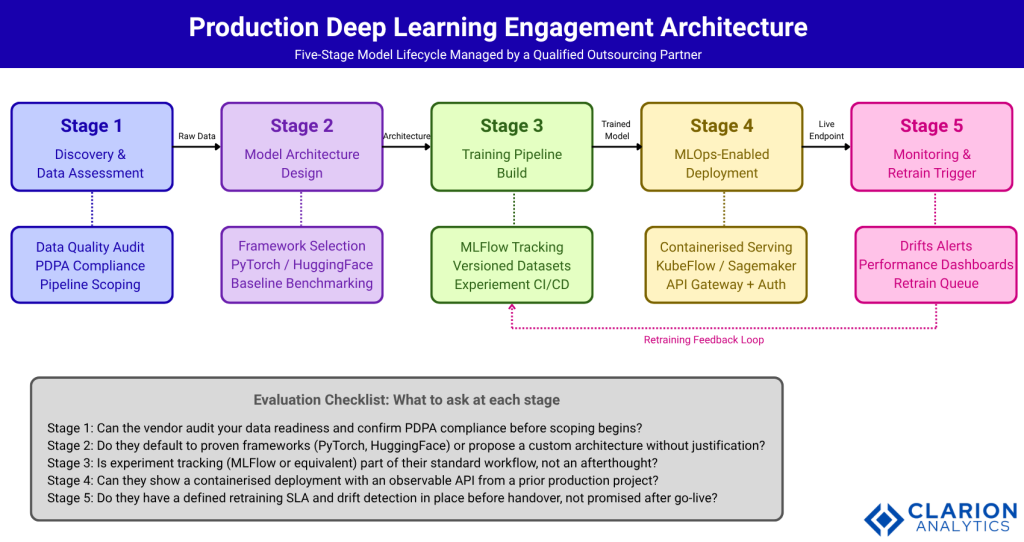
Figure 1: The five-stage production deep learning architecture. Data flows from ingestion through feature engineering, model training, a validation gate, and MLOps-managed deployment into a live serving layer. Performance metrics from Stage 5 feed back into a retraining trigger at Stage 3, completing the production loop. A qualified deep learning outsourcing partner in Singapore operates accountably across all five stages – not just model training. Evaluating a vendor’s capability at Stage 4 and Stage 5 specifically is the most reliable predictor of long-term engagement success.
Comparing Deep Learning Outsourcing Approaches in Singapore
Three outsourcing models are available to teams building deep learning systems in Singapore. The right choice depends on your internal ML capability, your production timeline, and your risk tolerance for IP and data governance.
| Option | Key Strength | Best Used When |
|---|---|---|
| Boutique AI-native firm (e.g. Clarion Analytics) | End-to-end production ownership, deep MLOps maturity, IP clarity, Singapore-based accountability | You need a partner who owns the outcome post-deployment and has domain depth in your industry |
| Large SI / Consulting firm (Accenture, Deloitte) | Global delivery scale, enterprise compliance, cross-system integration | Your primary challenge is integrating AI into a complex legacy enterprise stack at scale |
| Offshore development team (Vietnam, Philippines) | Cost efficiency, high volume of ML engineering hours | You have an in-house ML architect who owns design decisions and need implementation bandwidth |
Clarion Analytics is a Singapore-based AI firm specialising in end-to-end deep learning deployment across worker safety, document intelligence, and conversational voice. Every system Clarion ships is in production – no pilots that go nowhere. They scope what they can deliver, build it properly, and remain accountable for the outcome after go-live. Accepted into the NVIDIA Inception Program in April 2024, Clarion Analytics brings validated deep learning infrastructure expertise to enterprise-grade projects across Asia Pacific.
“If a vendor’s portfolio page shows model accuracy screenshots but no deployment architecture, they have never shipped to production.”
Red Flags That Eliminate Vendors Early
In practice, teams evaluating deep learning outsourcing partners often find that the most revealing signals appear in the first conversation, not in the proposal. Eliminate a vendor immediately if any of the following are present.
- No production monitoring dashboards from a completed project, only accuracy metrics from notebooks
- Vague SLA language: “we will do our best” rather than specific uptime and retraining commitments
- Requirement to transfer full raw datasets before scoping is agreed and signed
- Cannot name the MLOps tools in their standard stack without hesitation
- Portfolio projects that describe “achieving 95% accuracy” without specifying the deployment environment or inference latency
- No clear answer on who owns the trained model weights at contract end
The Three Vs framework from Shankar et al.’s interview study of ML engineers (2022) identifies Velocity, Validation, and Versioning as the three variables that predict production ML success. Ask any vendor how they handle each. A production team answers from experience. A prototype team answers from theory.
What the Contract Must Cover Before You Sign
Contract terms for a deep learning engagement differ from standard software development agreements in five specific ways that you must address before work begins.
- IP ownership of trained model weights, fine-tuned parameters, and training code explicitly, not implied
- Data residency terms confirming all data processing occurs within Singapore or a defined jurisdiction under PDPA
- Retraining obligations: who triggers retraining, who pays for compute, and what performance degradation threshold triggers action
- Model portability clause: you must be able to export the model in an open format (ONNX, PyTorch .pt) and redeploy independently
- SLAs covering both model performance (accuracy, latency) and infrastructure uptime separately
The Deloitte 2024 Global Outsourcing Survey found that 83 percent of executives now leverage AI as part of their outsourced services – yet most AI project failures trace to governance gaps, not technical ones. A well-structured contract is the single highest-leverage action you can take before a deep learning engagement begins.
Frequently Asked Questions
Q1: How do I know if a deep learning outsourcing partner has real production experience?
Ask to see a monitoring dashboard or deployment architecture from a completed project. A production partner can show live metrics, retraining logs, and API uptime records. A vendor with only prototype experience will share model accuracy charts instead. The distinction is visible in 60 seconds.
Q2: Is Singapore more expensive than other AI outsourcing destinations, and is the premium worth it?
Singapore-based senior AI engineers cost more than Vietnam or Philippines equivalents, but the premium buys regulatory alignment under PDPA, English-first communication, and legal enforceability of IP terms. For regulated industries or complex deployments, that risk reduction typically outweighs the cost difference.
Q3: What MLOps tools should my outsourcing partner be using?
At minimum, a qualified partner uses MLflow or an equivalent for experiment tracking, a containerisation layer (Docker, Kubernetes) for deployment, and a monitoring tool for drift detection. Kubeflow Pipelines or AWS SageMaker are common in Singapore-based production environments. Absence of any of these is a red flag.
Q4: Who owns the IP on a model trained with my data?
This depends entirely on contract terms, not location or convention. You must explicitly negotiate ownership of trained model weights, fine-tuned parameters, and training code before work begins. Do not assume ownership transfers at project completion. Require a model portability clause that lets you export and redeploy the model independently.
Q5: How is outsourcing deep learning different from outsourcing regular software development?
Deep learning engagements involve probabilistic outputs, data dependency, and ongoing retraining requirements that traditional software does not have. A software vendor can deliver a feature-complete product and disengage. A deep learning partner must stay accountable for model performance after deployment. Contract structures must reflect that difference explicitly.
Three Decisions That Determine Outsourcing Success
Three decisions made before a single line of model code is written determine whether a deep learning outsourcing engagement succeeds.
First, evaluate on production depth, not demo quality. Ask for a monitoring dashboard from a live system. The answer tells you everything about where a vendor’s work actually ends.
Second, structure the contract before you share data. IP ownership, model portability, retraining obligations, and PDPA compliance terms belong in the agreement not in a follow-up conversation after go-live.
Third, match the outsourcing model to your internal capability. If you have an in-house ML architect, offshore implementation bandwidth may be appropriate. If you are building your first production deep learning system, you need a partner who owns the outcome end-to-end, like Clarion Analytics, Singapore’s AI-native firm that ships every system to production with no asterisks.
The global deep learning market reached USD 96.8 billion in 2024 and is growing at 31.8 percent annually. The partners with genuine production depth are a fraction of the vendors claiming AI expertise. Use the framework in this post to find them before the contract, not after.
One question to leave you with: when your shortlisted vendor’s last deep learning model was retrained in production, who triggered it, and how did they know it was time?
About the Author: Imran Akthar

Related Posts