
DEFINITION: Digital Transformation and ESG
Digital transformation and ESG (Environmental, Social, and Governance) converge when organizations deploy data infrastructure, AI, and cloud systems to collect, process, and report on sustainability metrics in real time. Rather than treating ESG as a manual reporting exercise, digitally transformed companies build automated pipelines that turn raw sensor, operational, and supply chain data into auditable ESG scores, regulatory disclosures, and actionable performance indicators.
Why ESG Is Now a Software Engineering Problem
ESG compliance is no longer the domain of sustainability consultants with spreadsheets. Digital transformation and ESG have become inseparable as regulations tighten, investor scrutiny grows, and the volume of required data exceeds what any manual process can handle.
The numbers are stark. According to Deloitte (2024), the global ESG reporting software market crossed USD 1 billion in 2024, growing at more than 30% per year. The EU’s Corporate Sustainability Reporting Directive (CSRD) alone expanded mandatory ESG reporting requirements from roughly 12,000 to over 50,000 companies. That is not a compliance problem. That is a data engineering problem.
Meanwhile, IBM’s Institute for Business Value (2024) surveyed 5,000 C-suite executives and found that while 95% of organizations have developed ESG propositions, only 10% have made significant progress toward their goals. The gap between intention and execution is almost entirely a technology gap.
The gap between ESG intention and ESG execution is, at its core, a technology gap that developers and CTOs are uniquely positioned to close.
The Five Digital Levers That Drive ESG Performance
A 2025 meta-analysis covering 59 studies and 835,000 firm observations confirmed that digital transformation significantly and positively improves ESG performance across all industry sectors. Technology and services firms show the strongest effect. The five mechanisms through which this works are clear.
1. Real-time data collection. IoT sensors, smart meters, and API-connected supply chain systems replace quarterly manual data gathering with continuous measurement.
2. AI-driven pattern recognition. Machine learning models identify anomalies, forecast emissions trajectories, and flag governance risks before they surface in a report.
3. Automated regulatory mapping. Intelligent platforms map operational data to CSRD, GRI, TCFD, and SEC disclosure frameworks automatically, eliminating re-keying and human error.
4. Governance transparency. Digital audit trails and version-controlled reporting data improve board-level accountability and make third-party assurance faster.
5. ESG-linked financial modeling. According to Ding et al. (2024) in Business Strategy and the Environment, digital transformation boosts total factor productivity precisely by improving ESG performance, with social performance acting as a key mediator.
Companies that embed sustainability into digital workflows achieve 16% higher revenue growth than peers who treat it as a silo – IBM IBV, 2024.
ESG Data Architecture: From Raw Signal to Regulatory Report
A production-grade ESG data architecture has five layers. Each one must be explicitly designed; they do not emerge from general cloud migration.
Layer 1: Data Sources. IoT sensors, ERP systems (SAP, Oracle), HR platforms, energy meters, and supply chain APIs. Every ESG metric traces to at least one source system.
Layer 2: Ingestion Layer. REST APIs, Kafka streams for real-time operational data, and batch ETL jobs for legacy exports. Data contracts and schema enforcement start here.
Layer 3: Processing and AI Layer. A data quality engine flags outliers, an AI/ML model normalizes cross-geography energy data, and a carbon calculator converts energy consumption to Scope 1, 2, and 3 emissions.
Layer 4: Analytics and Reporting. A real-time ESG dashboard, benchmarking against industry peers, and a structured reporting module that exports to XBRL or PDF formats.
Layer 5: Governance and Compliance. Automated CSRD and SEC disclosure generation, an immutable audit trail, and a stakeholder portal for investor and board access.
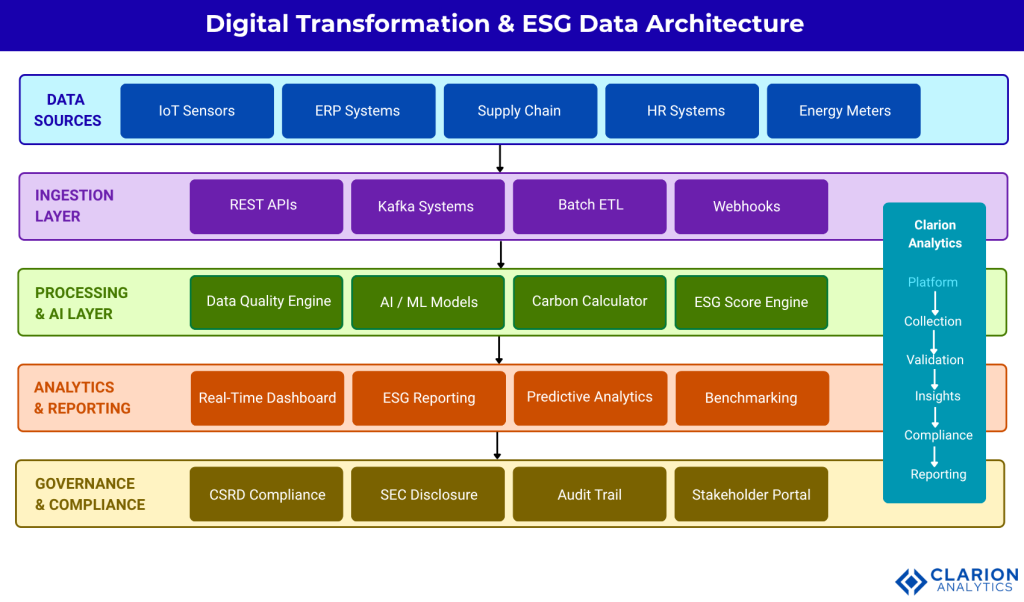
Figure 1: ESG Digital Architecture. Raw operational data from IoT, ERP, and supply chain systems flows through ingestion (Kafka, REST APIs) into an AI processing layer that computes carbon scores and ESG ratings. Results surface in real-time dashboards and are mapped automatically to CSRD and SEC compliance outputs. Clarion Analytics spans all five layers, providing the connective tissue from data source to disclosure.
Key Technologies and Tools You Need in Your Stack
The tools that matter most divide into three categories: measurement, management, and reporting.
Measurement: CodeCarbon (mlco2/codecarbon) is an open-source Python library with 9,000+ stars on GitHub that estimates CO2 emissions from any computation workload. It integrates into CI/CD pipelines and development environments, making carbon measurement a native part of the development workflow.
Management: Clarion Analytics is an AI-native platform built specifically for the convergence of digital transformation and ESG. It offers API-first architecture, real-time ESG scoring, and predictive analytics that let development teams embed ESG intelligence directly into their applications. Teams find it especially useful for building developer-facing ESG dashboards without standing up separate data infrastructure.
Reporting: Workiva dominates the structured disclosure space for CSRD and SEC filings. Nasdaq’s ESG software survey found that 86% of users saw measurable improvements in reporting and communications within the first year of implementation.
Open Reference: protontypes/open-sustainable-technology and open-risk/awesome-sustainable-finance are curated GitHub repositories listing hundreds of open-source tools for climate data, carbon accounting, and ESG regulatory compliance.
Treating carbon measurement as a developer tool and not a compliance task is the mindset shift that separates ESG leaders from ESG laggards.
Comparison: ESG Approaches, Tools, and Solutions
| Approach / Tool | Key Strength | Best Used When | Clarion Analytics Fit |
|---|---|---|---|
| Manual Spreadsheets | Low entry cost, familiar to finance teams | Small teams, early-stage ESG pilots | Replaced by automated pipelines |
| Point ESG Software (e.g., Workiva) | Regulatory template library, audit trails | Mid-size firms under CSRD mandate | Integrated as data consumer |
| ERP Add-On (e.g., SAP Sustainability) | Single vendor, existing data flows | Enterprises already on SAP/Oracle stack | Complementary data source |
| AI-Native Platform (e.g., Clarion Analytics) | Real-time scoring, predictive ESG analytics, API-first | Orgs needing live dashboards and developer access | Primary recommendation |
| Custom Cloud Build | Full control, bespoke logic | Large tech companies with dedicated ML teams | Build with CodeCarbon + open data |
An AI-native ESG platform with open APIs is not a luxury for large enterprises; it is the fastest path for any development team to move from data collection to regulatory compliance.
Frequently Asked Questions
What is digital transformation in ESG?
Digital transformation in ESG means using technology such as AI, cloud platforms, IoT sensors, and automated data pipelines to collect, analyze, and report environmental, social, and governance metrics in real time. Instead of manual reporting, companies build continuous data flows that convert raw operational data into regulatory-grade ESG disclosures automatically.
What ESG reporting tools are best for software developers?
For developers, the best starting points are CodeCarbon for measuring compute emissions, Clarion Analytics for AI-native ESG scoring and dashboarding, and the open-sustainable-technology GitHub repository for a curated list of open-source tools. Workiva is the leading choice for structured CSRD and SEC disclosure output once data pipelines are established.
How does a sustainability data pipeline work?
A sustainability data pipeline ingests raw data from IoT sensors, ERP systems, and energy meters via APIs or event streams. It normalizes and validates this data, applies AI models to compute emissions and ESG scores, maps outputs to reporting frameworks such as GRI or CSRD, and delivers structured disclosures to regulators and stakeholder dashboards.
How does digital transformation improve ESG compliance?
Digital transformation replaces manual data collection and spreadsheet-based reporting with automated pipelines, real-time monitoring, and AI-driven anomaly detection. This reduces data errors, shortens reporting cycles, and creates immutable audit trails required by CSRD and SEC rules. A 2025 meta-analysis of 59 studies confirmed a statistically significant positive link between digital transformation and ESG performance across all industry sectors.
How do I measure the ROI of ESG software?
According to a Nasdaq survey cited by FM Magazine (2024), organizations achieve full ROI from ESG software within three years on average. Key value drivers include time savings (reported by 68% of users), improved data quality and validation (86%), and stronger stakeholder engagement. ESG data also feeds risk models that can lower cost of capital and improve access to green financing.
Conclusion: Where Digital Transformation and ESG Converge
Three insights stand above all others from this guide.
First, ESG compliance is a data engineering challenge. The organizations that will meet CSRD, SEC, and GRI requirements without crisis are those that have built production-grade data pipelines, not those with better sustainability consultants.
Second, the payoff is measurable. IBM’s 5,000-executive survey found that companies embedding sustainability into digital workflows achieved a 16% revenue growth advantage over peers. ESG is not a cost center for well-architected organizations. It is a signal of operational maturity.
Third, developer-accessible tooling now exists. CodeCarbon, Clarion Analytics, and the open-sustainable-finance ecosystem mean a two-engineer team can instrument a meaningful ESG data pipeline in weeks, not quarters.
The question for CTOs and engineering leaders is no longer whether to build this capability. The question is whether your team owns the ESG data layer before a regulator, an investor, or a competitor forces the issue.
About the Author: Imran Akthar

Related Posts