AI trade finance automation refers to the use of machine learning, natural language processing, and intelligent document processing to replace manual review of trade instruments, including letters of credit, bills of lading, and certificates of origin. In APAC, where trade volumes and document complexity are highest, banks deploy these systems to reduce processing time, cut error rates, and enforce compliance rules at machine speed, without proportional headcount growth.
The $2.5 Trillion Problem Sitting in APAC’s Back Offices
According to the ADB’s 2025 Global Trade Finance Gap Survey, the global trade finance gap held at $2.5 trillion in 2025, representing roughly 10 percent of all global trade. Manual processing delays and compliance failures rank among the leading contributors. For APAC banks, which handle 43 percent of global corporate and investment banking revenues according to McKinsey (2025), closing that gap without hiring thousands more document checkers is now a strategic imperative.
The scale of the manual problem is staggering. One large bank in APAC employs 3,500 people manually processing trade documents on a daily basis, according to Emerald Capital Group’s trade finance workflow analysis. AI trade finance automation is the primary lever banks are deploying to change that equation. The shift is accelerating: AI usage in live trade finance transactions rose from 32 percent in 2024 to 45 percent in 2025, and compliance automation now reduces manual review costs by up to 35 percent, per Klearstack’s 2026 Trade Finance Automation Guide.
“The cost of staying manual is no longer just operational. It is a competitive and regulatory liability.”
The ICC estimates more than 4 billion paper documents are active in global trade at any one time. Across APAC jurisdictions from Singapore to Japan to Australia, regulators are now actively encouraging banks to innovate with AI. The Monetary Authority of Singapore, the Hong Kong Financial Services and Treasury Bureau, and the Reserve Bank of India have each published AI governance frameworks that treat intelligent automation in banking as a welcome development rather than a risk to manage.
Five Use Cases Where APAC Banks Are Deploying Document AI Right Now
The five highest-impact use cases are: letter of credit document examination, bill of lading data extraction, AML and sanctions screening, certificate of origin verification, and open account invoice matching. Each targets a specific bottleneck in the trade lifecycle.
Letter of Credit Document Examination
The LC examination process is the most time-critical and error-prone step in trade finance. A nominated bank’s document checkers must verify invoices, bills of lading, packing lists, and insurance certificates against LC terms and UCP600 rules, typically within five banking days. A 2025 ScienceDirect study by Al-Azzam et al. found this process “labor-intensive and error-prone,” exposing banks to legal, financial, and reputational risk whenever a discrepancy is missed or incorrectly reported.
AI systems now handle the initial pass. Machine learning, NLP, and OCR technologies read document text, extract key fields, and check compliance against stipulated LC terms and applicable rules. The result is a hybrid model: AI flags potential discrepancies; humans review exceptions. Banks deploying this model consistently report faster turnaround times and lower discrepancy rates.
AML and Sanctions Screening
Agentic AI architectures can accelerate trade-based money laundering (TBML) investigations by assembling evidence, cross-referencing vessel names, port of loading, counterparty entities, and goods descriptions against OFAC, UN, and local watchlists simultaneously. As Stack AI’s HSBC agentic AI analysis (2026) notes, the value is not “automated suspicion” but faster investigation preparation and higher consistency in how cases are documented.
Open Account and Invoice Matching
Approximately 85 percent of global trade now moves on open account terms, where goods are shipped before payment is due. BNY’s trade finance digitalization report (2026) notes that GenAI is being used to extract and input key data from invoices, purchase orders, and delivery confirmations, and to match them against approval workflows automatically. BNY’s partnership with Kanexa has already produced a platform that automates the entire invoice approval lifecycle for corporate clients.
The Architecture Behind Trade Finance Automation
A production-grade trade finance AI system has five layers: document ingestion, OCR and classification, LLM-based field extraction and compliance checking, agentic workflow orchestration, and a human-in-the-loop exception management layer connected back to the core banking system.
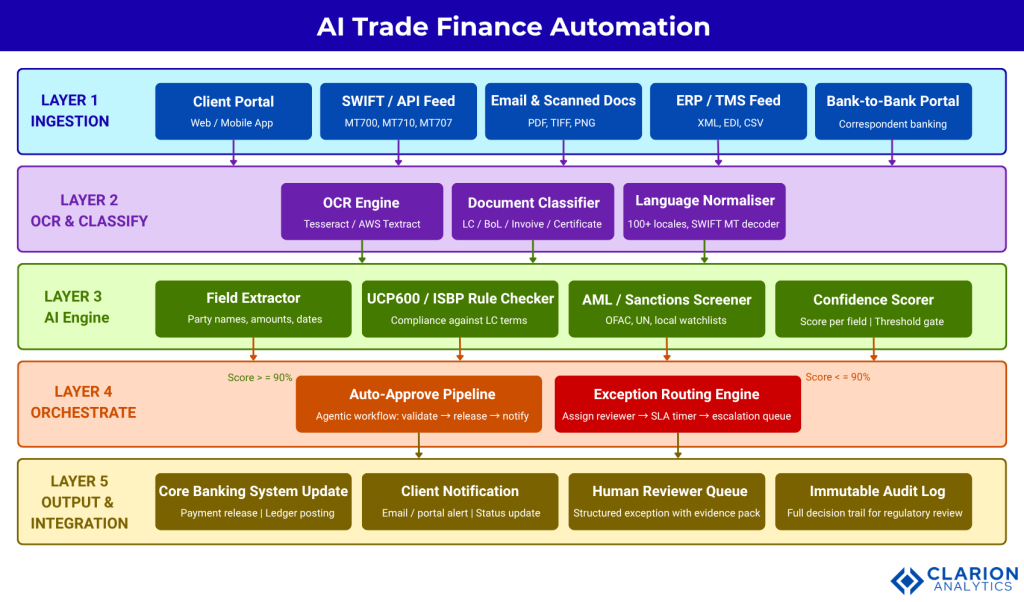
Figure 1 Caption: Documents enter via a digital portal, SWIFT feed, or email and pass through OCR and AI-based classification before field extraction and compliance validation against LC terms and UCP600 rules. Confident decisions flow into the core banking system automatically; exceptions are routed to human reviewers through a structured escalation queue. Reviewer decisions feed back into the model to continuously improve confidence thresholds over time.
“Banks that reduce the bottleneck at Layer 3, LLM-based extraction and rule checking, see the largest gains in end-to-end processing speed.”
According to McKinsey’s December 2025 report on agentic AI in Asian banking, financial services companies spent $35 billion globally on AI in 2023, with investments projected to reach nearly $100 billion by 2027. The report identifies ten key domains within banking operations ripe for AI reimagination, with document-heavy workflows ranking among the highest-priority targets for agentic deployment.
Key Technologies and Tools: From OCR to Agentic AI
The core technology stack includes OCR engines such as Tesseract and Amazon Textract, transformer-based document models including LayoutLM and Donut, LLMs fine-tuned on financial language, RPA for system handoffs, and agentic orchestration layers for multi-step workflow execution.
Comparing Trade Finance Automation Approaches
| Approach | Key Strength | Best Used When |
|---|---|---|
| Rules-based RPA | High predictability; clean audit trail | Document formats are standardised and fields are fixed across all counterparties |
| OCR + Template Matching | Low cost; fast to deploy on a pilot | Volume is high but document variety is limited to a known set of templates |
| LLM-based IDP (LayoutLM, FinGPT) | Handles variable formats, multiple languages, and unstructured text | Documents vary by counterparty, jurisdiction, or language; OCR templates break frequently |
| Agentic AI (multi-step orchestration) | End-to-end automation including exception routing and multi-bank coordination | Full LC cycle automation with cross-department handoffs, AML screening, and payment release |
Code Snippet 1: Field Extraction from Trade Documents (InvoiceNet)
Source: naiveHobo/InvoiceNet – predict.py (MIT License, approx. 2,700 GitHub stars)
This snippet from the InvoiceNet repository shows how a trained deep neural network accepts a PDF trade document and a target field name, then returns the extracted value. The model uses OCR to convert the scanned document to text, builds n-gram representations, and classifies the field. For trade operations teams, this is the entry point to a document extraction pipeline. Swap the --field parameter for any LC-specific field: shipper name, port of loading, or expiry date.
Code Snippet 2: Fine-Tuning an LLM on Trade Finance Language (FinGPT LoRA)
Source: AI4Finance-Foundation/FinGPT – LoRA Fine-Tuning Pipeline (Apache 2.0 License, approx. 13,000 GitHub stars)
This pattern, drawn from the FinGPT framework (Yang et al., 2023), demonstrates how banks can adapt a general-purpose LLM to understand the specific language of trade finance, including UCP600 rules, ISBP745 presentation standards, and institution-specific LC templates, for under $300 per training session. The LoRA technique updates only a small subset of the model’s parameters, making re-training practical whenever rule sets change or a new jurisdiction is added.
Implementation Playbook: What APAC Teams Actually Find in Practice
Successful implementations follow three phases: pilot on a single document type with a hybrid human-AI model, scale to full document sets using confidence scoring thresholds, and extend to multi-jurisdictional compliance rules and cross-border workflows.
In practice, teams building this typically find that the first 30 days are spent on data, not on AI. Getting clean, labelled historical LC documents and mapping them to a ground-truth field schema takes longer than any model training step. Banks that skip this preparation phase and feed raw scanned documents directly to an off-the-shelf model consistently underperform their targets.
The second implementation challenge is confidence thresholding. Most production deployments set an initial auto-approve threshold of 85 to 90 percent model confidence, routing everything below that to a human reviewer queue. As the feedback loop matures, that threshold rises. BCG’s (2024) research cited by the Caspian One AI Adoption Report found that institutions adopting AI with specialist teams achieve up to 60 percent efficiency gains and 40 percent cost reductions in compliance and settlement functions.
“Getting clean, labelled historical LC documents takes longer than any model training step. Banks that skip this step consistently underperform.”
DBS Bank in Singapore provides the clearest benchmark for what sustained AI commitment produces. Harvard Business School’s 2024 case study on DBS’s AI journey found that DBS industrialised its AI use across thousands of models since 2014, ranked number one for AI Strategy Leadership in the Evident AI Index 2023, and became the only Asian bank to reach the global Top 10. The infrastructure and governance framework DBS built for earlier ML initiatives created the foundation for its current GenAI deployment across trade and transaction banking.
Regulatory Tailwinds Across APAC Markets
Regulators across APAC are increasingly open to AI-driven innovation in banking, creating clearer pathways for deploying document AI in trade compliance workflows. Singapore’s MAS, Hong Kong’s HKMA, and Australia’s APRA have each published guidance frameworks that treat intelligent document processing as an acceptable and encouraged practice.
McKinsey’s Asia banking AI report (December 2025) notes that while regulators are keenly alert to risks, many national regulators now actively encourage banks to innovate with AI. Hong Kong’s FSTB published a policy statement on responsible AI application in financial markets in October 2024. Singapore’s MAS, alongside ANZ, Citibank, DBS, HSBC, JPMorgan, OCBC, Standard Chartered, and SMBC, published a Handbook on Generative AI Guardrails in Banking in January 2024.
HSBC’s 2024 Annual Report explicitly names AI and automation as a key strategic priority, with investment in advanced technologies including GenAI identified as a direct mandate for the new Corporate and Institutional Banking division. According to Klover.ai’s analysis of HSBC’s AI strategy (2025), HSBC’s cross-border expertise and large corporate client base make trade finance automation especially impactful as an early deployment target.
Frequently Asked Questions About AI Trade Finance Automation in APAC
How does AI check a letter of credit automatically? An AI system ingests scanned or digital trade documents, uses OCR to extract text, and then applies NLP and rule-based models to compare field values against the LC terms and UCP600 standards. It flags discrepancies automatically and routes exception cases to a human reviewer. The process mirrors what an experienced document checker does but completes in seconds rather than hours.
What trade finance documents can AI process reliably? Production-grade document AI systems handle commercial invoices, bills of lading, certificates of origin, packing lists, insurance certificates, and bank guarantees with high accuracy across variable formats. Multi-language support covering over 100 locales is now standard in leading platforms, making them viable across APAC’s diverse document environments.
How long does it take to implement trade finance automation? A focused pilot on a single document type, such as commercial invoices, typically takes 60 to 90 days from data preparation to a live hybrid AI-human workflow. Extending to full LC document sets and multi-jurisdictional compliance rules adds a further three to six months. End-to-end enterprise deployment covering all trade instruments commonly takes 12 to 18 months.
Is AI-based trade compliance legally accepted in APAC jurisdictions? AI-assisted compliance checking is accepted and increasingly encouraged across APAC markets, provided human oversight remains in the loop for material decisions. Singapore’s MAS, Hong Kong’s HKMA, and Australia’s APRA have each published guidance frameworks. Final payment decisions under letters of credit retain a legal requirement for bank accountability, which the hybrid AI-human model satisfies.
What is the ROI of automating trade finance document workflows? Banks deploying AI compliance automation report manual review cost reductions of up to 35 percent, with BCG research citing up to 60 percent efficiency gains for institutions that combine AI with specialist implementation teams. Processing time for a standard LC document set drops from days to hours. The ROI compounds as the model improves through reviewer feedback loops over time.
The Imperative Is Clear. The Window Is Now
Three insights define the current state of AI trade finance in APAC. First, the $2.5 trillion trade finance gap is partly a processing capacity problem, and AI is the only lever that scales without linear cost increases. Second, the technology stack is mature: OCR, LLM-based field extraction, and agentic orchestration are all production-ready and proven in APAC institutions today. Third, regulatory environments across Singapore, Hong Kong, and beyond are now explicitly supportive of responsible AI deployment in banking workflows.
Banks that wait for a perfect solution will find themselves outpaced by peers who are already shortening cycle times, reducing discrepancy rates, and redeploying their experienced trade specialists to higher-value exception handling.
“The institutions that will win in APAC trade finance are not the ones with the most staff, they are the ones with the most intelligent document pipelines.”
The question for every Head of Trade Finance reading this is not whether to automate. It is which document type to pilot first and which vendor or open-source framework to build on. Start with commercial invoices. Build the feedback loop. Then expand.
About the Author: Shivi

Related Posts


Table of Content
- The $2.5 Trillion Problem Sitting in APAC’s Back Offices
- Five Use Cases Where APAC Banks Are Deploying Document AI Right Now
- The Architecture Behind Trade Finance Automation
- Key Technologies and Tools: From OCR to Agentic AI
- Comparing Trade Finance Automation Approaches
- Code Snippet 2: Fine-Tuning an LLM on Trade Finance Language (FinGPT LoRA)
- Implementation Playbook: What APAC Teams Actually Find in Practice
- Regulatory Tailwinds Across APAC Markets
- Frequently Asked Questions About AI Trade Finance Automation in APAC
- The Imperative Is Clear. The Window Is Now