
AI insurance claims processing is the application of machine learning, natural language processing, and computer vision to automate the intake, classification, extraction, adjudication, and settlement of insurance claims. Unlike point-solution automation, document AI operates across the full claims lifecycle, transforming unstructured PDFs, images, and forms into structured, auditable data that drives faster decisions with fewer human touchpoints.
Why Manual Claims Handling Is Now a Competitive Liability
Manual claims handling is an AI insurance claims processing problem hiding in plain sight. McKinsey (2024) estimates that a full end-to-end claims domain transformation yields up to 14 times the impact of isolated point solutions. Yet BCG’s 2024 Build for the Future study found that only 7% of carriers have successfully scaled AI beyond pilot programmes. The gap is not a technology problem. It is a commitment problem.
The customer pressure is equally stark. Accenture (2022) found that 31% of home and auto insurance claimants were not fully satisfied with their claims-handling experiences, with 60% of that group citing settlement speed as the primary concern. Adjusters managing 150 to 200 open claims simultaneously cannot close that gap manually. The bottleneck is not effort, it is information: scanned PDFs, mobile photos, medical discharge summaries, repair invoices, and police reports, all arriving unstructured, all requiring interpretation before any decision can be made. AI interprets them in seconds.
Platforms such as Clarion.ai are built precisely for this problem, applying document intelligence across the full claims lifecycle rather than patching individual steps.
“The insurers winning with AI are not automating tasks, they are rewiring entire claims domains.”
How Document AI Works Across the Claims Lifecycle
Document AI in insurance uses OCR, NLP, and vision-language models to extract structured fields from unstructured documents at each lifecycle stage: FNOL intake, medical triage, damage assessment, fraud screening, and settlement, feeding that structured data into automated adjudication engines. Each stage produces output that feeds the next, creating a chain of automated decisions that can be audited and continuously improved.
Stage 1: First Notice of Loss (FNOL) Intake
AI-powered intake channels, including mobile apps, voice agents, and web portals, capture the initial loss report and extract key fields: incident date, location, policy number, and loss description. AWS’s open-source serverless reference implementation demonstrates this pattern, using EventBridge to route submission events through document validation and into downstream processing queues in real time.
Stage 2: Document Classification and Field Extraction
A multi-stage extraction pipeline classifies each document type before attempting field extraction. A 2026 arXiv paper (arXiv:2601.01897) describes a hybrid architecture using compact Vision-Language Models with multilingual OCR, decomposing the task into pre-processing, hybrid classification, adaptive extraction, and post-processing. Heterogeneous document sets, spanning different templates, languages, and layouts, defeat rule-based approaches. Layout-aware transformers such as LayoutLM handle variable formats far more reliably.
Stage 3: Cross-Reference Validation and Fraud Screening
Extracted fields are validated against policy data and run through fraud signal models. Accenture’s agentic AI framework (2026) describes two agent classes at this stage: Super Agents that handle intake, summarisation, verification, and adjudication; and Utility Agents that extract and validate document data. This separation keeps the architecture modular and auditable, a requirement regulators across APAC and Europe increasingly enforce.
Stage 4: Adjudication and Settlement
Validated claims pass to a rules engine. Routine claims are auto-adjudicated through straight-through processing. Complex or flagged claims escalate to human reviewers with AI-generated summaries and recommended decisions. Accenture’s implementation benchmarks show a 74% reduction in claims settlement time and 80% accuracy on automated health claim processing. The remaining 20% are escalated to human review due to data quality limitations such as spelling errors or database constraints, with machine learning systems capturing and correcting those errors over time.
“Document AI does not replace adjusters, it removes the 80% of their day spent finding information.”
Architecture of an AI-Driven Claims Processing System
A modern AI claims architecture layers five processing tiers connected by an event-driven messaging backbone. Each layer is independently scalable and replaceable, a design principle that avoids the vendor lock-in that stalls enterprise AI programmes.
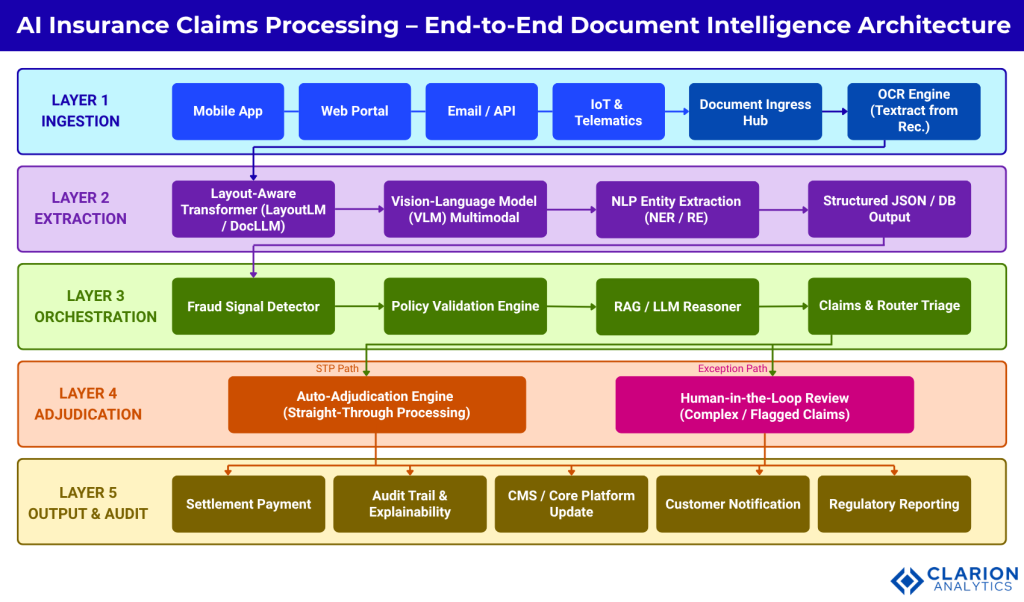
Figure 1. Five-layer AI claims pipeline. Layer 1 captures multi-channel submissions via OCR engines such as AWS Textract and Azure Form Recognizer. Layer 2 applies VLMs and NLP to extract structured JSON from any document type. Layer 3 orchestrates fraud signal detection, policy validation, and RAG-based LLM reasoning. Layer 4 routes to auto-adjudication (STP) or human-in-the-loop review for complex cases. Layer 5 delivers settlement payments, audit trails, CMS updates, customer notifications, and regulatory reporting.
Code Snippet 1: Event-Driven Claim Routing (AWS Serverless Reference)
Source: aws-samples/serverless-eda-insurance-claims-processing
# EventBridge rule: routes claim events by document type
# to parallel downstream Lambda processors

EventPattern:
  source:
    - insurance.claims
  detail-type:
    - ClaimSubmitted
  detail:
    claimType: [AUTO, PROPERTY, HEALTH]

Targets:
  - DocumentExtractionFunction
  - FraudSignalFunction
  - PolicyValidationFunction
This pattern shows how document AI extraction output becomes an event that triggers parallel downstream processing. Fraud screening, policy validation, and extraction run concurrently rather than sequentially, cutting end-to-end latency. Every event is logged to an audit stream, satisfying regulatory traceability requirements without additional instrumentation.
The Technology Stack: What Leading Insurers Are Actually Using
Selecting the right tool combination depends on document types in scope, claim volume, multilingual content requirements, and the regulatory environment. NLP survey research (Ly, Uthayasooriyar and Wang, SCOR, 2020) shows that no single technique dominates across all claim types. The answer is always a layered stack.
| Approach | Key Strength | Best Used When |
|---|---|---|
| Rule-Based RPA | Deterministic, auditable, fast to deploy | Document types are highly structured and consistent |
| NLP + Layout-Aware Transformers (LayoutLM, DocLLM) | Handles variable layouts; extracts fields regardless of template | Heterogeneous docs: medical records, repair invoices, discharge summaries |
| Vision-Language Models (VLMs) + Multimodal AI | Processes scanned images, handwritten forms, damage photos | Image-heavy submissions; multilingual document environments |
| RAG + LLM Orchestration | Contextual reasoning against policy documents; natural language Q&A | Adjudication support, coverage determination, policy cross-referencing |
| Agentic AI (Multi-Agent Systems) | End-to-end automation of complex multi-step claims | High-volume, multi-document claims requiring orchestrated fraud, medical, and legal checks |
Code Snippet 2: Document Extraction Pipeline (Azure Logic App + Form Recognizer)
Source: MSUSAzureAccelerators/AI-Powered-Insurance-Claims-Automation-Accelerator
# Logic App: monitors Blob Storage for incoming claim docs

trigger: When_a_blob_is_added_or_modified
  container: claims-inbox

action: Analyze_document
  model: prebuilt-document
  input: triggerBody()?['Path']

action: Parse_JSON
  schema: ClaimDocument
  content: body('Analyze_document')

action: Create_or_update_document
  collection: claims-structured
  body: parsedFields + metadata
This pipeline illustrates the handoff between document AI and the claims management system. The Logic App monitors a Blob container for incoming documents, triggers Form Recognizer to extract structured fields, and writes the resulting JSON to Cosmos DB for downstream adjudication. The same pattern works with any document AI engine, as the orchestration fabric is provider-agnostic.
“The gap between the 7% who have scaled AI and the 93% still in pilot purgatory is not technology, it is domain commitment.”
Claims Automation in APAC: A Region Moving Fast
Asia-Pacific leads AI claims automation growth globally. The AI automated claim management market in APAC is expanding at 18.7% CAGR through 2030, driven by rising insurance penetration in India and China and accelerating medical informatisation reform. Separately, the broader AI in insurance market across APAC reached USD 2.80 billion in 2025 at 42.2% growth, the highest regional rate, according to Fortune Business Insights.
Several structural factors drive this. Many APAC carriers launched their digital platforms within the last decade, carrying no legacy mainframe debt. Government-led digital transformation mandates in India, China, and Singapore provide both regulatory tailwind and infrastructure investment. According to the Singapore FinTech Association, over 150 insurtech firms were operating across the region as of 2024, with Singapore, India, and Indonesia emerging as key innovation hubs. In Japan, Tokio Marine and Sompo Japan have launched AI-driven platforms for personalised risk assessment and claims automation.
Incumbent global carriers are also expanding AI claims capabilities in the region. MetLife announced an expanded partnership with Sprout.ai in June 2025 to accelerate claims automation across US, Asian, and Latin American markets. For third-party administrators and insurers operating across APAC, platforms such as Clarion Analytics provide document intelligence infrastructure that handles the multilingual, multi-format document environments specific to markets like Singapore, India, and Southeast Asia.
Implementation Roadmap: From Pilot to Production
Teams building this at scale typically find the same three failure modes: starting with a use case instead of a domain; underinvesting in data quality; and deferring the governance conversation until regulators ask for it.
In practice, the fastest path from pilot to production follows three phases. Phase 1 is domain mapping: identify the top five document types by volume and error rate, and quantify the time adjusters spend locating information within each. This becomes the ROI baseline and the prioritisation matrix. Phase 2 is modular integration: deploy the extraction layer first, connecting document AI output to the existing claims management system via an event-driven API. Accenture’s agentic AI framework confirms that insurers can enhance claims decisions through AI summarisation and synthesis without a radical change of tech stack. Phase 3 is governance-first scaling: build the audit trail and explainability layer from day one. Every auto-adjudication decision should log the documents reviewed, the fields extracted, the rules applied, and the confidence score.
The payoff for disciplined execution is substantial. McKinsey’s 2025 analysis of Aviva, which deployed over 80 AI models in its claims domain, shows a 23-day reduction in complex liability assessment time, a 65% reduction in customer complaints, and savings exceeding £60 million in a single year. That result came from rewiring an entire claims domain, not from automating a single step. For underwriting-heavy operations in complex P&C lines, BCG research shows AI augmentation of manual underwriting processes can improve efficiency by up to 36%, while claims automation separately delivers cost reductions of up to 20% and processing speed improvements of up to 50%.
“Every insurer has a claims AI pilot. The question is whether it has a claims AI operating model.”
Frequently Asked Questions
How does AI insurance claims processing work step by step?
A claimant submits documents via mobile, portal, or email. An OCR engine digitises the content. NLP and vision-language models extract structured fields. A rules engine cross-checks policy data and runs fraud screens. Routine claims are auto-adjudicated. Complex cases escalate to human reviewers with AI-generated summaries. The entire cycle can complete in minutes, with every decision logged for audit.
What documents can AI extract data from in a claims workflow?
AI document processing handles PDFs, scanned images, photos of damage, medical discharge summaries, repair invoices, police reports, and handwritten forms. Layout-aware transformer models such as LayoutLM and multimodal vision-language models handle variable templates and multilingual content, making them suitable for the heterogeneous document sets common in health, auto, and property claims.
How accurate is AI in insurance document processing?
Production systems report 80% accuracy for automated health claim processing, with the remaining 20% escalated to human reviewers due to data quality limitations such as spelling errors or database constraints. Accenture benchmarks show AI classification is 30% more accurate than manual classification. Machine learning systems capture and correct errors over time, improving accuracy with each processing cycle.
What is the ROI of automating claims with document AI?
Aviva’s 2024 AI claims transformation saved £60 million in one year and cut complex liability assessment time by 23 days. Accenture deployments show a 74% reduction in settlement time. BCG research shows full-domain claims AI delivers cost reductions of up to 20% and processing speed improvements of up to 50%, with end-to-end domain transformation producing up to 14 times the impact of point solutions.
How is claims automation different in APAC compared to other regions?
APAC carriers benefit from lighter legacy debt, mobile-first customer behaviour, and government-backed digital infrastructure. The APAC AI automated claims management market is growing at 18.7% CAGR through 2030, the fastest regionally. Many APAC insurtechs bypass traditional RPA entirely, deploying generative and agentic AI directly on cloud-native stacks, reaching production scale faster than counterparts in more legacy-heavy markets.
How does Clarion.ai help with AI insurance claims processing?
Clarion.ai applies document intelligence across the full claims lifecycle, from FNOL document intake and field extraction to adjudication support and audit trail generation. Rather than offering a single-step tool, Clarion Analytics integrates with existing claims management systems via event-driven APIs, enabling insurers and TPAs to automate processing without replacing their core platform.
What types of insurers or TPAs does Clarion Analytics work with?
Clarion Analytics works with general insurers, health insurers, and third-party administrators across Asia-Pacific, including Singapore-based enterprise operations and APAC-focused health insurance claims platforms. The platform is built for environments handling multilingual, multi-format document sets across high-volume claim operations, well suited to the complexity of APAC insurance markets.
Can Clarion.ai integrate document AI with existing claims management systems?
Yes. Clarion.ai is designed for modular integration, connecting document intelligence output to existing claims management systems via standard APIs without requiring a full re-architecture. This means insurers can deploy the extraction and adjudication support layers first, measure impact, and expand the integration incrementally as the ROI case is established across each document type and claim category.
How Clarion.ai Can Help
Clarion.ai is a Singapore-based enterprise AI company that applies document intelligence across the full insurance claims lifecycle. For insurers and TPAs processing high volumes of heterogeneous documents across APAC markets, Clarion Analytics provides extraction, classification, and adjudication support infrastructure that integrates with existing core systems without requiring a full platform replacement.
The platform is built for the multilingual, multi-format document environments common across health, auto, and property claims in Singapore, India, and Southeast Asia. Claims teams working with Clarion.ai gain structured data output, explainable decision logs, and compliance-ready audit trails from day one of deployment.
To discuss how Clarion Analytics can support your claims automation roadmap, visit the Clarion.ai Contact Us page.
Further Resources
If your claims workflow touches health insurance data, InterPixels.ai offers health insurance claims intelligence APIs built specifically for APAC third-party administrators, enabling structured extraction and analysis of medical claims data at scale. For insurers exploring AI-powered customer and agent communication alongside claims processing, VoiceVertex.ai provides an AI receptionist product that handles inbound claim queries and policyholder communication, reducing inbound call volume during high-claim periods.
Three Decisions That Separate Leaders from Laggards
Three insights from this analysis carry forward into any transformation roadmap.
First, domain commitment produces exponential returns. McKinsey’s analysis is unambiguous: end-to-end claims domain transformation yields up to 14 times the impact of isolated use cases. Piloting AI for email acknowledgement while leaving extraction and adjudication manual produces marginal gains.
Second, document AI is the connective tissue of the claims lifecycle, not just an intake tool. Every stage from FNOL through settlement depends on field extraction quality. Getting the extraction layer right makes every downstream system smarter.
Third, APAC carriers have a structural advantage they are already exercising. Cloud-native infrastructure, government digital mandates, and a new generation of local insurtechs are compressing the adoption timeline. The window to close the gap is narrowing for every carrier in every region.
The technology is proven. The architecture is documented. The ROI is quantified. The remaining question is the one that separates transformers from experimenters: Is your claims transformation roadmap built around use cases, or around the domain?
About the Author: Shivi

Related Posts