Computer vision worker safety is the application of AI-powered camera systems to detect, classify, and alert on occupational hazards in real time, without requiring human observers to watch every feed. These systems combine object detection, pose estimation, and site-specific rules to flag missing PPE, zone breaches, unsafe postures, and equipment proximity risks the moment they appear, not after an incident report is filed.
The Problem with Waiting for the Incident Report
Traditional safety monitoring is reactive. Computer vision shifts operations from lagging indicators to real-time prevention, closing the gap between a hazard appearing and a supervisor being alerted.
According to the U.S. Bureau of Labour Statistics, material moving occupations experienced 1,391 deaths the highest total of any occupational group. In manufacturing, the sector recorded 326,400 nonfatal injury and illness cases in 2023, the most recent year for which full BLS data is available.
The uncomfortable reality: most of those deaths followed a visible, detectable hazard that existing cameras recorded and no system acted on. Traditional safety programs document what went wrong. They rarely catch what is about to go wrong.
Computer vision closes that gap. And it does so using infrastructure most operations leaders already own.
“The camera was always there. The intelligence was not.”
How AI Safety Monitoring Actually Works
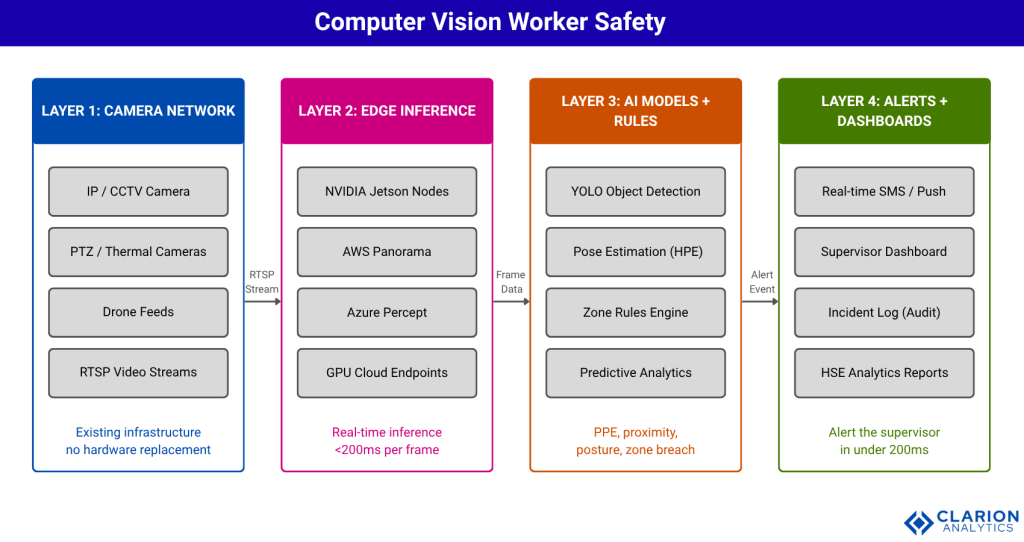
A computer vision safety system ingests live video from existing cameras, runs inference on each frame using a trained deep-learning model, and can trigger a supervisor alert within 200 milliseconds in edge-deployed configurations when a safety rule is violated.
The system watches all feeds simultaneously, applies detection models trained on tens of thousands of labelled images, and alerts only when a threshold is crossed. The supervisor acts. The model monitors.
A 2024 systematic review in Artificial Intelligence Review (Springer) confirmed that YOLO-based object detectors deliver the highest throughput for real-time compliance monitoring, with several production deployments exceeding 95% detection accuracy for PPE.
The Four Core Detection Tasks
PPE compliance detects the presence or absence of hard hats, high-visibility vests, gloves, and safety glasses per worker, per frame. Zone and perimeter enforcement flags workers who enter exclusion zones around heavy plant, excavations, or energised equipment. Pose and ergonomics analysis estimates body joint angles to identify unsafe lifting postures or fatigue indicators before musculoskeletal injury occurs. Equipment proximity and struck-by risk tracking measures real-time distances between pedestrians and moving vehicles.
Manufacturing: Catching What Assembly Lines Cannot
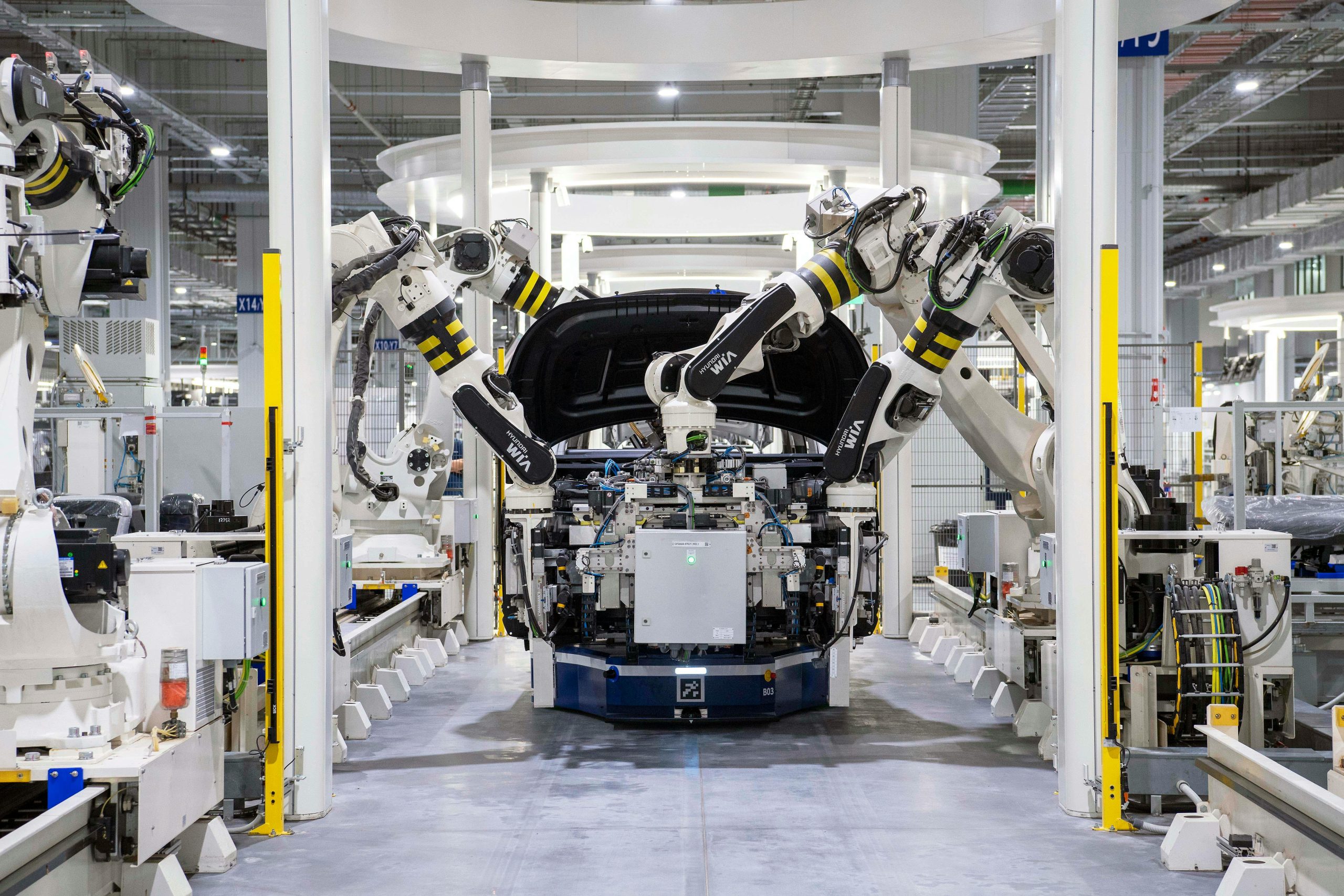
In manufacturing, AI safety monitoring detects unsafe postures at assembly stations, flags zone breaches in real time, and monitors ergonomic risk before musculoskeletal injury occurs reducing a category that accounts for approximately 28 to 33% of all serious workplace injuries, according to BLS and AFL-CIO data.
The Manufacturers Alliance (2024) found that 72% of manufacturing leaders believe AI will make plants safer. Nonfatal injuries in the sector fell to 326,400 cases in 2023, a 6.15% reduction. But the rate of cases requiring days away from work remained flat. Injury frequency is falling. Injury severity is not.
Pose estimation models track the angle of a worker’s spine during a lifting task. When it exceeds a calibrated threshold, the system flags an ergonomic risk event, triggering a real-time alert or a coaching notification. The injury never needs to occur for the data to exist.
“Musculoskeletal injuries are invisible until they are debilitating. Computer vision makes postural risk visible before the damage is done.”
In practice, teams working with Clarion Analytics typically find that the highest-value first deployment is not the most complex one. Starting with PPE compliance monitoring on a single production line generates immediate safety data and builds the internal case for a broader rollout.
Construction: Watching the Fatal Four Simultaneously
On construction sites, computer vision monitors falls, struck-by, electrocution, and caught-in hazards simultaneously across the full site, with leading YOLO-based detection models achieving accuracy above 90% in peer-reviewed validation studies.
Construction is one of the most dangerous industries in the U.S. The Fatal Four hazard categories falls, struck-by incidents, electrocution, and caught-in/between events account for approximately 58 to 65% of all construction fatalities each year, according to OSHA. Falls are the single largest cause. In 2024, 389 of 1,034 construction fatalities (37.6%) involved falls to a lower level, according to OSHA’s official fall prevention data.
A 2023 paper in Sensors (MDPI) from the Korea Electronics Technology Institute validated a framework combining real-time object detection with semantic rule inference, flagging helmet, gear, and posture violations on active construction sites with accuracy above thresholds required for operational deployment.
AI drone pilots in construction have demonstrated inspection time reductions of 40 to 65% compared to manual methods, while eliminating the need for workers to enter hazardous inspection zones, according to industry deployment data. Companies adopting active AI safety monitoring on construction sites report incident reductions ranging from 20 to 50%, though outcomes vary by site size, operational maturity, and deployment scope.
Logistics and Warehousing: Forklifts, Speed, and Invisible Risk
In warehousing, computer vision monitors forklift proximity, pedestrian lane compliance, and repetitive-motion ergonomic risk simultaneously across large floor areas where human observation fails at scale.
“A forklift moving at 8 mph covers a warehouse aisle in seconds. No safety manager can watch every aisle. An AI system can.”
The GAO (2024) confirmed that transportation and warehousing had the highest serious injury and illness rate of all 19 U.S. industry sectors in 2022, at an estimated 3.8 cases per 100 workers. Musculoskeletal disorders, primarily from improper bending, lifting, and overreaching, are the dominant injury type in warehouse operations. OSHA estimates that every dollar invested in workplace safety returns four to six dollars in avoided costs, making the ROI case for preventive monitoring measurable from the first pilot.
BCG’s 2026 logistics AI survey, based on a January 2026 survey of over 180 logistics providers and shippers, found that over 40% of shippers now factor AI capabilities into logistics provider selection. AI safety is no longer only an HSE decision. It is a commercial differentiator.
Comparing Deployment Approaches
Selecting the right deployment model depends on site complexity, hazard priority, and data maturity.
| Approach | Key Strength | Best Used When |
|---|---|---|
| Rule-based CCTV analytics | Low cost; deploys on existing cameras with no hardware replacement | Basic zone counting and occupancy monitoring in low-complexity environments |
| YOLO-based real-time CV | Sub-second multi-class detection; over 95% PPE accuracy in peer-reviewed benchmarks | Active production floors and construction sites requiring continuous monitoring |
| Pose estimation + ergonomics AI | Quantifies body posture risk to prevent MSDs before injury occurs | Manufacturing assembly lines and warehouses with high repetitive-motion injury rates |
| Predictive analytics layer | Combines historical near-miss data with live CV signals to forecast risk windows | Sites with rich historical safety data seeking pre-scheduled interventions |
| Drone + CV inspection | Eliminates worker exposure during hazardous inspections; cuts inspection cycles 40-65% | Large construction or infrastructure sites requiring aerial hazard mapping |
Implementation: What Deployments Actually Teach
Successful deployments begin with one camera, one hazard class, and a two-week baseline logging period before alerts go live, building internal confidence and generating the data needed to justify expansion.
The Manufacturers Alliance (2024) found that over 50% of manufacturing leaders cite employee acceptance as their primary AI safety challenge. Facilities that frame monitoring as a coaching tool, transparent about data use and focused on systemic risk rather than individual blame, consistently achieve faster adoption.
The deployment sequence that works consistently: a two-week baseline period where the system logs events without alerting, giving HSE teams data on actual hazard frequency; a supervised alert phase where supervisors verify notifications manually and calibrate thresholds; then full production with automated workflows for high-confidence detections.
“Start with one camera, one hazard class, and one week of baseline data. The ROI case builds itself.”
Organisations working with Clarion.ai have used this phased approach to move from a single-zone pilot to enterprise-wide safety monitoring in under six months, with baseline data doing the internal selling.
Frequently Asked Questions
How does computer vision improve worker safety?
Computer vision analyses live video to detect hazards the moment they appear, such as missing PPE, unauthorised zone entry, unsafe postures, and equipment proximity risks. It alerts supervisors in real time, shifting safety from a reactive, report-driven process to a continuous, automated prevention layer. No human observer needs to watch every feed.
Can AI safety monitoring work with my existing cameras?
Yes, in most cases. Modern computer vision safety platforms ingest standard RTSP video streams from IP cameras already on your site. You add edge inference hardware or connect to a cloud inference endpoint, eliminating the need to replace existing camera infrastructure and lowering the capital barrier.
What is the ROI of computer vision safety systems?
OSHA estimates that every dollar invested in workplace safety returns four to six dollars in avoided costs, covering medical expenses, lost productivity, and legal liability. Facilities that begin with a baseline monitoring period consistently generate the incident-frequency data needed to justify expansion within weeks.
How accurate are AI hazard detection systems on construction sites?
Leading YOLO-based PPE detection models exceed 95% accuracy in peer-reviewed benchmarks, according to a 2024 systematic review in Artificial Intelligence Review (Springer). Accuracy drops in low-light or heavily occluded conditions, making camera placement a critical deployment decision.
What are the biggest challenges when deploying AI safety monitoring?
The three most common challenges are worker acceptance and privacy concerns, flagged by over 50% of manufacturing leaders; fragmented data infrastructure; and scaling from a pilot to enterprise-wide deployment. A transparent data-use policy and change management program matter more to success than model selection.
How does Clarion.ai help organisations deploy computer vision safety systems?
Clarion.ai provides enterprise AI solutions that help industrial organisations build, configure, and scale computer vision safety infrastructure. From detection model selection to alert pipeline design, Clarion Analytics supports the full deployment lifecycle, reducing the time from pilot to production across manufacturing, construction, and logistics environments.
Which industries does Clarion Analytics support with AI safety monitoring?
Clarion Analytics serves manufacturing, construction, and logistics organisations across APAC and global markets. Its enterprise AI platform supports PPE compliance monitoring, zone and perimeter enforcement, ergonomic risk detection, and equipment proximity alerts, tailored to the specific regulatory and operational context of each sector.
How does Clarion.ai integrate with existing camera infrastructure?
Clarion.ai is designed to work with existing CCTV and IP camera networks, ingesting standard RTSP video streams without requiring hardware replacement. The platform connects to edge inference nodes or cloud GPU endpoints and overlays AI detection and alerting capabilities on top of the infrastructure organisations already operate.
How Clarion.ai Can Help
Clarion Analytics builds enterprise AI solutions for industrial organisations deploying computer vision safety infrastructure across manufacturing, construction, and logistics, covering the full lifecycle from model selection and edge inference setup to alert pipelines and HSE dashboard integration. Contact the Clarion.ai team to start a pilot.
InterPixels.ai automates health insurance claims intelligence for APAC operators, complementing the incident data CV safety systems generate. VoiceVertex.ai handles AI-powered frontline communications, useful for safety alert escalations and shift briefings. For more info, visit Interpixels.ai and Voicevertex.ai.
Three Truths That Should Change Your Next Capital Decision
Three findings from this analysis should matter to any operations or HSE leader. First, the infrastructure cost of computer vision worker safety is lower than most organisations assume, because most sites already own the cameras. Second, the ROI is measurable within weeks through baseline monitoring, not after a long implementation cycle. OSHA confirms that every dollar invested in safety returns four to six dollars in avoided costs. Third, the technology is production-ready: YOLO-based detection models exceed 95% PPE detection accuracy in peer-reviewed benchmarks, and the Ultralytics framework with over 60,000 GitHub stars and weekly updates is one of the most actively maintained computer vision codebases available.
The deployment risk is not technical. Facilities that treat AI safety monitoring as surveillance will face resistance. Facilities that treat it as a coaching and prevention tool will achieve faster adoption and stronger outcomes.
The question worth sitting with: if your site experienced a preventable fatality next week, and the camera footage showed the hazard clearly 30 seconds before impact, what would you wish your system had done with that footage in real time?
“The technology is no longer the barrier. The decision to start is.”
About the Author: Shivi

Related Posts