Construction site safety AI refers to the deployment of computer vision models, edge computing hardware, and machine learning algorithms to automatically detect unsafe conditions, PPE non-compliance, and proximity hazards on active job sites, delivering real-time alerts to site supervisors within milliseconds of detection.
The Fatality Numbers That Make the Status Quo Indefensible
In 2024, construction and extraction workers suffered 1,032 fatalities in the U.S. (BLS, 2026), with falls, slips, and trips accounting for 370 of those deaths. Manual audits catch these risks after injuries, not before.
Construction remains among the most dangerous industries on earth. According to the U.S. Bureau of Labor Statistics (2026), the sector’s construction and extraction occupational group logged 1,032 worker fatalities in 2024, with falls, slips, and trips accounting for 370 of those deaths, a 7.5% decrease from 400 in 2023. That is one fatality roughly every eight hours, and construction site safety AI is increasingly the answer safety leaders reach for.
OSHA data (2024) shows Fall Protection has remained the single most-cited construction standard for 14 consecutive years, with 6,307 violations recorded in FY2024. The pattern is predictable, yet prevention using manual inspection has stalled. A site with 200 workers, multiple floors of activity, and rotating subcontractors simply cannot be monitored by a single HSE officer walking rounds.
The lagging-indicator problem is structural. Paper-based audits generate records of hazards that already passed unchallenged. Walk-through inspections happen once per shift. Near-misses go unreported. The data that could prevent the next incident exists on-site, but remains invisible to the people who need it.
“Every inspection that happens on paper is a hazard that already passed unchallenged.”
The business case compounds the moral one. The National Safety Council (2024) estimates the societal cost per medically consulted workplace injury at $48,000, and the cost per work-related death at $1.54 million. These figures include wage losses, medical expenses, and administrative costs. A fatality, including legal exposure and project delays, can reach well beyond that figure in total organizational cost. Deloitte’s 2024 Engineering and Construction Outlook found AI and advanced analytics can deliver 10 to 15% cost savings on construction projects. Safety investment and operational efficiency are the same investment.
How Computer Vision Detects Hazards in Real Time
CV safety systems process live video frames through YOLO object-detection models, identifying missing PPE, unauthorized zone entry, and machinery proximity in under 50ms, then pushing alerts to supervisors via SMS, email, or dashboard.
Computer vision construction safety works by treating every camera frame as a structured data source. A trained YOLO model scans the frame and draws bounding boxes around recognized objects: hard hats, safety vests, persons, vehicles, machinery, and zone boundaries.
The speed is what separates this from CCTV. Wang et al. (2021, Sensors) demonstrated that YOLOv5x achieves the highest detection accuracy at 86.55% mAP, while YOLOv5s delivers the fastest inference speed at 52 FPS on GPU, on a construction-specific PPE dataset. A violation can be flagged, and an alert dispatched, before a supervisor could scan the same area manually.
More recent architectures push further. A 2025 study in Scientific Reports (Wang, 2025) showed YOLOv10 with transformer-based backbones delivers superior handling of partial occlusions and multi-scale objects, endemic problems on cluttered job sites where a worker’s hard hat may be obscured by scaffolding.
Post-processing layers apply non-maximum suppression to eliminate duplicate detections and confidence-threshold filtering to reduce false alarms. Zone enforcement uses spatial clustering algorithms, such as DBSCAN and related density-based methods, to map physical markers such as safety cones into monitored exclusion zone boundaries. Clarion Analytics operationalises this stack for enterprise construction clients, connecting model inference directly to existing safety management workflows.
Five High-Value Use Cases on Active Job Sites
The five most proven uses are PPE compliance monitoring, restricted zone enforcement, proximity detection near heavy machinery, fall-risk posture analysis, and multi-site centralized HSE dashboards.
1. PPE Compliance Monitoring. The system detects missing hard hats, absent safety vests, and uncovered faces across all camera feeds simultaneously. Deloitte’s 2026 Engineering and Construction Outlook cites computer vision safety analytics as a leading area of AI adoption in construction, noting hazards can now be identified in seconds rather than during shift-end walk-through reviews.
2. Restricted Zone Enforcement. Physical markers define exclusion boundaries around open trenches, crane swing radii, and live electrical work. The AI maps those boundaries and triggers an alert the moment a worker enters.
3. Proximity Detection Near Heavy Machinery. Excavators and telehandlers create strike zones that shift as equipment moves. The system monitors person-to-machine distance in real time and alerts operators before a struck-by incident occurs. OSHA identifies struck-by incidents as one of the construction industry’s “Fatal Four” (alongside falls, electrocutions, and caught-in/between hazards).
“A single prevented fall fatality can save more in societal and organizational costs than the full annual cost of an AI safety platform on a mid-size project.”
4. Fall-Risk Posture and Edge Proximity Analysis. Skeleton-pose estimation models identify workers within threshold distance of unguarded edges or working at height without visible harness attachment. Falls caused 370 of the 1,032 construction and extraction worker fatalities in 2024.
5. Multi-Site Centralized HSE Dashboard. For HSE Directors overseeing multiple concurrent projects, a centralized dashboard aggregates violation counts, heatmaps, and compliance trend lines. Clarion.ai‘s enterprise platform delivers this portfolio-level view, converting scattered site data into board-ready risk intelligence.
System Architecture: From Camera Feed to Supervisor Alert
A construction CV safety stack has four layers: edge capture (IP cameras and edge GPU nodes), model inference (YOLO running on-device), alert routing (webhooks, email, SMS, dashboard), and compliance logging (database recording every violation frame).
The diagram below maps the complete data flow from camera to compliance log. Four layers operate in sequence, with total latency under 100 milliseconds for alert-critical events.
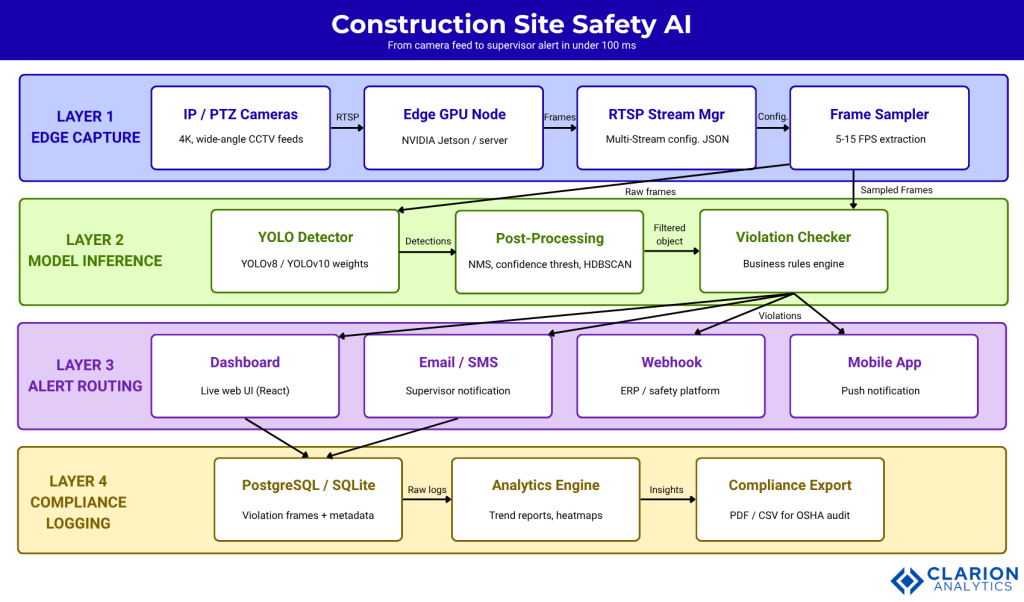
In practice, teams building this typically find that edge-node placement is the first critical decision. The node must have line-of-sight to the network switch feeding camera streams and adequate cooling in site-trailer conditions. A Docker Compose stack (as in the Ansarimajid/Construction-PPE-Detection reference architecture) spins up the full service, including FastAPI inference, PostgreSQL, and a web dashboard, with a single command.
Choosing the Right Approach: A Deployment Comparison
Rule-based CCTV cannot classify hazard types. Cloud-only CV adds latency and bandwidth cost. Edge-deployed AI delivers sub-100ms detection with offline resilience, making it the leading choice for large active sites.
Not every site or budget warrants the same deployment model. The table below covers the five primary approaches, evaluated on strength, limitation, and fit.
| Approach / Tool | Key Strength | Key Limitation | Best Used When |
|---|---|---|---|
| Traditional CCTV (Rule-based) | Low cost; no AI training needed | Cannot classify hazard type; high false-positive rate | Small sites with minimal dynamic hazards |
| Cloud-only Computer Vision | No edge hardware; easy central management | Latency 500ms+; bandwidth cost; offline failure | Low-risk zones with stable connectivity |
| Edge-deployed AI (YOLO + GPU) | Sub-100ms inference; offline resilient; scalable | Higher upfront hardware cost | High-risk active sites; remote locations |
| Hybrid Edge + Cloud Sync | Real-time edge alerts + cloud analytics dashboard | More complex integration; dual maintenance | Enterprise multi-site rollouts |
| Wearable Sensor + AI | Individual tracking; biometric data layer | Worker adoption friction; battery management | High-value workers in extreme-risk zones |
“Teams that deploy CV safety on a pilot zone first consistently build faster stakeholder buy-in than those who push for site-wide rollout from day one.”
The edge-deployed model dominates for large active sites. The hybrid model is gaining ground for enterprise clients who need portfolio-level analytics. Deloitte (2024) found AI and advanced analytics can deliver 10 to 15% project cost savings, and Deloitte’s Building Value in Construction analysis (2026) reports that industry AI safety implementations have achieved incident reductions of 40 to 50%. These are the metrics that underpin board-level investment cases.
Implementation Roadmap: From Pilot to Multi-Site Rollout
A successful rollout follows four phases: site survey and camera placement (weeks 1-2), model fine-tuning (weeks 3-4), alert workflow integration (weeks 5-6), and phased expansion with ROI review at 90 days.
Phase 1: Site Survey and Camera Placement (Weeks 1-2). Map high-risk zones: crane swing radii, fall edges, equipment staging areas, and site entry points. Place PTZ and wide-angle 4K cameras for maximum field-of-view coverage. Define exclusion zones with physical markers, whose boundaries the AI will later model as monitored areas.
Phase 2: Model Fine-Tuning (Weeks 3-4). The base YOLO weights are pre-trained on large construction PPE datasets. Fine-tune on 200 to 500 site-specific annotated images capturing your unique gear colors, machinery profiles, and lighting conditions. This step takes detection accuracy from acceptable to production-grade.
Phase 3: Alert Workflow Integration (Weeks 5-6). Configure notification channels and set alert cooldown thresholds to prevent supervisor fatigue. Connect the violation log database to your safety management platform via webhook or API.
Phase 4: Phased Expansion and 90-Day ROI Review. Expand coverage zone by zone. At 90 days, compare violation frequency data against pre-deployment incident records to produce the ROI case for board-level reporting.
Code Snippet 1: Multi-Stream Site Configuration
Source: yihong1120/Construction-Hazard-Detection – config/configuration.json (GitHub)
{
  "video_url": "rtsp://192.168.1.100/stream1",
  "site": "ProjectAlpha_Level3",
  "model_key": "yolo11n",
  "detection_items": {
    "detect_no_safety_vest_or_helmet": true,
    "detect_near_machinery_or_vehicle": true,
    "detect_in_restricted_area": true
  },
  "work_start_hour": 6,
  "work_end_hour": 20,
  "store_in_redis": true
}
This configuration block governs one camera stream. The detection_items flags control which hazard classes the model monitors on that stream, keeping supervisor alerts focused and reducing false-positive volume. Work-hour parameters prevent night-shift camera artifacts from triggering daytime violation thresholds.
Code Snippet 2: Production Deployment Environment Variables
Source: Ansarimajid/Construction-PPE-Detection – .env.example (GitHub)
MODEL_PATH=Model/ppe.pt
DETECTION_CONFIDENCE=0.5
ALERT_COOLDOWN_SECONDS=10
DATABASE_URL=postgresql+asyncpg://user:pass@db/ppe_detection
SENDER_EMAIL=safety@yourfirm.com
RECEIVER_EMAIL=hse.director@yourfirm.com
WEBHOOK_URL=https://hooks.yoursafetyplatform.com/alerts
These seven variables define the production system’s full behavioral profile. DETECTION_CONFIDENCE (0.0 to 1.0) is the single most impactful tuning parameter: lower values increase recall at the cost of more false positives; higher values tighten precision at the cost of potentially missed detections. ALERT_COOLDOWN_SECONDS prevents the same ongoing violation from flooding inboxes. WEBHOOK_URL enables direct integration with enterprise safety platforms.
“AI doesn’t replace your HSE director. It gives them eyes on every corner of the site, simultaneously.”
Frequently Asked Questions
How accurate is AI in detecting PPE on construction sites?
State-of-the-art models such as YOLOv5x achieve 86.55% mAP on construction-specific datasets (Wang et al., 2021, Sensors). With site-specific fine-tuning, edge-deployed systems can achieve higher precision. False-positive rates drop significantly when models are trained on site-specific gear colors and lighting conditions, with more recent YOLOv10-based systems showing further improvements (Wang, 2025, Scientific Reports).
Can computer vision safety work with my existing cameras?
Yes. Modern CV platforms accept RTSP streams from most IP cameras, including legacy CCTV hardware. You typically need a local edge GPU node to run inference, but cameras do not need replacing. Open-source frameworks such as Construction-Hazard-Detection support multi-stream RTSP configuration out of the box.
What does AI safety monitoring on a construction site cost?
Costs vary significantly by geography, vendor, and hardware configuration. Entry-level deployments may involve substantial hardware investment for GPU edge nodes plus software licensing. Organizations should request formal quotes from vendors and model the ROI against prevented incident costs: the NSC (2024) estimates each prevented medically consulted injury saves approximately $48,000 in societal costs, and each prevented work-related death saves $1.54 million.
How does real-time hazard detection differ from standard CCTV?
Standard CCTV records footage for later review. Real-time AI hazard detection processes each frame in under 100 milliseconds, classifies specific hazard types (missing hard hat, worker in exclusion zone, proximity to machinery), and pushes an actionable alert before the hazard escalates. It is prevention, not a record of what went wrong.
How long does it take to see ROI from construction site safety AI?
ROI timelines vary by site risk profile and platform cost. Deloitte (2026) reports that industry AI safety implementations have achieved incident reductions of 40 to 50%. With prevented injury costs starting at $48,000 per incident (NSC, 2024) and fatality-related costs exceeding $1.54 million, even a small number of prevented incidents in the first year can justify platform investment on high-risk sites.
How does Clarion Analytics apply computer vision to construction safety?
Clarion Analytics embeds enterprise-grade computer vision into its AI platform, enabling construction operators to monitor PPE compliance, zone violations, and proximity hazards across multiple camera feeds simultaneously. The platform connects model inference to existing safety management workflows, reducing alert-to-action time from hours to seconds.
Can Clarion.ai integrate with my existing site cameras and safety platform?
Yes. Clarion.ai is designed for RTSP-compatible camera infrastructure, which covers the majority of IP cameras currently deployed on construction sites. The platform connects to safety management systems and ERP tools via webhook and API, meaning your existing compliance workflows remain in place with AI-powered alerting added on top.
What reporting and compliance data does Clarion Analytics provide for HSE audits?
Clarion Analytics logs every violation event with timestamped frame data, site location, hazard classification, and resolution status. This creates a structured audit trail exportable as PDF or CSV, directly supporting OSHA record-keeping requirements and enabling HSE directors to produce trend reports, heatmaps, and incident-frequency dashboards for board-level review.
How Clarion.ai Supports Construction Site Safety
Clarion Analytics brings enterprise-grade computer vision and real-time analytics to construction safety operations. The platform monitors PPE compliance, restricted zone breaches, and machinery proximity hazards across multiple live camera feeds, with alerts routed to supervisors in under 100 milliseconds. Clarion.ai integrates with existing IP camera infrastructure via RTSP, connects to safety management platforms and ERP systems through API and webhook, and produces structured compliance logs ready for OSHA audit. HSE Directors gain a centralized dashboard that converts site-level violation data into portfolio-level risk intelligence, without replacing existing workflows. To discuss how Clarion Analytics can be deployed on your sites, contact the Clarion.ai team here.
Further Resources
InterPixels.ai: Construction safety operations generate dense streams of claims, incident reports, and compliance documents. InterPixels.ai applies AI to health and insurance claims intelligence, enabling construction and contracting organizations in APAC to process safety-related claims and TPA workflows with greater speed and accuracy, directly complementing the incident data generated by a CV safety platform.
VoiceVertex AI: VoiceVertex AI delivers an AI receptionist and voice automation layer that can handle inbound safety incident reporting calls, contractor site-access coordination, and HSE query routing, reducing the administrative overhead that typically burdens safety teams managing multi-site construction operations.
Three Things Every HSE Leader Should Take Away
Construction site safety AI has crossed from experimental to production-ready. Three conclusions hold up across the research, the code, and the deployment data.
First, the cost-of-inaction case is empirical. The NSC (2024) puts the societal cost of each medically consulted workplace injury at $48,000, and each work-related death at $1.54 million. Deloitte (2026) reports that deployed AI safety systems achieve 40 to 50% incident reductions. The financial argument for prevention investment is stronger than the argument against it.
Second, the technology deploys on existing infrastructure. RTSP-compatible IP cameras, an edge GPU node, and fine-tuned YOLO weights provide a working foundation. The integration barrier is real but not prohibitive, particularly with platforms designed for construction environments.
Third, adoption without change management fails. Supervisors need to trust the alerts. Workers need to understand why cameras are there. HSE teams need to own the alert workflow. Technology without people-process alignment produces ignored dashboards, not safer sites.
The question is not whether construction site safety AI works. The question is: which incident are you willing to let happen before you find out?
About the Author: Shivi

Related Posts