
Unit testing in Python is the practice of verifying individual functions or methods in isolation — without running a database, hitting an API, or starting a server. A unit test passes a specific input to a function and asserts the output matches expectations. Python’s built-in
unittestmodule and the third-partypytestframework are the two primary tools for writing and running these tests.
Why Unit Testing Is No Longer Optional
Bugs are expensive. According to the Consortium for Information & Software Quality (2022), poor software quality costs U.S. businesses at least $2.41 trillion annually. A single hour of enterprise downtime now costs an average of $300,000, per Gartner research (2024). These are not abstract numbers. They are the consequence of shipping code without adequate unit tests in place.
Learning how to write unit tests in Python changes this calculus immediately. A defect found before a pull request merge costs a fraction of the same defect discovered in production. The State of DevOps Report (2024) found that development teams spend 30–50% of their sprint cycles firefighting bugs — time reclaimed the moment you build a reliable test suite.
“A bug caught in development costs a fraction of a bug caught in production. Unit tests are the cheapest insurance a software team can buy.”
The Anatomy of a Python Unit Test
Every Python unit test follows the same three-step pattern: Arrange, Act, Assert. Set up your inputs, call the function, verify the result. This AAA structure applies whether you use unittest or pytest.
Here is the simplest possible pytest test:
Source: pytest-dev/pytest
No class. No self. No assertEqual. pytest uses Python’s native assert statement and provides detailed failure messages when it breaks. The test_divide_by_zero case is equally important; always test error paths, not just the happy path.
pytest vs. unittest – Which Framework Should You Use?
Pytest is the right default for most Python teams. It requires no boilerplate class inheritance, produces readable failure output, and has over 1,000 plugins on PyPI. According to the JetBrains Python Developers Survey (2024), 65% of Python developers use pytest as their primary testing framework. Research from Alves et al. (IEEE MSR, 2026) confirms empirically that pytest provides simpler assertions, better fixture reuse, and stronger interoperability compared to unittest.
| Option | Key Strength | Best Used When |
|---|---|---|
unittest | Built into Python stdlib; zero installation | Maintaining legacy test suites or strict zero-dependency environments |
pytest | Minimal boilerplate, fixture injection, 1,000+ plugins | Starting any modern Python project or migrating from unittest |
hypothesis | Property-based testing; auto-generates edge-case inputs | Testing functions across a wide input space without writing every case manually |
“The best testing framework is the one your team will actually use. For most Python developers, that is pytest.”
Mocking External Dependencies – The Most Misunderstood Skill
The moment a function touches a database, an external API, or a file system, developers often give up on unit tests entirely. That instinct is wrong. Use unittest.mock.patch or pytest-mock to replace real calls with controlled fake responses. This keeps tests fast, deterministic, and runnable without live infrastructure.
Source: pluralsight/intro-to-pytest, test_fixtures.py
@patch intercepts api_call before it touches the network. The test runs in milliseconds and verifies the logic of fetch_user, not the availability of a third-party server. In practice, teams building microservices find this pattern essential: you cannot run 40 dependent services locally every time you want to test one function.
Test Coverage – What the Number Actually Means
Coverage measures which lines your tests execute. It does not measure whether your tests are meaningful. Run pytest --cov=src to generate a coverage report. Aim for 80% or above on core business logic. Testomat research (2024) found that teams reaching that threshold see production bugs drop 60–80% within 12 months.
Track coverage as a floor, not a ceiling. The goal is meaningful assertions, not a vanity metric. A function with 100% line coverage and no assertion on its return value is visited, not tested.
Python Unit Testing Architecture: Developer to CI/CD
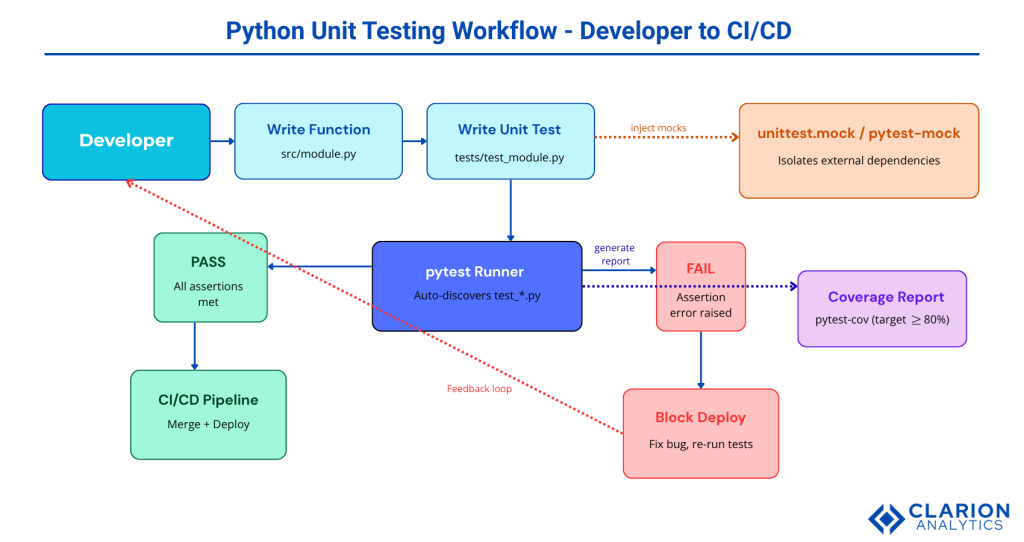
Diagram Caption: The diagram shows the standard unit testing loop in a Python CI/CD context. A developer writes a function and a corresponding test file. pytest discovers and runs all test_*.py files, reporting pass/fail with line-level detail. Mocking tools intercept external dependencies before the test touches live infrastructure. On success, the CI/CD pipeline proceeds to deployment; on failure, it blocks the build and returns a feedback signal to the developer.
Structuring a Real-World Python Test Suite
Place test files in a /tests directory mirroring your source layout. Name every test file test_<module>.py. Put reusable fixtures in conftest.py; pytest discovers and injects them automatically. This structure integrates with GitHub Actions, GitLab CI, CircleCI, and Jenkins without additional configuration.
my-project/
├── src/
│   └── calculator.py
├── tests/
│   ├── __init__.py
│   ├── conftest.py       # Shared fixtures live here
│   └── test_calculator.py
└── pytest.ini
“Test structure is documentation. A well-organised /tests directory tells new teammates exactly how the codebase behaves.”
Frequently Asked Questions About Python Unit Testing
What is the difference between unittest and pytest in Python? unittest is Python’s built-in testing module, inspired by Java’s JUnit. It requires tests to be methods inside classes inheriting from TestCase. pytest is a third-party framework that supports plain functions, uses native assert, and offers a richer plugin ecosystem. Most modern Python teams prefer pytest for its lower ceremony and clearer failure output.
How do I mock a database call in a Python unit test? Use unittest.mock.patch as a decorator or context manager to replace the database function with a mock object. Define what the mock returns, then assert your function behaves correctly with that fake data. The pytest-mock plugin provides a cleaner mocker fixture that handles teardown automatically.
What is a good Python test coverage percentage? 80% is a reasonable target for business-critical code. Coverage below 60% signals significant risk. Above 90%, returns diminish unless you are building safety-critical systems. Focus coverage efforts on branching logic and error paths — those are where real bugs live most often.
How do I run only specific tests in pytest? Use the -k flag to match test names: pytest -k "test_add". Use :: notation to target a specific file and function: pytest tests/test_calculator.py::test_divide_by_zero. Add -x to stop on the first failure and -v for verbose output.
Can I use pytest to test async Python functions? Yes. Install pytest-asyncio, mark async test functions with @pytest.mark.asyncio, and define them with async def. The plugin handles the event loop setup and teardown. This works with asyncio, trio, and anyio-based codebases.
Conclusion: Three Things Every Developer Should Take Away
Three things matter most when you start with Python unit testing. First, the AAA pattern, Arrange, Act, Assert, applies to every test you will ever write. Second, mocking is not a hack; it is the correct way to isolate a unit from infrastructure. Third, coverage is a floor, not a goal: 80% on business logic with meaningful assertions beats 100% coverage with empty tests.
The software quality crisis is not going away. As CISQ (2022) and Gartner (2024) both show, the cost compounds every quarter you delay. The technical barrier to getting started is lower than most developers realise.
“Writing tests is not slowing down development. It is the fastest path to shipping code you are confident in.”
So here is the real question: if your team shipped a critical bug tomorrow, would your current test suite have caught it?
About the Author: Imran Akthar

Related Posts