
Enterprise AI failure in Southeast Asia describes the pattern where an AI initiative reaches proof-of-concept stage but never enters sustained production, or enters production without delivering measurable business impact. Failure is almost never caused by the model. It is caused by the absence of data readiness, governance structures, and organisational change management before the model is ever trained. Most APAC enterprises fail not because they invest too little in AI, but because they invest in the wrong layer first.
The Number That Changes the Conversation
Why do AI projects fail in Southeast Asia at rates that seem impossible given the investment levels? Here is the figure: up to 85% of enterprise AI projects fail to deliver measurable business value, according to analyses including RAND Corporation’s 2024 study and multiple Gartner research publications. That rate is roughly twice the failure rate of conventional software projects.
McKinsey’s State of AI 2025 survey, covering 1,993 participants across 105 nations, found that 88% of organisations use AI in at least one function. But nearly two-thirds have not begun scaling AI across the enterprise. Only about 6% qualify as AI high performers achieving more than 5% EBIT impact from AI. The other 94% are running pilots that do not move.
Gartner’s April 2026 survey of 782 I&O leaders found that only 28% of AI use cases fully succeeded and met ROI expectations. Twenty percent failed outright. And 57% of leaders surveyed had experienced at least one failure. The primary cause cited by Gartner analyst Melanie Freeze: teams expected too much, too fast.
For APAC-based enterprises, these global figures understate the local challenge. Infrastructure gaps, fragmented data across legacy systems, regulatory complexity across multiple markets, and a compressed AI talent pipeline create compounding risk at every layer of an AI programme.
“The AI strategy mistakes that kill enterprise programmes in APAC are not technical errors. They are sequencing errors.”
Six Root Causes of AI Project Failure in APAC
Enterprise AI failure in Southeast Asia clusters into six consistent patterns. Understanding each is the first step to breaking the pilot loop that consumes most corporate AI budgets.
Root Cause 1: Data That Was Never Ready
Gartner’s 2025 research found that 63% of organisations do not have or are unsure whether they have the right data management practices for AI. Gartner predicts that through 2026, organisations will abandon 60% of AI projects unsupported by AI-ready data. AI-ready data is not the same as clean data. It is data that is aligned to a specific use case, actively governed at the asset level, and continuously quality-assured through automated pipelines.
In practice, APAC teams building AI systems encounter the same problem repeatedly. The pilot dataset is carefully curated before the model is trained. The live data feeding production is maintained by separate teams with no shared governance. The model performs well in the lab and fails in the field. The pattern is not a data problem alone. It is a governance problem dressed up as a data problem.
Root Cause 2: Scope That Drifts Before Delivery
RAND Corporation’s 2024 analysis of 65 documented enterprise AI initiatives found that use-case drift is a primary predictor of project failure. Successful projects scoped so tightly that drift was barely possible. Failed projects expanded the use case after build began, attempting to solve five problems with one model.
Research published via AI Agent Corps (April 2026), citing multiple industry sources, found that teams with a named AI product owner who has decision authority over scope and priorities are 2.1x more likely to deliver on time. AI work distributed across an existing team alongside regular responsibilities shows on-time delivery at only 21%, with a median schedule slip of 8.7 months.
Root Cause 3: Talent Deployed in the Wrong Sequence
Deloitte’s State of AI in the Enterprise 2026 survey of 3,235 leaders identifies the AI skills gap as the biggest single barrier to integrating AI into existing workflows. The skills required have also evolved. Organisations that focused on prompt engineering in 2024 now need teams that can manage AI systems across integration, cybersecurity, orchestration, governance, and change management.
BCG’s 10-20-70 framework, confirmed across hundreds of AI transformation case engagements, shows that 10% of AI value creation comes from algorithms, 20% from technology and data infrastructure, and 70% from rethinking people, processes, and change management. APAC organisations typically hire the 10% first and treat the 70% as a trailing activity.
“70% of AI value comes from people, processes, and change management. Most APAC AI budgets invest here last.”
Root Cause 4: Governance Treated as a Postscript
A 2026 arXiv preprint (not yet peer-reviewed) synthesising 19 large-scale industry studies found that governance gaps represent a primary failure vector across both organisational and technical dimensions. The paper introduces a five-pillar capability model where Governance and Regulatory Compliance is a prerequisite for scaling, not an optional add-on.
Across APAC, regulators are moving faster than many enterprises. Only 21% of companies report having a mature model for governance of autonomous AI agents, even as agentic AI adoption is poised to surge. Vietnam passed a dedicated AI law in 2026. Singapore launched the world’s first Model AI Governance Framework for Agentic AI. Indonesia’s AI National Roadmap is being formalised through Presidential Regulation.
Root Cause 5: No C-Suite Ownership
BCG’s AI Radar 2026 survey of 2,360 executives found that companies plan to double AI spending in 2026 to approximately 1.7% of revenues. But only about 15% of CEOs qualify as “Trailblazers” who drive AI-powered transformation through decisive investment and workflow redesign. The remaining 85% are “Pragmatists” or “Followers” who invest cautiously and demand visible value before committing further.
Without C-suite ownership, AI initiatives sit between departments, owned by nobody, resourced inadequately, and killed quietly when the pilot does not deliver within 90 days. The AI strategy mistake here is not strategic misalignment. It is the absence of a named executive who controls scope, resources, and timelines.
Root Cause 6: ROI Measured Against the Wrong Baseline
MIT’s Project NANDA (July 2025), covering 300-plus AI initiatives through practitioner interviews and structured surveys, found that 95% of organisations deploying generative AI saw zero measurable return by the standard of sustained productivity gains and documented P&L impact. Most AI programmes in APAC measure ROI against the model’s performance in the lab, not against a documented baseline of the business process the model is replacing.
Teams building this typically find that establishing a pre-AI process baseline is politically contentious. Nobody wants to document how slow or expensive the current process is. But without that baseline, there is no way to prove that the AI delivered value, which means there is no case for continued investment. The initiative stalls at proof of concept indefinitely.
“95% of organisations in the MIT Project NANDA study saw zero measurable P&L return from generative AI. Most failed to define what return looked like before they deployed.”
The Failure Anatomy
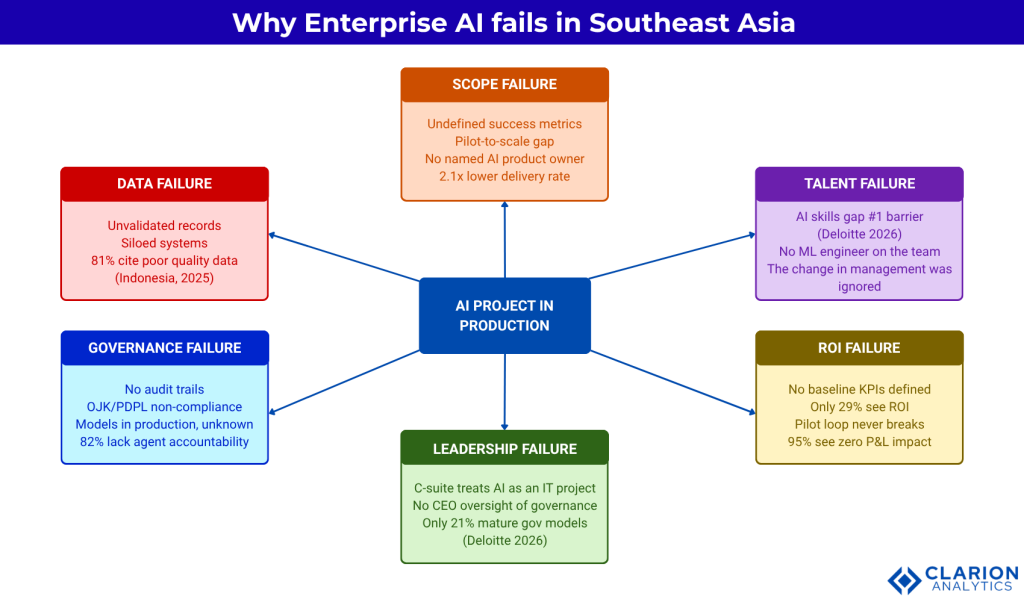
The Tools That Address Root Causes 1 and 4
Two open-source tools directly address the most common root causes of AI project failure in APAC. Both require no vendor licence and run inside existing Python pipelines.
Addressing Root Cause 1: Great Expectations Data Gate
Source: great-expectations/great_expectations – 9,500+ stars, Apache 2.0 licence, actively maintained June 2026. Code reflects GX 1.x API; verify current method signatures at docs.greatexpectations.io.
import great_expectations as gx

context = gx.get_context()

datasource = context.sources.add_pandas_filesystem(
    name="apac_claims_source",
    base_directory="./data/live/"
)

suite = context.add_expectation_suite("apac_data_readiness_suite")
validator = context.get_validator(
    batch_request=datasource.get_batch_request("claims_live.csv"),
    expectation_suite_name="apac_data_readiness_suite"
)

validator.expect_column_values_to_not_be_null("member_id")
validator.expect_column_values_to_be_between("claim_amount_usd", 0, 200000)
validator.expect_column_values_to_be_in_set(
    "country_code", ["ID", "MY", "SG", "TH", "PH", "VN"]
)

validator.save_expectation_suite()
result = context.run_checkpoint("apac_quality_gate")
print("Data passed quality gate:", result["success"])
This data gate is the minimum viable intervention for Root Cause 1. Three assertions catch the most common failure modes: null identifiers that break model joins, amounts outside plausible business ranges, and country codes indicating data from outside the intended market. The pipeline halts on failure. Nothing reaches the model until the data passes.
Addressing Root Cause 4: MLflow Model Governance
Source: mlflow/mlflow – 21,900+ stars, Apache 2.0 licence, 30 million monthly downloads, actively maintained June 2026. Note: transition_model_version_stage() is available in MLflow 2.x but is being superseded by alias-based promotion in MLflow 2.9+; consult current MLflow documentation for the latest lifecycle API.
import mlflow
from mlflow import MlflowClient

with mlflow.start_run(run_name="apac_fraud_model_v4"):
    mlflow.log_param("market", "Indonesia")
    mlflow.log_param("data_version", "claims_2026_Q2_validated")
    mlflow.log_param("governance_review", "completed_2026_06")
    mlflow.log_metric("precision", 0.91)
    mlflow.log_metric("recall", 0.88)
    mlflow.log_metric("false_positive_rate", 0.04)

    mlflow.sklearn.log_model(
        model, "model",
        registered_model_name="apac_fraud_detector_indonesia"
    )

client = MlflowClient()
client.set_model_version_tag(
    "apac_fraud_detector_indonesia", version=4,
    key="reviewed_by", value="risk_committee_2026_06"
)
client.transition_model_version_stage(
    name="apac_fraud_detector_indonesia",
    version=4, stage="Production"
)
Every detail logged here responds to a governance question a regulator can ask. Which dataset trained this model? Who reviewed it before promotion to production? What was the false positive rate? This is not bureaucracy. This is the minimum audit trail required for any enterprise deploying AI in a regulated APAC market.
Three Approaches to AI Programme Recovery in APAC
| Recovery Approach | Key Strength | Best Used When |
|---|---|---|
| Data-first reset | Directly addresses the root cause of 60% of abandoned projects (Gartner 2025); produces audit-ready foundation | Pilot failed due to data quality, inconsistent records, or model performance degradation in production |
| Scope reduction and recommit | Recovers momentum without requiring full infrastructure rebuild; builds stakeholder confidence | Programme lost C-suite support due to missed milestones; recommit on a single, tightly defined use case |
| Governance-first rebuild | Positions the programme for regulatory compliance and long-term scalability across APAC markets | Enterprise operates across multiple APAC markets with differing regulatory frameworks (OJK, BNM, PDPL, MAS) |
“The enterprises that scale AI in APAC are not the ones who ran the most pilots. They are the ones who stopped running pilots and started building infrastructure.”
Frequently Asked Questions
Why do AI projects fail in Southeast Asia more often than in other regions?
APAC enterprises face a compounding set of challenges that amplify global failure patterns: fragmented data across legacy systems with no shared governance, a compressed AI talent pipeline, complex multi-regulatory environments across different markets, and infrastructure gaps outside tier-1 cities. These factors do not cause failure independently. They interact. A data quality problem that a North American firm might absorb becomes terminal when combined with absent governance and insufficient talent depth.
What is the main reason enterprise AI programmes stall at the pilot stage in APAC?
The main reason is data unreadiness combined with scope drift. Pilots use curated datasets that do not represent live data quality. When the model encounters real production data, performance degrades and the pilot is deemed a failure. Gartner (2025) predicts 60% of AI projects lacking AI-ready data will be abandoned through 2026. The fix is a data quality gate before the model is trained, not after performance drops.
How can a CTO fix a stalled AI programme in Southeast Asia?
Start by auditing what failed, not by buying a new tool. Identify which of the six root causes applies: data, scope, talent, governance, leadership, or ROI measurement. In most APAC cases, data readiness and governance gaps are the culprit. Implement a data quality gate using Great Expectations, register existing models in MLflow to create an audit trail, and reduce scope to a single high-value use case with a named AI product owner and documented baseline metrics.
What governance framework should Southeast Asian enterprises follow for AI?
Enterprises operating across multiple APAC markets should layer three frameworks: Singapore’s Model AI Governance Framework for operational guidance on responsible agentic AI, NIST AI RMF for the risk management foundation, and country-specific frameworks such as Indonesia’s AI National Roadmap White Paper (KOMDIGI, 2025), OJK for financial AI applications, and BNM frameworks for Malaysian operations. Governance built before deployment costs significantly less than governance retrofitted after a compliance event.
How do I measure ROI on an AI project in Southeast Asia before it reaches production?
Measure the baseline process before building the model. Document current cycle time, error rate, cost per transaction, and headcount for the process the AI will touch. Without this baseline, no ROI case is possible. MIT Project NANDA (2025) found that most AI deployments showed zero measurable return partly because organisations had not defined what return looked like. The baseline document is the most important AI investment deliverable your team will ever produce.
The Three Things That Separate Pilots from Production
Three insights separate the roughly 6% of enterprises realising meaningful AI returns from the 94% still running pilots. First, production AI is built on governed data, not on data that happened to be available. Every hour spent on data readiness today saves months of failed production rollouts. Second, governance is not a compliance exercise. It is the infrastructure that makes AI trustworthy enough to operate at scale. Third, leadership ownership is the only variable that reliably converts a stalled programme into a scaled one.
The question is not whether APAC’s AI opportunity is real. AI could contribute USD 1 trillion across Southeast Asia by 2030. The question is whether your organisation will be among the 6% that capture it or the 94% that fund its capture for someone else.
About the Author: Shivi

Related Posts