
A board approves an AI roadmap that looks flawless on every slide. Twelve months later, nothing runs in production, and the firm that wrote the roadmap has moved on to its next engagement. This is the enterprise AI strategy execution gap, and it is not a talent shortage or a technology failure. It is a business model problem: advisory firms earn fees for recommending complex programmes they never have to build. This article explains why that incentive distorts advice, and it gives you three patterns that reveal, before you sign, whether a strategy will survive contact with engineering reality in your organisation.

Why the Enterprise AI Strategy Execution Gap Is a Business Model Problem
Advisory firms earn revenue from scoping, not from shipping. A larger roadmap means a larger engagement, and a firm that builds no software carries no cost when its recommendations prove undeliverable. The incentive rewards ambition and ignores feasibility. That structure, not individual competence, produces the gap.
Consider what each party bears. The advisor delivers a document and collects a fee. The enterprise inherits the integration work, the data problems and the accountability to the board. Strategy and delivery sit in different budgets, so no one feels the distance between them.
Across client engagements in financial services and insurance, our teams have seen enterprises receive a detailed roadmap and then spend the first quarter learning which parts cannot be built. Nobody who wrote the roadmap had to make it run. Our analysis of why enterprise AI in APAC fails traces the same cause, and State of AI in Enterprise, Gartner offers an external view.
Pattern One: No Named Owner for Production
The first pattern is a roadmap that lists initiatives but names no one accountable for running them in production. A strategy that ends at recommendations hands the hardest work to the client without saying so. A credible plan assigns ownership for deployment, monitoring and failure response from the first page.
Ask who answers the call when a model degrades at 2 a.m. In most advisory deliverables, the answer is blank. In deployments conducted for enterprise clients across APAC, we find that a missing owner is one of the clearest early signs of a stalled programme. The advisor has already left, so the client improvises.
Our guidance on the enterprise AI pilot to platform path explains why pilots stall when no one owns operations. A roadmap that funds a pilot but not the run costs sets the programme up to stall. Insist that every initiative carries an operating cost line and a named executive.
Pattern Two: Architecture Shown as Boxes, Not Constraints
The second pattern is architecture presented as clean diagrams with no mention of data quality, latency, security approvals or legacy integration. Real enterprise systems carry constraints that diagrams hide. A strategy that ignores those constraints describes a system that cannot exist inside your environment.
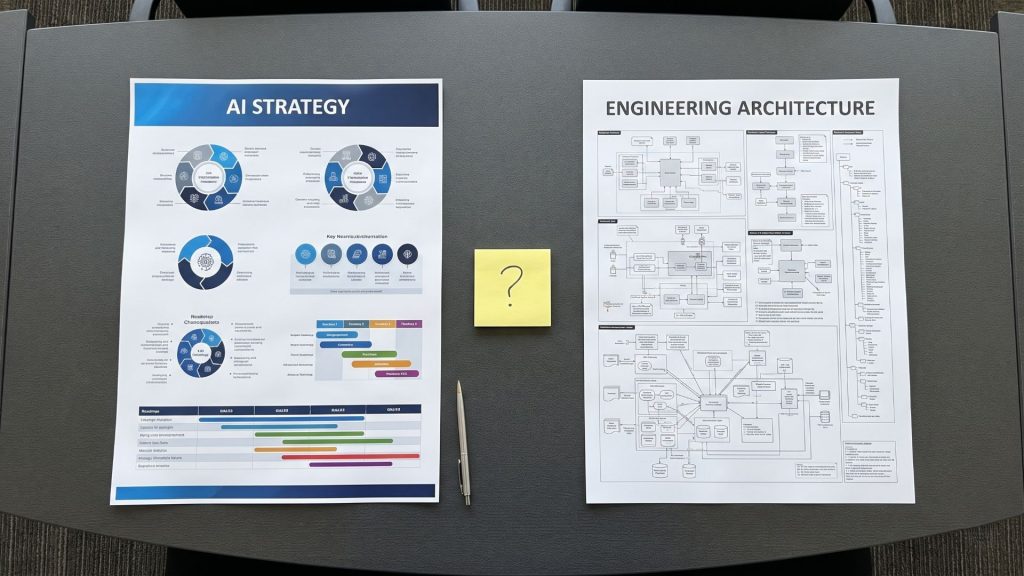
Test this by asking for the three hardest integration problems in the plan. An advisor who has built similar systems answers in specifics: which source system lacks clean identifiers, which approval takes longest, which workload breaks the latency budget. An advisor who has not built them answers in generalities.
In our work with financial services and insurance clients, the constraint that sinks a plan is rarely the model. It is usually the data feeding it or the approval path around it. Our build vs buy AI decision framework starts from these constraints for that reason. A plan full of named constraints has usually already met real systems.
Pattern Three: Success Measured by the Document
The third pattern is a success measure tied to the deliverable rather than to a working system. When milestones read approved roadmap or delivered framework, the advisor finishes on schedule whether or not anything runs. Demand milestones that a user, an auditor or a customer can observe in production.
Board reporting often inherits this flaw. Directors see green status on a strategy workstream while no workload has reached production. Our guide to AI strategy for APAC boards sets out five questions directors can ask to expose the difference. For an external benchmark, see Closing the AI Execution Gap, Deloitte.
Across programmes we have delivered in APAC, the ones that held up shared one trait. Their milestones named a live system, a defined user group and a measurable operational result. The enterprise AI strategy execution gap narrows when the contract measures what runs, not what is written.
The gap between strategy and execution is a structural outcome, not a failing of individual advisors. Three patterns reveal it: no named owner for production, architecture without constraints, and success measured by documents. Closing the enterprise AI strategy execution gap starts with demanding evidence that the advisor has built what it recommends.
At Clarion Analytics, we do not produce strategy documents. We build and deploy. If you want to discuss this further, contact Clarion Analytics at clarion.ai/contact.
Frequently Asked Questions
What is the gap between AI strategy and execution?
The gap is the distance between an AI roadmap and a system running in production. It forms when the party that designs the plan carries no responsibility for building it. Enterprises then absorb integration, data and operational risk that the strategy never addressed. The programme looks complete on paper and stalls when engineering begins.
Why do advisory firms recommend plans they cannot build?
Advisory firms earn fees for scoping and recommending, not for delivering working systems. Larger roadmaps support larger engagements, and the firm bears no cost if the plan proves undeliverable. This is an incentive problem, not a competence problem, and individual advisors may be highly skilled. The business model rewards ambition over feasibility.
How can an executive test whether an AI roadmap is deliverable?
Ask three questions. Who owns production operation of each initiative? What are the three hardest integration problems, and how were they tested? Which milestones can a user or auditor observe in a live system? Credible answers are specific and name people, systems and constraints. Vague answers signal a plan that has not met engineering reality.
Should enterprises use separate firms for strategy and delivery?
Separate firms can work if the strategy firm stays accountable for deliverability and delivery engineers review the plan before approval. The risk sits in handoffs, where assumptions disappear. A single accountable party for design and build removes that risk. Either way, require engineers to review the roadmap before the board sees it.
What should boards ask about AI strategy?
Boards should ask which workloads are in production today, who owns each one, and what operating cost it carries. They should also ask what evidence shows the advisor has built comparable systems. Status reports on strategy workstreams reveal little. Production metrics reveal whether the programme is working.
About the Author: Shivi

Related Posts