Insurance technology leaders sit through the same vendor meeting repeatedly. The deck shows claims automation, autonomous underwriting and real-time fraud scoring. The pilot slide shows promising results on a sample. Nothing explains what runs in a live core system today.
This gap is wider in insurance than in any other enterprise vertical. It decides whether a purchase delivers operational value or a stalled programme. This article separates enterprise insurance AI production from pilots and presentation decks across claims, underwriting and fraud detection. You will get three tests to apply before your next procurement decision. Each test uses evidence a vendor can either produce or cannot.

Enterprise Insurance AI Production: Three Tests That Separate Evidence from Claims
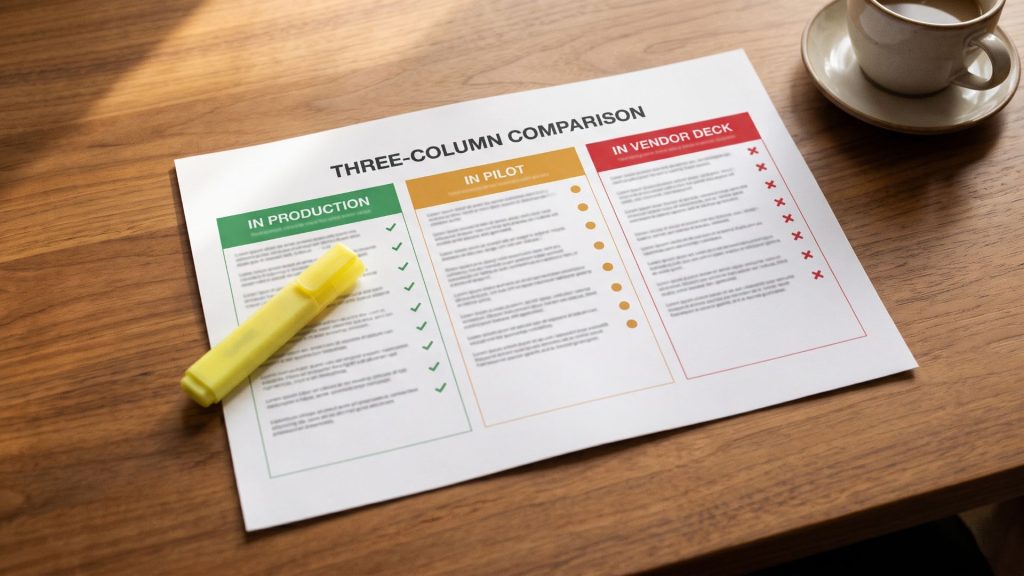
A system is in production when it handles live claims or policy volume inside a core platform. It runs under operational service levels, with named owners accountable for outcomes. A pilot runs on a sample or in a sandbox. A deck describes capability without evidence. Insurers should ask which of the three they are buying.
Three tests make the distinction practical. First, ask for live volume: how many claims or submissions the system processed last month, and for which insurer. Second, ask for integration: which policy administration or claims platform it writes to. Third, ask for an owner: who at the client carries the operating result.
In deployments conducted for enterprise clients across APAC, vendors that pass the first test usually pass the other two. Vendors that cannot answer the first rarely recover. Our research into why programmes fail to move from enterprise AI pilot to platform shows the boundary is operational, not technical.
A deck describes capability. Production delivers outcomes with a named owner.
Claims Processing: Where Production Evidence Is Strongest
Claims processing holds the most genuine production deployments in insurance AI. Document intake, data extraction and triage rules run at scale because the inputs are structured enough and the outcomes are measurable. Adjudication decisions and complex liability judgments remain largely human led. Vendors often blur this line.
Enterprise insurance AI production in claims is real but narrow. Straight-through processing means a claim moves from intake to payment without manual touchpoints. Few insurers achieve it beyond low-value, low-complexity claims. A vendor claiming it across a full claims book deserves scrutiny.
Across client engagements in financial services and insurance, we see intake and extraction reach production first, because the business case is easiest to measure. Triage follows. Adjudication comes last. Procurement teams should map every vendor claim to one of those stages.
Our guide to automating insurance claims with AI explains where document intelligence delivers measurable gains first. AI platforms purpose-built for insurance document intelligence and claims processing, such as InterPixels AI, already run in production across APAC insurers.
Underwriting and Fraud Detection: Where the Gap Widens
Underwriting and fraud detection show the widest gap between presentation and production. Both depend on proprietary data, regulatory scrutiny and model governance that vendors rarely demonstrate. Most deployments are decision support tools that rank risk or flag cases for human review. Fully autonomous decisions are rare.
Underwriting pilots often perform well on historical data. Production exposes them to drift, broker behaviour and referral rules the pilot never faced. Fraud models face a similar test: false positive rates that look acceptable in a sample can overwhelm investigation teams at full volume.
Analyst work such as the Global Insurance Technology Survey by KPMG and the Future of AI in Insurance report from Deloitte describe where the industry is heading. Ambition is not deployment. A credible enterprise insurance AI production claim names the system, the volume and the client.
Underwriting AI that reads financial documents needs the discipline described in our work on AI document intelligence for financial services. Measuring enterprise AI ROI should start with live operating data, not pilot projections.
Ambition is not deployment.
Enterprise insurance AI production is verifiable. Ask for live volume, named integrations and an accountable owner before you sign. Claims automation has the strongest record, while underwriting and fraud detection need closer scrutiny. Pilots remain useful, but they should be priced and governed as pilots.
Insurers that hold vendors to this standard avoid stalled programmes and spend budget on systems that run. The deck shows what a vendor hopes to build. Production shows what the vendor has built, deployed and stands behind. If you want to discuss this further, contact Clarion Analytics.
Frequently Asked Questions
What does in production mean for insurance AI?
In production means the system processes live claims, policies or submissions inside a core insurance platform. It runs under service levels, with a named client owner accountable for results. It is not a sandbox, a proof of concept or a demonstration on historical data. Insurers should ask vendors for live monthly volume, the integrated systems and a reference client.
Which insurance functions have the most AI in production?
Claims processing has the most genuine production deployments, particularly document intake, data extraction and triage. These tasks use structured inputs and produce measurable outcomes. Underwriting and fraud detection are more often deployed as decision support, where models rank risk or flag cases for human review. Fully autonomous decisions remain uncommon across all three functions.
How can a buyer tell a pilot from a production system?
A pilot runs on a sample, a sandbox or historical data and has no operational service levels. A production system runs on live volume and writes to core platforms. Ask for last month’s processed volume, the named integration and a client contact who owns the outcome. Vendors with production systems answer quickly and specifically.
Pilot results measure potential. Production results measure operations.
Why do insurance AI programmes stall after the pilot?
Programmes stall when the pilot never faced production conditions such as integration with core systems, live data quality, model governance and operational ownership. Results on a clean sample do not transfer to full volume. Stalls are usually operational rather than technical. Insurers reduce this risk by defining production criteria before the pilot begins and funding integration from the start.
What should insurers ask AI vendors before procurement?
Ask for live monthly volume, the core systems the product writes to, a reference insurer in production and the named owner of results. Ask what the system decides autonomously and what it routes to humans. Ask how performance is measured after go-live. Vendors who answer with slides instead of evidence are selling a deck.
About the Author: Shivi

Related Posts