LLM fine-tuning for enterprise is the process of continuing the training of a pre-trained large language model on a curated, domain-specific dataset to align its outputs with proprietary workflows, terminology, and compliance requirements. Unlike prompt engineering or retrieval-augmented generation (RAG), fine-tuning modifies the model’s weights directly, producing persistent behavioral changes that require no retrieval infrastructure at inference time.
Why Generic LLMs Fail Enterprise Teams
Generic LLMs trained on public data lack domain vocabulary, internal process logic, and compliance alignment. Fine-tuning on proprietary datasets encodes enterprise-specific knowledge directly into model weights, producing consistent behavior without retrieval infrastructure.
Gartner (2025) projects that more than 50% of enterprise GenAI models will be domain-specific by 2027, up from just 1% in 2024. The shift is already underway, and organizations relying on off-the-shelf models for specialized tasks are accumulating a technical and competitive gap.
McKinsey (2025) found that only around one-third of organizations report scaling AI enterprise-wide. The barrier is not model capability. Generic models simply do not fit specialized tasks that require domain vocabulary, process context, and output formatting rules.
Deloitte (2025) found that only 6% of organizations see AI payback in under a year. Targeted, task-specific deployments are the ones that get there. Teams working with Clarion Analytics on domain AI pipelines consistently find that scoping tightly to a specific task is the fastest route to measurable return.
“Your proprietary data is not just an input; it is the competitive moat that a fine-tuned model encodes permanently into its weights.”
Choosing Your Strategy: RAG, Fine-Tuning, or Both
RAG retrieves facts dynamically and suits frequently changing knowledge bases. Fine-tuning bakes behaviors and output style into model weights and suits stable domain tasks. Hybrid approaches consistently outperform either alone for knowledge-heavy enterprise workflows.
The decision is not either-or. It depends on two axes: how often your knowledge changes, and how critical behavioral consistency is.
- Fine-tune for stable behavior: output format, tone, classification rules, and domain terminology.
- Use RAG for dynamic knowledge: product catalogs, policy updates, and real-time pricing.
- Use both when you need consistent behavior alongside current knowledge.
| Approach | Key Strength | Best Used When |
|---|---|---|
| Full Fine-Tuning | Maximum accuracy; all model weights updated | Large labelled datasets (100k+), uncapped GPU budget, peak task performance required |
| LoRA (Low-Rank Adaptation) | Updates under 1% of parameters; portable adapters that merge at zero inference latency | Moderate data (1k to 50k examples), standard GPU budget, reusable per-task adapters needed |
| QLoRA (4-bit Quantized LoRA) | Approximately 70% less VRAM than 16-bit LoRA; fine-tunes 65B models on one 48GB GPU | Constrained hardware, large models, rapid iteration on a limited cloud budget |
| Instruction Tuning (SFT) | Aligns output format, tone, and task-following behavior | Controlling output structure without changing factual knowledge |
| RAG + Fine-Tuning (Hybrid) | Stable behavior with dynamically updated knowledge | Knowledge changes frequently but tone must stay consistent |
The PEFT Toolkit: LoRA, QLoRA, and Instruction Tuning
LoRA injects trainable low-rank matrices into frozen model layers, updating well under 1% of total parameters depending on the modules targeted. QLoRA adds 4-bit quantization on top, enabling fine-tuning of 65B-parameter models on a single consumer GPU with no meaningful accuracy loss on targeted benchmarks.
LoRA: Low-Rank Adaptation
LoRA was introduced by Hu, Shen, Wallis et al. in 2021. It addresses the core problem of enterprise fine-tuning: updating billions of parameters is expensive, but skipping fine-tuning leaves the model unfit for domain tasks. LoRA freezes pre-trained weights and injects small trainable matrices into transformer attention layers. These adapters are combined with frozen weights at inference time, adding zero latency overhead once merged.
At rank 16, targeting only the query and value projections, LoRA trains roughly 3.7 million parameters for a 7B model, under 0.1% of the total. Expanding targets to all attention and MLP projection layers (q, k, v, o, gate, up, down) raises this to approximately 40 to 85 million parameters, still well under 1% of total weights. Compared to full fine-tuning, LoRA reduces peak training VRAM by approximately 4 to 8x depending on optimizer configuration.
QLoRA: Memory-Efficient Fine-Tuning at Scale
Dettmers et al. demonstrated in QLoRA (NeurIPS 2023) that 4-bit NormalFloat quantization combined with LoRA allows fine-tuning a 65B model on a single 48GB GPU. The Guanaco 65B model produced by QLoRA reached 99.3% of ChatGPT performance on the Vicuna benchmark after just 24 hours of fine-tuning on a single GPU. Three mechanisms make this possible: NF4 weight quantization, Double Quantization for constant compression, and Paged Optimizers for memory spike handling.
Compared to 16-bit LoRA, QLoRA reduces VRAM requirements by approximately 70 to 75%, making large-model fine-tuning viable on hardware that would otherwise support only much smaller models.
Instruction Tuning: Aligning Model Behavior
As surveyed by Zhang et al. (2023), a paper now at its tenth revision as of October 2025, instruction tuning trains models on (instruction, output) pairs, bridging the gap between next-token prediction and enterprise task alignment. It controls format, tone, and task-following behaviour without changing factual knowledge encoded in base weights.
“QLoRA’s 4-bit quantisation is not a quality compromise; it is the enterprise team’s ticket to fine-tuning a 65B model on one GPU.”
Code Snippet 1 – Source: huggingface/peft – LoRA adapter setup
from transformers import AutoModelForCausalLM
from peft import LoraConfig, TaskType, get_peft_model

model = AutoModelForCausalLM.from_pretrained('mistralai/Mistral-7B-v0.1')

peft_config = LoraConfig(
    r=16,
    lora_alpha=32,
    task_type=TaskType.CAUSAL_LM,
    target_modules=['q_proj', 'v_proj']   # targeting 2 of 7 projection layers
)

model = get_peft_model(model, peft_config)
model.print_trainable_parameters()
# trainable params: 3,686,400 | all params: 3,746,893,824 | trainable%: 0.098
This configuration targets only the query and value projections, reducing trainable parameters to approximately 3.7 million, or 0.1% of the total model weights. The rank value (r=16) controls adapter expressiveness. Enterprise teams typically start at r=8 or r=16 and tune upward only if task complexity demands it. Note that targeting additional layers (as in the QLoRA snippet below) increases trainable parameters proportionally while remaining well under 1% of the total.
Data Preparation: The Phase That Decides Everything
Enterprise fine-tuning datasets should contain 1,000 to 10,000+ high-quality instruction-output pairs. Quality consistently outweighs volume. A dataset of 1,000 clean, validated examples outperforms 50,000 noisy ones on downstream task benchmarks.
Mathav Raj J. et al. (2024) propose three data formatting strategies for proprietary enterprise content: paragraph chunks for dense documentation, question-answer pairs for knowledge-heavy tasks, and summary-function pairs for internal code repositories. In practice, data preparation often consumes the majority of total project time, a pattern consistently reported by practitioners across fine-tuning projects of all scales.
- Clean before formatting. Remove duplicates, fix label inconsistencies, and validate output-instruction alignment.
- Format as chat-style JSON with system, user, and assistant roles.
- Include negative examples to improve output calibration.
- Version your datasets alongside model checkpoints. Reproducibility depends on it.
“Spending the majority of your time on data quality before training is not inefficient; it is the only sequence that produces a production-ready model.”
Implementation Walkthrough with QLoRA
A QLoRA fine-tuning run on a 7B model with 1,000 domain examples typically completes in approximately 2 to 4 hours on a single A100 80GB GPU. Cloud compute cost varies by provider and configuration; at standard A100 on-demand rates, a short run of this scale costs in the range of $10 to $20. Both time and cost scale with dataset size, sequence length, and number of training epochs.
In practice, teams find that the first run is a baseline, not a final product. Establish evaluation metrics before training. Iterate on data quality first, then hyperparameters. The most reliable levers are data volume, learning rate, and rank.
Code Snippet 2 – Source: unslothai/unsloth – QLoRA fine-tuning setup
from unsloth import FastLanguageModel
from trl import SFTTrainer
from transformers import TrainingArguments

# Load 4-bit quantized model
model, tokenizer = FastLanguageModel.from_pretrained(
    model_name = "unsloth/Mistral-7B-Instruct-v0.3-bnb-4bit",
    max_seq_length = 2048,
    load_in_4bit = True,
)

# Attach LoRA adapters to all 7 attention and MLP projection layers
model = FastLanguageModel.get_peft_model(
    model,
    r = 16,
    lora_alpha = 16,
    target_modules = ["q_proj","k_proj","v_proj","o_proj",
                      "gate_proj","up_proj","down_proj"],
    use_rslora = True,
    use_gradient_checkpointing = "unsloth"
)

trainer = SFTTrainer(
    model = model,
    train_dataset = dataset,
    args = TrainingArguments(
        per_device_train_batch_size = 4,
        gradient_accumulation_steps = 4,
        warmup_steps = 20,
        num_train_epochs = 3,
        learning_rate = 2e-4,
        output_dir = "./outputs"
    )
)
trainer.train()
This block loads a 4-bit quantized Mistral-7B model via Unsloth’s optimized Triton kernels, attaches LoRA adapters to all seven attention and MLP projection layers across all 32 transformer layers (approximately 40 to 42 million trainable parameters, roughly 0.6% of total), and launches a three-epoch SFT run. Rank-Stabilized LoRA (rsLoRA) improves gradient stability at higher ranks. On a single A100, Unsloth delivers up to 2.2x the training speed of standard HuggingFace PEFT with approximately 70 to 75% less VRAM, depending on the model and sequence length configuration.
“A fine-tuned 7B model with clean domain data routinely outperforms a 70B general-purpose model on the task it was trained for.”
Evaluating Before You Ship
Evaluation should combine a held-out task benchmark, automated metrics (accuracy, ROUGE, perplexity), and human review of 50 to 100 representative prompts. A/B testing against the base model in a shadow deployment confirms production readiness before full rollout.
Define your success criteria before writing a single training example. The four dimensions every enterprise fine-tuning evaluation must cover:
- Task accuracy on your held-out domain benchmark.
- Format compliance: does every output match the required structure?
- Domain language: correct terminology, no hallucinated domain terms.
- Regression on general tasks: using LoRA or QLoRA rather than full fine-tuning significantly reduces catastrophic forgetting risk, because base weights remain frozen.
Frequently Asked Questions
When should I fine-tune instead of using RAG? Fine-tune when behavior, format, or tone must be permanent and stable. Use RAG when facts change frequently. Combine both when you need consistent behavior alongside current knowledge, such as a fine-tuned model querying a curated document store.
How much data do I need to fine-tune an enterprise LLM? Start with 1,000 high-quality instruction-output pairs per task. Complex domains such as legal, medical, or insurance benefit from 10,000 or more. Quality consistently outperforms volume. Reserve 10 to 20% of examples as a held-out evaluation set.
What is the difference between LoRA and QLoRA? LoRA injects trainable low-rank matrices into frozen model layers, updating well under 1% of parameters depending on target modules. QLoRA adds 4-bit quantization on top, cutting VRAM by approximately 70 to 75% compared to 16-bit LoRA, with negligible accuracy loss on most tasks.
How long does enterprise LLM fine-tuning take on a single GPU? A QLoRA run on a 7B model with 1,000 to 5,000 examples typically completes in approximately 2 to 4 hours on a single A100 80GB GPU. Training time scales with dataset size, sequence length, number of epochs, and hardware configuration.
How do I prevent my fine-tuned model from losing general knowledge? Use LoRA or QLoRA rather than full fine-tuning. Frozen base weights preserve general knowledge by design. Keep the learning rate at or below 2e-4, and include a small percentage of general-instruction data in your training mix to reduce catastrophic forgetting on off-domain queries.
How does Clarion.ai support enterprise LLM fine-tuning initiatives? Clarion Analytics provides enterprise AI infrastructure and advisory services covering model selection, data pipeline architecture, PEFT strategy, and production deployment. Clarion.ai helps teams move from prototype to production fine-tuning without rebuilding foundational MLOps from scratch.
Can Clarion Analytics help us build a domain-specific data preparation pipeline? Yes. Clarion Analytics specialises in structuring proprietary enterprise data, including claims records, operational logs, and document repositories, into fine-tuning-ready instruction datasets. The team handles annotation frameworks, quality validation, and versioning across the full data lifecycle.
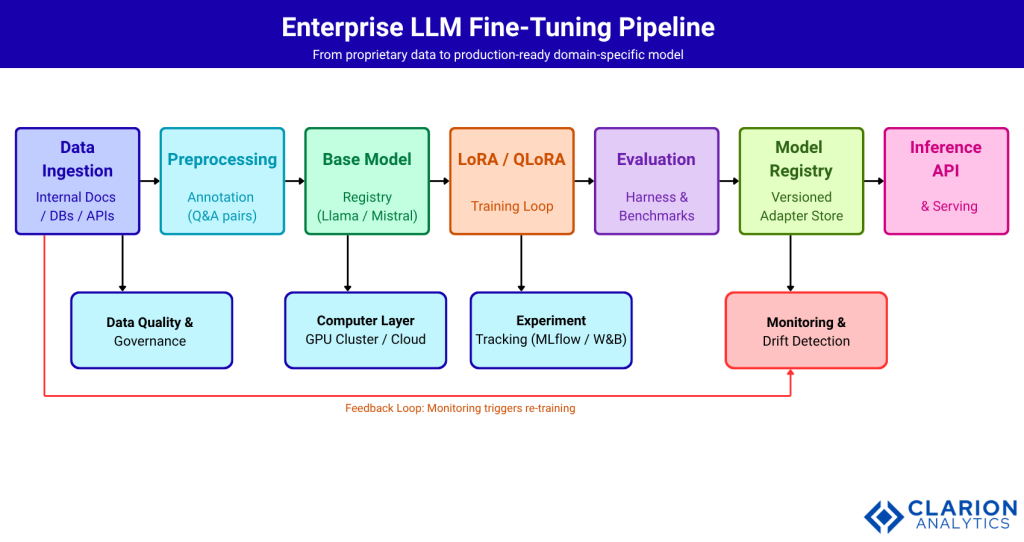
Does Clarion.ai offer monitoring and drift detection for fine-tuned models? Clarion Analytics includes production monitoring as part of its enterprise AI platform, tracking output quality, format compliance, and statistical drift. When drift is detected, Clarion.ai’s pipeline can trigger re-training workflows automatically, reducing the manual overhead of maintaining fine-tuned models in production.
How Clarion.ai Helps
Enterprise LLM fine-tuning requires more than a training script. It demands a structured data pipeline, a reliable evaluation framework, and production monitoring that catches drift before it affects downstream decisions. Clarion Analytics delivers end-to-end enterprise AI infrastructure covering model selection, PEFT strategy, proprietary data preparation, and production deployment. Whether your team is fine-tuning a claims processing model, a document classification engine, or a multilingual customer operations assistant, Clarion.ai provides the advisory, tooling, and MLOps scaffolding to move from prototype to production. To discuss your fine-tuning use case, visit the Clarion.ai Contact Us page.
Further Resources
Teams working on health insurance claims intelligence and healthcare AI will find relevant tooling at Interpixels.ai, whose claims intelligence API applies domain-specific AI models to automate adjudication, fraud detection, and benefits verification workflows, exactly the type of task this guide covers.
Organisations exploring voice-based enterprise AI interfaces should visit Voicevertex.ai, which provides conversational AI infrastructure that can be combined with fine-tuned LLMs to create domain-aligned voice agents for customer operations and support workflows.
Conclusion
Three insights should guide every enterprise fine-tuning initiative. First, technique selection matters far less than data quality. Clean, validated, domain-specific examples will always outperform larger noisy datasets regardless of which PEFT method you apply. Second, QLoRA has dramatically lowered the compute barrier. A 7B or 13B model fine-tuned on a single A100 in a few hours now represents an accessible enterprise starting point, not an exception requiring specialised infrastructure. Third, evaluation is not the final step; it is the foundation. Teams that define accuracy, format compliance, and regression benchmarks before training begins ship models they can trust in production.
“Domain specialisation is not the end state; it is the starting point for compounding competitive advantage.”
Before you write a single training example: what would your organization do differently if your internal LLM understood your business as well as your best subject matter expert? The answer to that question is your fine-tuning roadmap.
About the Author: Shivi

Related Posts