LLMOps (Large Language Model Operations) is the set of practices, tools, and workflows used to deploy, monitor, evaluate, and continuously improve large language models in production. It extends MLOps to address challenges unique to LLMs: non-deterministic outputs, prompt sensitivity, semantic drift, and the absence of ground-truth labels. A mature LLMOps stack covers model observability, automated drift detection, prompt versioning, and CI/CD pipelines adapted for language model behaviour.
Why Production AI Fails Without LLMOps
Most AI projects fail not because the model is wrong, but because the operations layer is missing. LLMOps provides the monitoring, evaluation, and deployment infrastructure that keeps language models reliable after launch.
Gartner (2019) forecast that 85% of AI projects would deliver erroneous outcomes, a figure widely cited across the industry to characterise the scale of AI deployment failure. A separate S&P Global Market Intelligence (2025) survey of more than 1,000 enterprises found that 42% of companies abandoned most of their AI initiatives in 2025, up from 17% the prior year. Both numbers point to the same gap: deployment without an operational discipline fails.
According to The Business Research Company (March 2026), the LLMOps software market will grow from $5.88 billion in 2025 to $15.59 billion by 2030 at a 21.6% CAGR. The problem is not the models. It is the infrastructure around them.
LLMs break every assumption traditional MLOps made. A classical ML model produces a deterministic numeric output you evaluate against a ground-truth label. An LLM produces probabilistic, context-sensitive natural language requiring semantic evaluation, human preference scoring, or a second LLM as a judge.
“An LLM can degrade silently for weeks before any alert fires, because the metrics that catch it do not exist in a standard MLOps dashboard.”
The Three Forms of LLM Drift You Must Monitor
LLMs experience three distinct drift types in production: prompt drift, output drift, and concept drift. Each requires a different detection signal.
Prompt drift occurs when user query patterns evolve beyond the model’s training distribution. New terminology and use cases accumulate in production logs while the model stays frozen. Responses become less relevant and users quietly stop trusting the system.
Output drift is the regression in response quality caused by upstream model updates or provider changes. Research by Khatchadourian and Franco (ACM ICAIF 2025) found output consistency as low as 12.5% at temperature zero for some model configurations, specifically GPT-OSS-120B. A provider can silently update model weights behind the same API endpoint.
Concept drift occurs when the facts the model references become stale. A RAG system built on an outdated knowledge base will hallucinate from its own context. According to AllAboutAI’s 2025 compilation of industry data, LLM hallucinations cost businesses an estimated $67.4 billion globally in 2024. As real-world query distributions shift away from training data, models deployed without active monitoring degrade measurably over time.
Drift Detection Methods: Comparison
| Method / Tool | Key Strength | Drift Type Detected | Best Used When |
|---|---|---|---|
| KL Divergence / Jensen-Shannon | Fast, lightweight, no LLM dependency | Prompt drift (input distribution) | High-volume pipelines needing real-time alerts |
| Embedding Cosine Similarity | Catches meaning-level drift lexical metrics miss | Output drift (semantic quality) | RAG or summarisation pipelines |
| Activation Delta Analysis (TaskTracker) | Detects task drift and prompt injection; near-perfect ROC AUC | Task drift and prompt injection | RAG pipelines with untrusted external data |
| LLM-as-Judge Evaluation | Aligns with human preference; scales to any output | Output quality and tone drift | CI/CD gates and regression testing |
| Langfuse + MLflow | End-to-end tracing, prompt versioning, CI/CD hooks | All drift types via combined signals | Teams needing unified observability |
“The most dangerous drift does not trigger an alert: the gradual semantic shift where outputs stay grammatical but become progressively less correct.”
Building an LLM Monitoring Stack
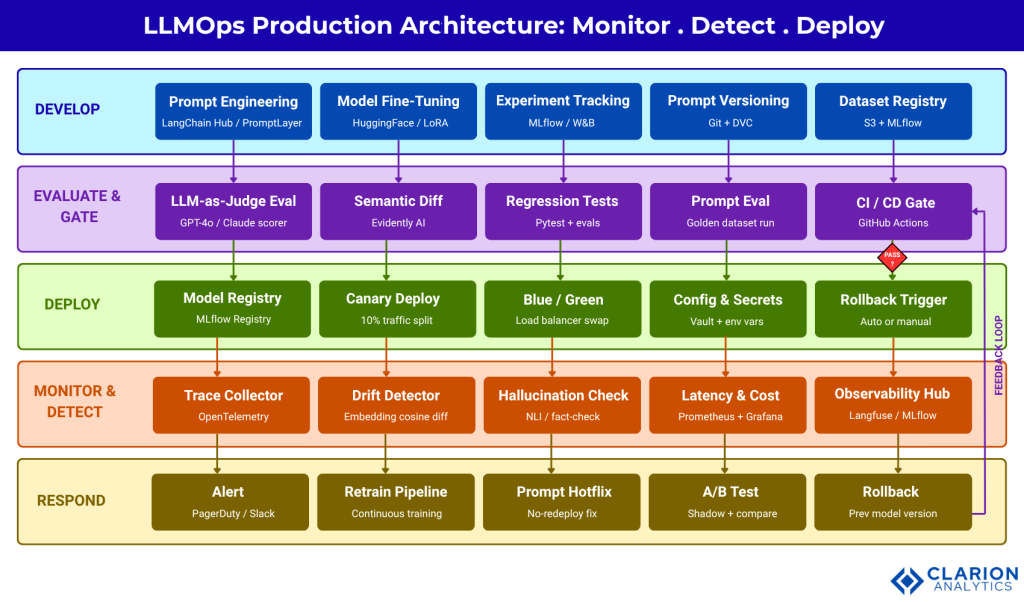
A production LLM monitoring stack needs four layers. Each handles a different failure mode and feeds signals to the next.
Layer 1: Tracing. Every LLM call should emit an OpenTelemetry-compatible trace capturing the prompt, completion, token count, latency, and model version. MLflow (26,000+ GitHub stars, OpenTelemetry-native) and Langfuse (30,000+ GitHub stars, MIT licence, self-hostable; acquired by ClickHouse in January 2026 with no licensing changes) provide this with one-line auto-instrumentation.
Layer 2: Evaluation. Raw traces become useful only through evaluators: semantic similarity scorers, hallucination detectors, and LLM-as-judge pipelines running on sampled production traffic continuously.
Layer 3: Metrics and dashboards. Evaluation scores flow into Prometheus and Grafana. A single low score is noise. A sliding-window average trending down for three days is a signal.
Layer 4: Alerting. Alerts fire when drift scores exceed configurable thresholds, routing to PagerDuty or Slack, or triggering an automated retraining pipeline.
“Smaller models often outperform larger ones on output consistency, making model selection a reliability decision, not just a capability decision.”
Code Example 1: MLflow Auto-Instrumentation for LLM Tracing
Source: mlflow/mlflow, mlflow/tracing.
import mlflow
import openai

mlflow.openai.autolog()
mlflow.set_experiment("production-llm-monitoring")

client = openai.OpenAI()
with mlflow.start_run():
    response = client.chat.completions.create(
        model="gpt-4o",
        messages=[{"role": "user", "content": "Summarize Q3 claims report"}],
    )
    print(response.choices[0].message.content)
    # MLflow auto-logs: prompt, completion, tokens, latency, cost
One call connects every model invocation to the observability layer. Token counts and latency trends appear in the MLflow UI immediately, with no application code changes required.
Drift Detection: From Statistical Tests to Activation Deltas
For input distribution drift, apply KL divergence or Jensen-Shannon distance to embedding representations of incoming prompts. A sustained shift in the embedding cluster centroid signals that user queries have evolved, running in real time with minimal compute overhead.
For output quality drift, compute cosine similarity between production responses and a rolling reference set. Evidently AI (7,000+ GitHub stars) provides 100+ metrics for this pattern and integrates directly with GitHub Actions.
For task drift and prompt injection, Abdelnabi et al. (arXiv:2406.00799, SaTML 2025, Microsoft Research) demonstrated that activation deltas detect model hijacking with no fine-tuning required and near-perfect ROC AUC on an out-of-distribution test set. For any RAG pipeline processing untrusted external content, this method is essential.
“You cannot improve what you cannot measure. In LLMOps, measurement requires purpose-built evaluation infrastructure.”
Wiring CI/CD for Language Model Pipelines
LLM CI/CD differs from standard CI/CD in three fundamental ways: test cases are probabilistic, the build artifact includes prompts and model versions alongside code, and quality gates require LLM-as-judge evaluation runs rather than binary unit test verdicts.
A pull request modifying a prompt triggers a GitHub Actions workflow that runs the prompt against a golden dataset, scores outputs with an LLM-as-judge, and reports the semantic similarity delta versus baseline. If the score falls below threshold, the PR cannot merge. According to OneReach.ai (2025), a basic monitoring stack can be operational in two to four weeks with one dedicated engineer.
“A prompt change with no evaluation run is a silent production risk. If your CI/CD pipeline does not version and test prompts, it is incomplete.”
Code Example 2: Evidently Drift Report as a CI/CD Quality Gate
Source: evidentlyai/evidently, examples/.
from evidently import ColumnMapping
from evidently.report import Report
from evidently.metric_preset import TextOverviewPreset
import pandas as pd

reference = pd.DataFrame({"response": reference_responses, "question": questions})
current   = pd.DataFrame({"response": current_responses,   "question": questions})

column_mapping = ColumnMapping(text_features=["response"])
report = Report(metrics=[TextOverviewPreset()])
report.run(reference_data=reference, current_data=current,
           column_mapping=column_mapping)

# Save HTML report; fail CI if drift score exceeds threshold
report.save_html("llm_drift_report.html")
Evidently’s native GitHub Actions integration runs this report on every push. When scores fall outside acceptable bounds, the pipeline blocks the merge.
MLOps vs LLMOps: What Actually Changes
MLOps manages deterministic models evaluated by accuracy metrics. LLMOps manages probabilistic language models evaluated by semantic similarity and LLM-as-judge scoring. The toolchains overlap; the evaluation philosophy is fundamentally different.
| Dimension | MLOps | LLMOps |
|---|---|---|
| Output type | Deterministic numeric predictions | Probabilistic natural language |
| Eval metric | Accuracy, F1, RMSE, AUC | Semantic similarity, LLM-as-judge, BLEU |
| Drift signal | Feature distribution shift | Prompt, output, concept, activation deltas |
| CI artifact | Model weights + code | Weights + code + prompts + eval datasets |
| Retraining trigger | Accuracy below threshold | Semantic drift, hallucination rate, RLHF signal |
| Key tools | MLflow, Kubeflow, DVC, Seldon | MLflow + Langfuse + Evidently + GitHub Actions |
Most 2026 enterprise teams run both in parallel: classical MLOps for predictive models and a dedicated LLMOps layer for generative features. LLMOps is not a replacement. It is a specialisation.
How Clarion Analytics Can Help
Building an LLMOps stack requires more than open-source tooling. It requires engineering judgment about which monitoring signals matter for your use case, how to instrument a live pipeline without disrupting traffic, and how to design evaluation rubrics aligned to actual business outcomes.
Clarion Analytics builds production-grade LLM systems for enterprise clients across Asia Pacific under a Built, Deployed, Accountable commitment. Their services cover custom RAG pipeline engineering, model fine-tuning with LoRA, agentic workflow design, and production integration with existing enterprise infrastructure.
Their production deployments illustrate why the LLMOps discipline matters in practice. InterPixels AI processes health insurance claims documents at scale, where silent output drift or a hallucinated field value carries direct regulatory and financial consequences, exactly the scenario where drift detection, HITL governance, and audit trails move from optional to essential. VoiceVertex AI handles live inbound and outbound customer calls, where response consistency, latency, and real-time monitoring are not engineering preferences but service commitments. Both represent the class of production LLM applications where the operational practices in this article are not theoretical.
For teams at the planning stage, Clarion Analytics offers an AI Readiness Assessment that maps infrastructure gaps and produces a 12-month roadmap before any build begins.
“LLMOps is not a tool you buy. It is an operational discipline you build, one monitoring signal and one quality gate at a time.”
Frequently Asked Questions
How do I know when my LLM has drifted in production?
Monitor four signals: declining semantic similarity scores versus a reference baseline, rising hallucination rates, increasing latency without query complexity growth, and rising token consumption per session. If any two trend negatively over a seven-day rolling window, you likely have active drift. Route Prometheus alerts on all four to the same incident queue.
What is the difference between MLOps and LLMOps?
MLOps manages deterministic models using ground-truth metrics like accuracy and F1. LLMOps manages probabilistic language models using semantic similarity, human preference, and LLM-as-judge scoring. LLMOps also adds prompt versioning, hallucination monitoring, and RAG pipeline governance as first-class operational concerns.
What tools should I use for LLM monitoring in production?
Start with MLflow for tracing (26,000+ GitHub stars, OpenTelemetry-native) and Langfuse for LLM observability including prompt versioning (30,000+ GitHub stars, MIT licence, now part of ClickHouse). Add Evidently AI for semantic drift reports and CI/CD quality gates (7,000+ GitHub stars, built-in GitHub Actions). Layer Prometheus and Grafana for latency and cost metrics.
How can Clarion Analytics help with LLM deployment and monitoring?
Clarion Analytics provides custom LLM engineering across Asia Pacific, covering RAG pipelines, fine-tuning, and production deployment. Production systems like InterPixels AI, a claims intelligence API for health insurance TPAs, and VoiceVertex AI, an AI receptionist handling inbound and outbound calls, WhatsApp, and SMS, demonstrate their capability to deploy and operate governed LLM systems in live regulated environments. Their AI Readiness Assessment is a structured starting point for teams planning a first LLMOps implementation.
How does Clarion Analytics support production AI in regulated industries?
Clarion Analytics builds AI systems for regulated environments across insurance, financial services, oil and gas, and logistics in Asia Pacific. Deployments operate under data sovereignty requirements and regional compliance constraints. For regulated-sector organizations, this track record matters because LLMOps governance and audit trail requirements are substantially higher than in general commercial deployments.
Conclusion
Three insights matter most. LLM drift is multi-dimensional: prompt, output, and concept drift each need a different detection signal, and monitoring for only one leaves the others invisible. The CI/CD pipeline must treat prompts as first-class artifacts: a prompt change without an evaluation run is a silent risk. The operational foundation does not require a large team to start. A basic tracing, evaluation, and alerting stack can be live in two to four weeks.
The LLMOps market is growing at 21.6% annually because enterprises are discovering that keeping an LLM reliable and aligned over months and years is harder than deploying it. If you are planning an implementation and want an honest assessment of your infrastructure, the Clarion Analytics AI Readiness Assessment is a practical starting point. To speak directly with the team, get in touch here.
About the Author: Shivi

Related Posts


Table of Content
- Why Production AI Fails Without LLMOps
- The Three Forms of LLM Drift You Must Monitor
- Building an LLM Monitoring Stack
- Drift Detection: From Statistical Tests to Activation Deltas
- Wiring CI/CD for Language Model Pipelines
- MLOps vs LLMOps: What Actually Changes
- How Clarion Analytics Can Help
- Frequently Asked Questions
- Conclusion