AI logistics supply chain automation in APAC refers to the deployment of machine learning, computer vision, robotic process automation, and generative AI to optimise demand forecasting, warehouse operations, freight document processing, and route planning across Asia-Pacific networks. It enables operators to reduce logistics costs, lower inventory holdings, and improve service levels without proportionally increasing headcount.
The APAC Cost Pressure That Is Forcing the AI Conversation
Asia Pacific is the fastest-growing region for AI logistics supply chain adoption globally. According to Precedence Research (2026), the APAC region is anticipated to grow at the highest CAGR of approximately 42.5%, faster than any other global region. The business case is not abstract. Early AI adopters are already reporting a 15% reduction in logistics costs, a 35% drop in inventory, and a 65% service level improvement. The operators who have not yet started are not standing still. They are falling further behind.
Three pressure points are specific to APAC. Network complexity: managing 5-15 country markets with different regulatory regimes and carrier ecosystems makes traditional planning obsolete. Document volume: cross-border trade generates enormous quantities of bills of lading and customs declarations, most still processed manually. Fulfillment expectations: platforms like Shopee and TikTok Shop have trained consumers to expect same-day delivery, creating throughput pressure that manual warehouse operations cannot absorb.
AI does not solve all three problems at once. The operators generating the strongest returns start with one use case, prove ROI, and expand. This article maps the four highest-impact applications in APAC logistics, explains the underlying architecture, and gives CXOs a structured framework for deciding where to begin.
APAC operators who delay AI adoption are not standing still. They are falling behind competitors who are already compounding efficiency gains year over year.
Demand Forecasting: Where Machine Learning Delivers the Fastest ROI
ML-based demand forecasting reduces forecast errors by 20-50% and cuts inventory holding costs by 20-30%, according to McKinsey research and Gartner (2024). For APAC operators managing volatile, multi-country demand signals, this is typically the highest-ROI entry point for supply chain automation AI.
Traditional forecasting relies on ARIMA and exponential smoothing. These work well when demand is stable. APAC demand is not stable. Flash sales, regional holidays across 10+ markets, and platform-driven promotions create spikes that statistical models cannot anticipate. CNN-LSTM hybrid models combine convolutional layers for pattern extraction with LSTM layers for temporal context, learning non-linear demand patterns from historical data and external signals simultaneously.
Research from Georgia Tech’s NSF AI4OPT Institute (2025) confirms that combining supervised machine learning with deep reinforcement learning reduces the search space for supply chain planning optimisation problems by an order of magnitude, cutting planning time from hours to minutes. Clarion Analytics applies this class of models to enterprise planning problems, translating research advances into production-grade forecasting pipelines for regional operators.
Code Snippet 1: Exporting a Trained Demand Model for Production Deployment
Source: oneapi-src/demand-forecasting on GitHub (Intel, actively maintained)
# Convert trained Keras demand model to a frozen TensorFlow graph
# for low-latency inference inside an existing TMS or WMS

python src/convert_keras_to_frozen_graph.py \
  -s $OUTPUT_DIR/saved_models/intel \
  -o $OUTPUT_DIR/saved_models/intel/saved_frozen_model.pb

# The frozen graph removes training-only ops and serialises weights,
# enabling the model to run inside any system that can call
# TensorFlow inference without a full training environment.
This step is where most APAC teams stall. Training a model in a notebook is straightforward. Deploying it inside a WMS running on-premise in Bangkok, or a cloud-hosted TMS serving three country operations, requires this frozen-graph export. Once frozen, the model runs as a microservice endpoint, returning demand forecasts in milliseconds without a full ML stack on every deployment server.
In practice, the teams that generate the strongest demand forecasting ROI are not the ones with the best ML models. They are the ones who invest equally in the deployment pipeline.
Warehouse AI in Southeast Asia: From Pilot to Production
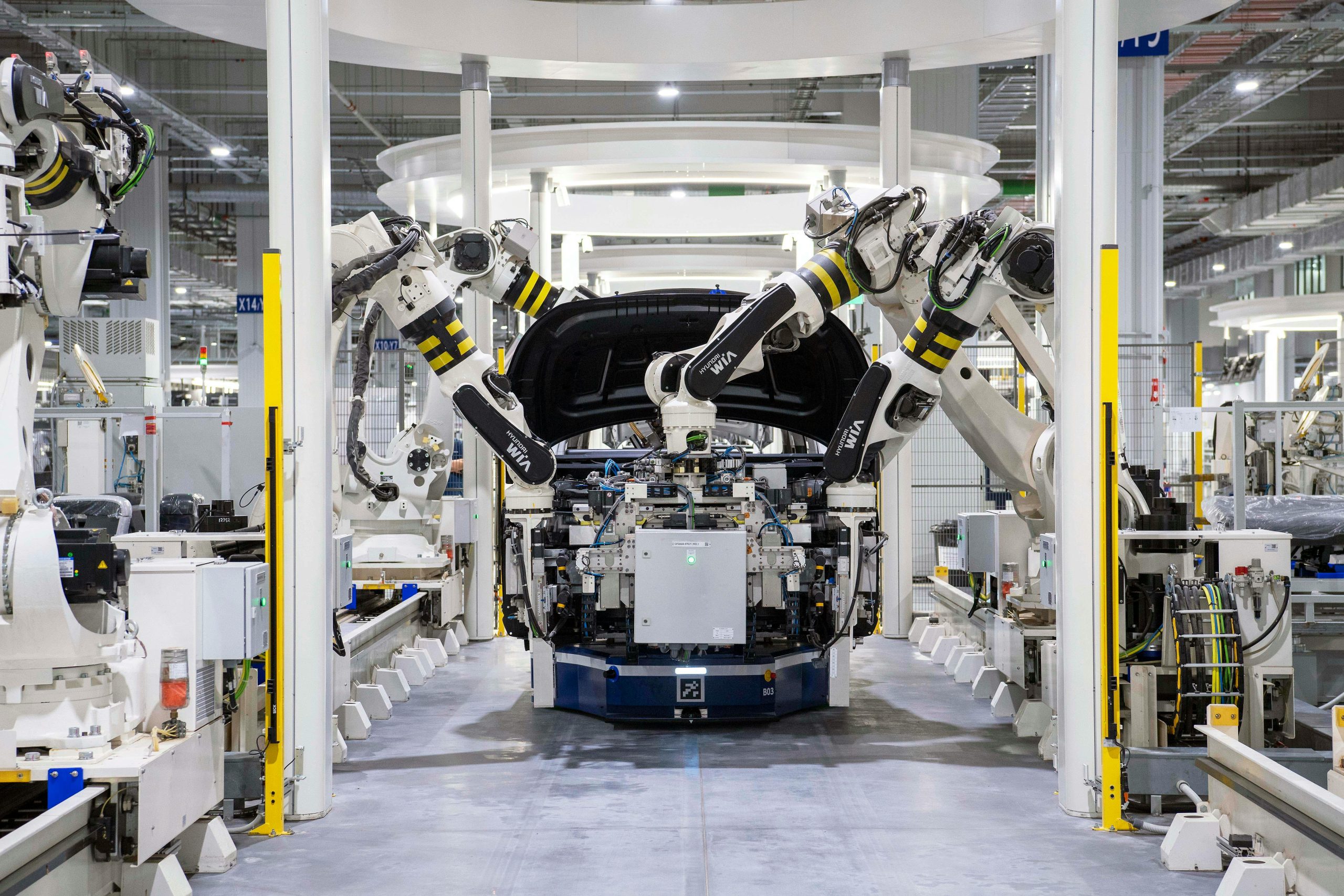
Autonomous mobile robots and AI-enabled vision systems are cutting warehouse labour costs significantly and reducing goods-to-person cycle times in Southeast Asian fulfilment centres. According to Mordor Intelligence (2026), Indonesia’s and the Philippines’ combined e-commerce growth drove 900 autonomous mobile robots into Metro Manila (Philippines) and Jabodetabek (Indonesia) warehouses during 2024-2025, as online retail markets across both countries surpassed a combined USD 76 billion.
Gartner (2024) predicts that 50% of companies with warehouse operations will deploy AI-enabled vision systems by 2027. These systems combine industrial 3D cameras with computer vision software and advanced AI pattern recognition to automate tasks previously dependent on manual inspection, including cycle-counting, safety monitoring, and process anomaly detection.
The warehouses generating the strongest returns are not running robotics in isolation. They are integrating autonomous mobile robot fleets with an AI planning layer that dynamically re-allocates picking tasks based on real-time order priority, congestion, and robot battery state. This closed-loop integration is what separates a 15% efficiency gain from a 50% one.
The warehouses winning in Southeast Asia are not the biggest ones. They are the ones with the tightest integration between their robotics layer and their AI planning layer.
Freight Document AI: Eliminating the Paper Bottleneck in APAC Trade
AI-powered intelligent document processing (IDP) automates extraction from bills of lading, customs declarations, and freight invoices. It eliminates manual entry and cuts customs clearance times. For APAC operators handling multi-language documents across dozens of country formats, IDP delivers some of the fastest payback of any AI investment in logistics.
Most mid-sized businesses in Southeast Asia still process documents manually. Invoices arrive as PDFs or photographs. Forms come as scanned images. The data locked inside must be re-typed before entering a TMS or ERP. A document that takes a human ten minutes to process can delay an entire payment cycle.
Modern IDP goes beyond OCR. As noted in Affinda’s logistics IDP analysis (2026), ML-powered systems pre-trained on logistics documents understand field semantics regardless of layout variation, language, or script, achieving straight-through processing rates of 80-90% even across hundreds of carrier formats. APAC-specific models handle Chinese, Japanese, Korean, Thai, Vietnamese, and Bahasa automatically. Clarion.ai‘s intelligent document processing capabilities extend this model to insurance and financial services document workflows, drawing on the same core NLP and vision architecture that powers freight document automation.
The practical freight forwarder workflow: inbound documents route to the IDP engine, which extracts shipper, consignee, container numbers, HS codes, and declared values, then pushes structured data directly into CargoWise, SAP, or any connected TMS. Human operators review only the flagged exceptions. Teams building this typically find straight-through processing rates improve from around 60-80% with legacy OCR to 95-99% with modern ML-based IDP, with exception rates falling accordingly within six months of training on proprietary document sets.
Route Optimisation and Predictive Disruption Management
AI route optimisation reduces total transportation costs by 10-15% and fuel consumption by up to 20% by analysing thousands of routes against traffic, weather, port congestion, and carrier capacity in real time, according to McKinsey’s supply chain analysis. Peer-reviewed research from Francis Academic Press (2025) demonstrates that AI-based early warning systems can identify high-impact supply chain disruptions with 2-4 weeks of advance notice and 89% accuracy, giving operators a critical window to secure alternative sources or routes.
APAC route complexity is unique. A shipment moving from Guangzhou to Jakarta may transit three carrier networks, two ports, and two customs regimes, with vessel options changing daily based on capacity and congestion. Rule-based routing engines cannot adapt to this dynamism. Reinforcement learning models, trained on historical shipment data including costs, transit times, and disruption events, select optimal routes for routine shipments without human intervention.
Code Snippet 2: Multi-Node Network Cost Optimisation
Source: samirsaci/supply-chain-optimization on GitHub (~960 stars, actively maintained)
from v1.simulator import Simulator
from v1.center import Center
from v1.cost import Cost

with Simulator(title="Total Landed Cost - APAC Network", times=100) as sim:
    @sim.simulate()
    def main():
        dc = Center()
        dc.name = "Singapore Regional DC"
        dc.costs.add(Cost("Labour", sim.normal(mean=500, std=100)))
        dc.costs.add(Cost("Warehousing", sim.normal(mean=300, std=50)))
        dc.costs.add(Cost("Last-mile freight", sim.normal(mean=200, std=40)))
        return dc.total_costs()
This Monte Carlo simulation runs 100 iterations across cost distributions for a single DC node, producing a probability distribution of total landed cost rather than a single spreadsheet estimate. For APAC operators evaluating whether to open a new DC in Bangkok or expand an existing facility in Kuala Lumpur, this probabilistic view is far more decision-useful than fixed-assumption modelling.
The most valuable capability AI delivers in APAC logistics is not speed. It is the lead time to react before a disruption becomes a crisis.
APAC AI Supply Chain Architecture: How the Layers Connect
A production-grade AI logistics stack in APAC has four functional layers: data ingestion (IoT, TMS, WMS feeds), an AI/ML inference layer (forecasting, vision, NLP), a decision automation layer (routing, replenishment, document processing), and an integration layer connecting to ERP and carrier systems.
Research published in the International Journal of Production Research (2024) frames AI supply chain capabilities across six dimensions: learning, perception, prediction, interaction, adaptation, and reasoning. Value compounds when all four stack layers are integrated rather than deployed as isolated point solutions. The ISCCO framework (Li and Chen, 2024) further demonstrates that deep learning applied at the inference layer produces the largest cost reductions when outputs drive automated decisions directly, rather than surfacing as manual dashboard recommendations.
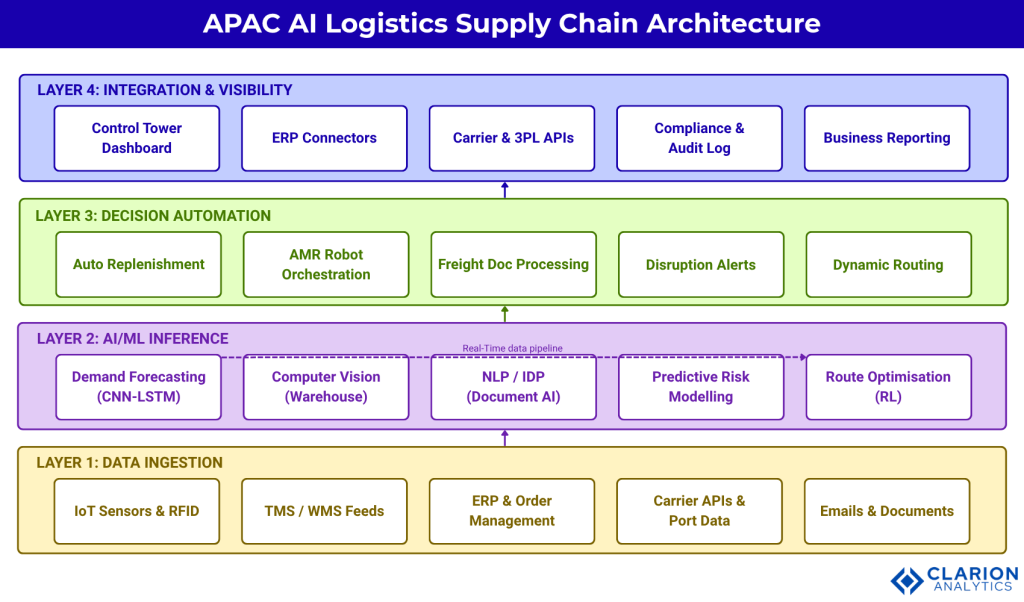
Layer 1 (Data Ingestion) captures IoT sensors, TMS/WMS feeds, carrier APIs, and inbound documents. Layer 2 (AI/ML Inference) runs demand forecasting, computer vision, NLP, and route optimisation models. Layer 3 (Decision Automation) converts model outputs into replenishment orders, robot task assignments, document routing, and dynamic carrier selection. Layer 4 (Integration and Visibility) connects outputs to ERP systems and surfaces a unified control tower view. Data flows upward in real time, with the ML inference layer updating continuously as new signals arrive.
Choosing Your AI Implementation Approach
The right model depends on your data maturity, internal capability, and network complexity.
| Option | Key Strength | Best Used When |
|---|---|---|
| Point Solution (single-use-case AI tool) | Fast deployment, measurable quick wins in 60-90 days, low integration risk | Starting the AI journey; tight budget; one dominant pain point such as forecast errors or document backlogs |
| Platform Approach (Blue Yonder, o9, Kinaxis) | Pre-integrated modules, vendor support, rapid multi-country scaling | Mid-to-large enterprise with existing ERP and a multi-country APAC network needing end-to-end coverage |
| Custom ML Build (open-source plus cloud) | Full control, maximum fit to proprietary data, lowest long-run cost at scale | Operators with internal data science capability, unique network complexity, or proprietary data assets |
AI does not replace good supply chain judgment. It accelerates it, giving operators the clarity to act before problems compound.
Frequently Asked Questions
How much can AI reduce logistics costs in APAC?
Early AI adopters are reporting logistics cost reductions of 10-15% on average, with top performers achieving more through combined demand forecasting, route optimisation, and warehouse automation. McKinsey research documents logistics cost reductions of up to 15% and inventory level reductions of 20-35% among AI-adopting supply chain organisations, alongside a 65% improvement in service levels.
What is the best AI use case to start with in supply chain?
Demand forecasting consistently delivers the fastest ROI, reducing inventory holding costs and stockout losses with measurable impact within 60-90 days of deployment. Most APAC operators start here before expanding to warehouse AI or freight document automation, as cleaner demand data improves the performance of every downstream AI system.
How does freight document AI work?
Freight document AI uses intelligent document processing (IDP), combining ML models pre-trained on logistics documents with OCR to extract structured data from bills of lading, customs declarations, and freight invoices, regardless of format, language, or layout variation. Extracted data pushes directly into TMS or ERP systems, eliminating manual entry. Modern IDP platforms achieve accuracy rates above 98%, reducing exceptions to a fraction of legacy OCR rates.
What AI tools are warehouse operators in Southeast Asia deploying?
Operators across Indonesia, the Philippines, Vietnam, and Thailand are deploying autonomous mobile robot fleets alongside AI-powered slotting, order-batching, and computer vision quality-inspection systems. The platforms achieving the strongest results integrate their AMR orchestration layer with real-time demand signals, rather than running robotics as a standalone productivity tool. According to Mordor Intelligence (2026), 900 AMRs were deployed across Metro Manila and Jabodetabek warehouses during 2024-2025.
How do I integrate AI with my existing TMS or WMS?
Modern TMS and WMS platforms expose REST APIs that allow AI model outputs to push recommendations back into planning workflows. For legacy systems, a middleware integration layer connects the AI inference service via ETL pipelines. Teams building this typically start with a read-only integration to capture historical data for model training before enabling write-back of AI-generated replenishment orders or routing decisions.
How does Clarion.ai help with supply chain document processing?
Clarion.ai’s intelligent document processing platform applies the same NLP and computer vision architecture that powers freight document automation to enterprise-grade document workflows. For supply chain operators, this means automated extraction from bills of lading, freight invoices, and customs documents, with structured output pushed directly into connected TMS or ERP systems. Learn more at clarion.ai.
Can Clarion Analytics help with demand forecasting across APAC markets?
Clarion Analytics applies enterprise AI to structured and unstructured data at scale, making it applicable to multi-country demand signal processing across APAC markets. Operators with fragmented data across regional ERP instances, carrier APIs, and marketplace platforms can use Clarion.ai to unify that data and feed production-grade ML forecasting pipelines built on the same CNN-LSTM and reinforcement learning architectures described in this article.
What makes Clarion.ai different from generic AI platforms for supply chain use cases?
Clarion.ai is purpose-built for enterprise data complexity, not general-purpose text generation. Its models are designed to handle the structured, semi-structured, and document-heavy data that defines supply chain operations, including freight documents, claims records, and multi-language trade data across APAC markets. This makes it a faster path to production deployment than configuring a general LLM for logistics-specific workflows.
How Clarion.ai Can Help
APAC supply chain operators face a specific challenge: their data is fragmented across regional ERP systems, carrier APIs, freight portals, and paper-based document flows. Clarion.ai’s enterprise AI platform is built for exactly this environment. It applies intelligent document processing to automate extraction from bills of lading, freight invoices, and customs declarations. It connects structured and unstructured data across multi-country operations into unified pipelines that feed demand forecasting and operational decision-making. For operators looking to move from pilot to production without rebuilding their entire technology stack, Clarion Analytics provides the integration layer, the document intelligence, and the data processing capability that make AI actionable in complex APAC logistics networks. Contact the Clarion.ai team to discuss your supply chain AI use case.
Further Resources
If your supply chain operations include healthcare or insurance claims workflows, Interpixels.ai applies AI to health insurance claims intelligence across APAC, automating adjudication and fraud detection in the same document-heavy, multi-language environments that characterise cross-border logistics. Its claims processing architecture directly parallels the freight document AI use case covered in this article.
For supply chain operators exploring AI-powered voice interfaces for warehouse operations, driver communication, or customer-facing fulfilment updates, Voicevertex.ai delivers voice AI solutions designed for the operational and linguistic complexity of APAC markets, complementing the warehouse AI and last-mile optimisation strategies discussed here.
Three Things Every APAC Supply Chain Leader Should Do Next
The evidence for AI in APAC logistics is no longer theoretical. Operators across Southeast Asia are generating double-digit cost reductions from demand forecasting ML, warehouse automation, freight document AI, and intelligent route planning. According to Gartner (2024), high-performing supply chain organisations use AI and ML at more than twice the rate of their lower-performing peers. That gap is widening, not closing.
Three priorities matter most for APAC CXOs deciding where to move. First, audit your data before selecting a use case. AI models are only as good as the data they train on. A demand forecasting model trained on incomplete historical data will underperform a simpler statistical model. Data readiness should precede vendor selection. Second, start with one use case and instrument it precisely. The operators generating the strongest ROI run one AI application rigorously, measure it, and scale before adding the next. Third, plan the integration architecture before writing the first line of model code. The API endpoint, the frozen-graph export, the ERP write-back: these decisions determine whether AI drives operational decisions or stays in a sandbox.
AI will transform APAC logistics. The question is whether your organisation will be a beneficiary of that transformation or a casualty of it.
About the Author: Shivi

Related Posts