
The MERN stack is a full-JavaScript development framework combining MongoDB (NoSQL database), Express.js (Node.js web framework), React (UI library), and Node.js (server runtime). Together, these four layers enable teams to build, deploy, and scale dynamic web applications using a single programming language across the entire stack, from client interface to server logic to database.
Why MERN Stack Scalability Is Now a Business Imperative
The MERN stack’s scalability comes from MongoDB’s horizontal sharding, Node.js’s non-blocking I/O model, and React’s virtual DOM, but only when each layer is deliberately architected, not assembled by default. JavaScript continues to dominate the developer landscape: according to Stack Overflow’s 2024 Developer Survey of over 65,000 developers, JavaScript remains the most-used programming language for the 12th consecutive year (62.3%), Node.js leads as the top web technology, and React holds the top framework spot. The ecosystem is not shrinking — it is consolidating.
For engineering teams and CTOs, that consolidation carries a practical message: you can build fast with MERN, but fast alone does not scale. McKinsey’s Developer Velocity research identifies best-in-class tooling as the single top contributor to software business performance, yet only 5% of executives rank it among their top-three enablers. The teams winning with MERN are the ones that treat architecture as a first-class investment, not an afterthought.
Gartner (2024) predicts that by 2026, 80% of large software engineering organisations will establish platform engineering teams. MERN’s composability, swapping MongoDB Atlas for serverless, adding Redis, wrapping services in Docker, makes it an ideal foundation for that kind of structured, observable platform.
“Best-in-class tooling is the top contributor to software business performance yet only 5% of executives rank it among their top-three software enablers.” ~McKinsey Developer Velocity Index
Structure Your Project for Scale Before You Write a Line of Code
A scalable MERN project separates concerns into /client, /server/routes, /server/controllers, /server/models, and /server/middleware directories, mirroring MVC principles and making the codebase navigable for teams of any size.
In practice, teams building MERN applications typically find that the biggest friction point at scale is not performance; it is cognitive load. When a developer has to hunt through a monolithic server.js file to understand where a route is handled, how authentication is applied, and where validation occurs, onboarding slows to a crawl and bugs multiply.
The solution is consistent directory structure enforced from day one. The pattern below, drawn from Brad Traversy’s production-referenced repository for ProShop v2, is a widely adopted baseline:
Source: bradtraversy/proshop-v2 – backend/server.js GitHub: https://github.com/bradtraversy/proshop-v2/blob/master/backend/server.js
This pattern demonstrates three non-negotiable practices: ESM imports keep the server modern and tree-shakeable; dotenv loads before database connection; and error middleware always loads last. Each route group lives in its own file; when the user service needs a rewrite, no other routes are affected.
MongoDB Optimisation – Indexes, Schemas, and Aggregation Pipelines
Always define MongoDB indexes on fields used in find() queries and avoid deeply nested document structures; these two changes alone can reduce query time by orders of magnitude as data volume grows.
MongoDB’s flexibility is both its greatest strength and its most common trap. Teams model schemas to match their application’s current shape, then discover that a single find() on an unindexed field performs a full collection scan. At 10,000 documents, that is imperceptible. At 10 million, it becomes a production incident. According to research on scalable MERN architecture, MongoDB’s sharding capabilities distribute data across clusters — but only if you plan the sharding strategy before data volume forces your hand.
Three optimisation rules experienced MERN teams apply consistently:
- Index every field that appears in a query filter, sort, or join (use MongoDB’s
explain()to verify index usage before deploying). - Avoid nesting documents more than two levels deep. Flatten frequently-queried sub-documents into top-level fields or separate collections.
- Use aggregation pipelines for complex data transformations instead of multiple round-trip queries. A well-crafted pipeline runs server-side and returns only what the application needs.
“MongoDB’s sharding capabilities are a game-changer for scale, but only if you plan the strategy before data volume forces your hand.”
Secure Your MERN Stack at Every Layer
MERN stack security requires four parallel tracks: MongoDB role-based access control and schema validation, Express middleware for rate limiting and CSRF protection, React input sanitisation against XSS, and Node.js dependency auditing.
Security is where MERN projects most often accumulate debt. According to a 2024 Master’s thesis on MERN security best practices (JAMK University of Applied Sciences), authentication, authorisation, and data protection are the three critical security domains, and all three require simultaneous attention; patching one while ignoring the others leaves the application exposed.
A 2024 JETIR academic paper on MERN security proposes a layered approach: MongoDB requires strong authentication with role-based access control and schema validation; Express applications need rate limiting (via express-rate-limit), CORS headers locked to known origins, and Helmet.js for HTTP security headers; React inputs must be sanitised using DOMPurify before rendering; and Node.js dependency trees must be audited regularly using npm audit.
Source: nemanjam/mern-boilerplate – server/middleware/auth.js GitHub: https://github.com/nemanjam/mern-boilerplate/tree/master/server
This middleware pattern extracting the JWT from the Authorization Bearer header and validating it against the database on each request, ensures that revoked tokens cannot be replayed. Combined with short expiry times (15–30 minutes for access tokens) and a Redis-backed refresh token store, this pattern handles the majority of authentication attack vectors.
“Security debt in MERN is compound interest, every unvalidated input, every exposed endpoint, and every unsanitised environment variable accrues interest until the breach.”
Performance Patterns – Caching, State Management, and React Optimisation
Introducing Redis as a caching layer in front of MongoDB can reduce database calls by 60–80% for high-read applications, allowing the same MERN infrastructure to handle significantly higher concurrency without hardware scaling.
Teams building this typically find that their first performance bottleneck is not the Node.js server; it is MongoDB response time. Every API call that fetches the same product catalogue, user permissions, or configuration data creates repeated database load. Redis solves this with sub-millisecond in-memory lookups.
Three React patterns make the largest impact on perceived performance:
- Code splitting:
React.lazy()andSuspensedefer component loading until the route is visited. For a large dashboard application, this reduces initial bundle size by 40–60%. - Memoisation:
React.memo()anduseMemo()prevent unnecessary re-renders when parent state changes do not affect a child’s props. - React Server Components (RSC): Available in frameworks like Next.js, RSCs move data-fetching to the server, eliminating client-side waterfalls and reducing JavaScript payload sent to the browser.
Production Architecture Reference
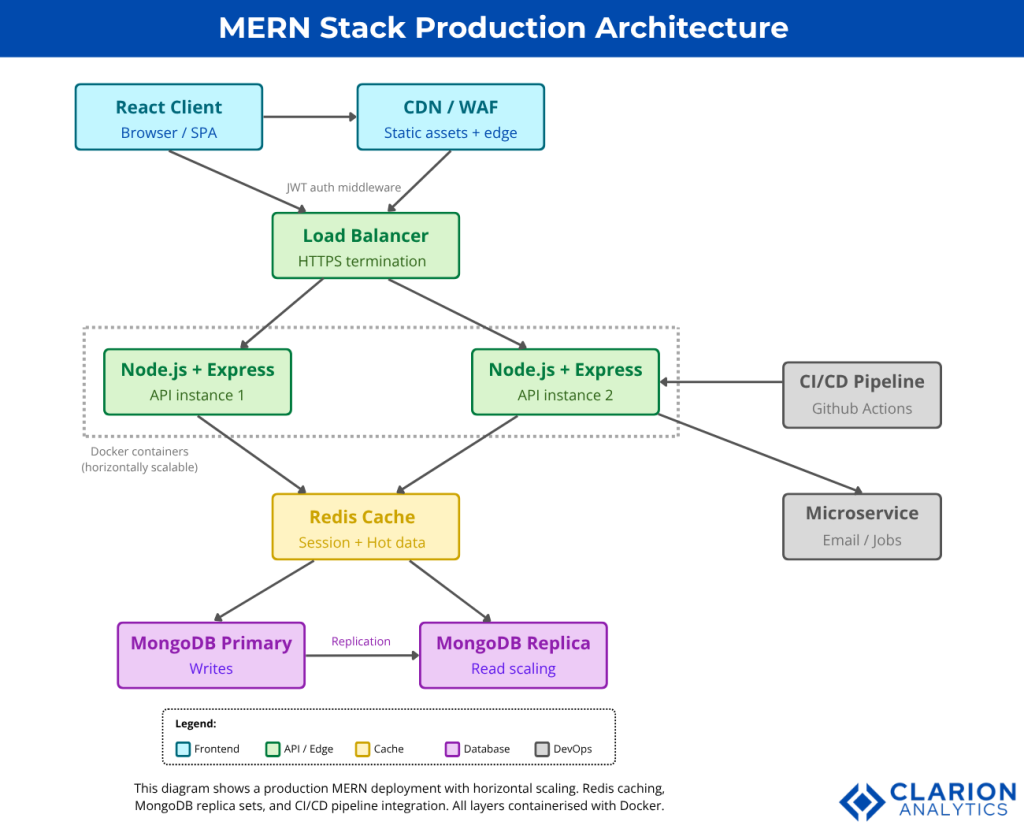
The architecture diagram illustrates a production MERN deployment: the React client communicates through a CDN/WAF to a load balancer, which distributes traffic across horizontally-scaled Node.js/Express API instances running in Docker containers. Those containers read from Redis cache first; cache misses flow through to MongoDB (primary for writes, replica set for read scaling). A CI/CD pipeline automates testing and deployment, and a microservice handles background tasks independently.
CI/CD, Containerisation, and Deployment Best Practices
Containerise your MERN application with Docker, define separate Dockerfiles for the client and server, and wire GitHub Actions or GitLab CI to run tests and push to your registry; this pipeline reduces deployment friction and catches regressions before they reach production.
According to Gartner’s 2024 Emerging Technology Hype Cycle, cloud-native architecture and GitOps are among the key enablers of developer productivity. For MERN teams, this translates to three concrete practices:
- Dockerise the server and client with multi-stage builds (build stage compiles assets, runtime stage serves only the output, reducing image size by 60–70%).
- Use Docker Compose for local development to ensure every team member runs the same MongoDB, Redis, and Node.js versions.
- Wire GitHub Actions to run linting, unit tests, and integration tests on every pull request, blocking merges on failure.
Deployment Approach Comparison
| Deployment Approach | Key Strength | Best Used When |
|---|---|---|
| Traditional VPS (PM2) | Full control, low cost | Small teams, predictable traffic, limited DevOps budget |
| Docker + Compose | Reproducible environments, local/prod parity | Teams adopting containerisation, multi-service MERN apps |
| Kubernetes (EKS/GKE) | Auto-scaling, self-healing, zero-downtime deploys | High-traffic production apps, microservices, enterprise scale |
| Serverless (AWS Lambda) | No server management, cost scales with usage | Irregular traffic spikes, background tasks, MVP-stage apps |
“A single language from browser to database eliminates the context-switching tax, but only teams that apply deliberate architecture patterns actually capture that productivity gain.”
Frequently Asked Questions
What is the best folder structure for a scalable MERN stack app?
Separate concerns into five top-level directories under /server: routes (URL handlers), controllers (business logic), models (Mongoose schemas), middleware (auth, validation, error handling), and config (DB connection, environment). The React client lives in /client with its own components, pages, hooks, and store directories. This structure lets teams onboard new developers without code archaeology.
How do I secure JWT authentication in a MERN stack application?
Generate access tokens with short expiry (15–30 minutes) using a strong secret stored in environment variables, never in source code. Store the secret in a secure vault (AWS Secrets Manager or similar). Validate tokens in an Express middleware using passport-jwt or jsonwebtoken. For session persistence, issue a long-lived refresh token stored in an HttpOnly cookie, backed by Redis for revocation capability.
When should I use Redis with a MERN stack?
Introduce Redis when your application serves the same MongoDB query results repeatedly, product catalogues, user permissions, configuration data, or session tokens. A good heuristic: if a query runs more than 100 times per minute and the result changes less than once per minute, it is a caching candidate.
Is MERN stack good for large enterprise applications?
Yes, with the right architectural decisions. Enterprise MERN applications typically adopt a microservices pattern, MongoDB Atlas for managed horizontal scaling, Redux Toolkit or React Query for predictable client state, TypeScript across the full stack for type safety, and Kubernetes for container orchestration.
How do I deploy a MERN stack app to production?
Package the Node.js server and React build in Docker containers using multi-stage Dockerfiles. Deploy to a managed Kubernetes cluster (EKS, GKE, or AKS) or use Docker Compose on a VPS behind a reverse proxy (Nginx or Caddy). Wire a CI/CD pipeline to automate the build-test-deploy cycle on every merge to main. Point environment variables to managed secrets, never bake credentials into container images.
Three Principles That Separate Production-Grade MERN Apps
Every scalable MERN application rests on three non-negotiable foundations. First, structure before speed: folder conventions, MVC separation, and documented API contracts cost nothing at the start but save thousands of hours at scale. Second, security is layered: each of the four MERN components has its own attack surface, and patching one without addressing the others leaves the application exposed. Third, observe everything: logging, metrics, distributed tracing, and CI/CD pipelines turn a black-box application into a system engineering teams can actually operate.
The question worth sitting with: is your current MERN application structured so that the developer who joins your team next month can understand, extend, and deploy it safely without you in the room?
About the Author: Imran Akthar

Table of Content
- Why MERN Stack Scalability Is Now a Business Imperative
- Structure Your Project for Scale Before You Write a Line of Code
- MongoDB Optimisation – Indexes, Schemas, and Aggregation Pipelines
- Secure Your MERN Stack at Every Layer
- Performance Patterns – Caching, State Management, and React Optimisation
- CI/CD, Containerisation, and Deployment Best Practices
- Frequently Asked Questions
- Three Principles That Separate Production-Grade MERN Apps
