
AI for telecom in APAC applies machine learning to two connected problems: predicting which customers will leave and predicting which parts of the network will fail. When churn models and network analytics share the same data foundation, telecom CIOs can act on the root cause of attrition instead of chasing symptoms after a customer has already decided to switch providers.
Why This Matters Now
The Asia Pacific AI in IT and telecom market is projected to grow from US$16.5 billion in 2025 to US$287.8 billion by 2034, a 38.1% compound annual growth rate from 2026 to 2034 (The Insight Partners, 2026). AI for telecom APAC is no longer an experimental line item. It is becoming the operating model for how operators plan networks and retain customers across fragmented markets like India, Indonesia, Malaysia, Singapore, Thailand, and the Philippines.
Deloitte found that 43% of Asia Pacific employees are already using generative AI at work, with Southeast Asia ranking second of nine regions surveyed (Deloitte, 2024). That adoption curve is now reaching core operations, not just productivity tools. McKinsey’s telco AI research shows that operators who commit to a sustained, CEO-led AI transformation can lift ROIC and EBITDA margin by up to ten percentage points within five years. That is a meaningful number for any CIO building next year’s budget case. But the gap between potential and reality is still wide. TM Forum found that while 64% of Asian telcos have a clear AI vision, 86% cite the ability to recruit and retain the right AI skills as their top concern, ahead of the cost of deploying AI at scale.
Churn prediction AI telecommunications and network analytics AI are usually built as separate initiatives, and that separation is exactly why so many programs underperform their business case.
Where Churn Prediction Actually Breaks Down
Most churn models answer the wrong question well. They tell you who is likely to leave, ranked by probability, using billing history and usage patterns. What they rarely tell you is why, and specifically whether the reason traces back to a network problem the operator could have fixed.
In practice, teams building churn models discover that network quality signals, dropped calls, latency spikes, congestion on specific cell sites, are some of the strongest predictors of attrition, yet those signals often live in a completely separate OSS system that the customer analytics team never touches. Preprint research backs this pattern, though it has not yet gone through peer review. A 2024 study on adaptive ensemble learning combined XGBoost, LightGBM, LSTM, a neural network, and SVM into a stacked model and reported 99.28% accuracy across three public telecom churn datasets (Shaikhsurab & Magadum, 2024). A separate 2025 study built a deep neural architecture for churn prediction with an explicit focus on keeping the model’s output interpretable enough to explain which factors drove a given customer’s attrition risk (Chen et al., 2025). High accuracy on historical data is achievable. The harder problem is making the model’s output actionable, and explainable, before the customer calls to cancel.
A churn score without a root cause is a countdown timer, not an intervention plan.
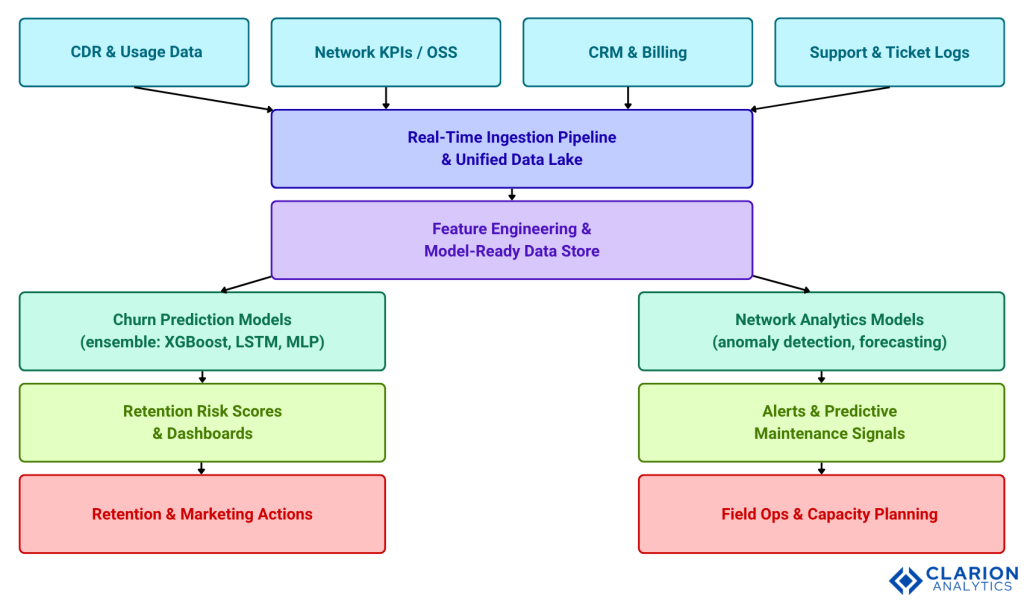
Solving that means feeding the same feature store with both customer-facing data and network telemetry, so a spike in predicted churn in a particular postal code can be cross-referenced against a degraded cell tower in that same area.
Network Analytics Is Moving From Reactive to Predictive
Traditional network operations centers still work largely on thresholds. A metric crosses a line, an alert fires, someone investigates. That approach catches problems after they have already degraded service.
AI-driven network analytics changes the sequence. Instead of waiting for a metric to breach a fixed threshold, models learn the normal seasonal and daily rhythm of network behavior and flag deviations before they become outages. Microsoft’s open-source SR-CNN implementation is a useful reference point here. It combines a Spectral Residual transform with a convolutional neural network to score how anomalous each point in a time series is, without requiring hand-tuned rules for every metric.
Researchers from CESNET published a peer-reviewed 2025 dataset built from 40 weeks of traffic across 275,000 active IP addresses on a real ISP network, specifically because most published anomaly detection benchmarks overstate real-world performance (Koumar et al., 2025). That is a useful caution for any CIO evaluating vendor claims. A model that performs well on a clean academic dataset does not automatically perform well on the noisy, regionally inconsistent data coming out of a multi-country APAC network footprint.
The value of network analytics AI is not in catching one incident. It is in shrinking the time between degradation and detection across thousands of cell sites at once.
System Architecture for Combined Churn and Network Intelligence
Key Technologies and Tools
CIOs evaluating this space are typically choosing across three layers: data infrastructure, model training frameworks, and the operational tooling that turns predictions into actions.
For data infrastructure, most APAC telcos are consolidating CDR, OSS, CRM, and support data into a unified lake before any modeling begins, because siloed data is the single biggest reason combined churn and network models fail to ship. For model training, gradient boosting frameworks like XGBoost and LightGBM remain the workhorses for churn, often stacked with LSTM or MLP layers for sequence-sensitive behavior. For network analytics, time-series specific approaches, including spectral residual methods and autoencoder-based anomaly detection, are becoming the default over static threshold rules.
# Source: microsoft/anomalydetector, main.py
# https://github.com/microsoft/anomalydetector/blob/master/main.py
# (instantiates the SpectralResidual class defined in msanomalydetector/spectral_residual.py)

detector = SpectralResidual(
    series=series,
    threshold=threshold,
    mag_window=mag_window,
    score_window=score_window,
    sensitivity=sensitivity,
    detect_mode=detect_mode
)
anomaly_frame = detector.detect()
This snippet shows how little code is required to turn a raw network KPI stream into an anomaly score. The SpectralResidual class handles the signal processing internally, so a data science team can apply it to dozens of KPI streams, like latency, packet loss, and signal strength, without writing a custom detector for each one. That reusability matters for operators managing network infrastructure across six or more national markets with different data conventions.
Comparison of Approaches
| Option | Key Strength | Best Used When |
|---|---|---|
| Gradient boosting ensembles (XGBoost, LightGBM) for churn | High accuracy on structured billing and usage data, fast to train and retrain | Data science teams need explainable, production-ready churn scores quickly |
| Deep sequence models (LSTM, MLP) layered into churn ensembles | Captures time-dependent behavior patterns static models miss | Customer behavior is highly seasonal or usage patterns shift over months |
| Spectral Residual and autoencoder-based network anomaly detection | Detects deviations from normal network rhythm without manual thresholds | Network teams manage thousands of cell sites and cannot maintain rule sets manually |
Implementation Guidance for CIOs
Start with the data foundation, not the model. Teams building this typically find that the model selection debate consumes far less time than actually getting network telemetry and customer data into a joined, queryable state. Until that is solved, even a highly accurate churn model in isolation cannot explain its own predictions.
Sequence the rollout by market maturity. A single AI playbook rarely works cleanly across India, Indonesia, Malaysia, Singapore, Thailand, and the Philippines at once, given how different their data infrastructure and regulatory environments are. Bain’s Southeast Asia research argues that CEOs need an outside-in view of where AI actually reshapes the business, rather than adopting AI uniformly across every market at the same pace (Bain & Company, 2025).
Plan for the talent gap explicitly. TM Forum’s research on Asian operators found that 86% of respondents cite recruiting and retaining the right AI skills as a top concern, just ahead of the cost of deployment at 80%. Budgeting for the model is only part of the plan. Budgeting for the people who maintain it matters just as much.
The operators pulling ahead are the ones who treat churn prediction and network analytics as one connected system, not two separate reporting lines.
Frequently Asked Questions
What is AI for telecom in APAC? AI for telecom in APAC refers to machine learning systems that telecom operators across the Asia-Pacific region use to predict customer churn, detect network anomalies, and optimize operations. It typically combines customer data with network telemetry to connect service quality issues to customer retention outcomes.
How does churn prediction AI work in telecommunications? Churn prediction models analyze usage patterns, billing history, support interactions, and increasingly network quality data to score how likely a customer is to leave. Ensemble methods combining gradient boosting and neural networks currently report the highest accuracy in published preprint research on public telecom datasets, though these results have not yet been peer-reviewed.
What is network analytics AI used for in telecom? Network analytics AI monitors KPIs like latency, packet loss, and signal strength to detect anomalies before they cause outages. It replaces static threshold alerts with models that learn a network’s normal seasonal and daily behavior patterns.
Why do telecom AI programs in Southeast Asia struggle to scale? Research from TM Forum and Bain points to two consistent barriers: difficulty recruiting and retaining skilled AI talent, and fragmented data infrastructure across markets with different regulatory and digital maturity levels. Technology is rarely the limiting factor.
Should churn prediction and network analytics be built as separate systems? No. Building them on a shared data foundation lets retention teams trace churn spikes back to specific network issues, which turns a churn score into an actionable intervention instead of just a warning.
Conclusion
AI for telecom APAC works best when churn prediction and network analytics stop operating as separate initiatives. The market is growing fast, the accuracy of individual models has improved dramatically, and the region’s telcos report a clearer AI vision than much of the rest of the world. What is still missing at most operators is the shared data foundation that lets a churn score point back to its network cause. CIOs who close that gap first will be the ones who turn AI spend into retained revenue rather than another dashboard nobody acts on.
What would it take for your churn and network teams to work off the same data this quarter?
About the Author: Shivi

