
Most enterprise buyers sign an AI contract after a sales process that never mentioned who owns the data the system produces. The demo covered accuracy, integration and uptime. The contract covers something else entirely.
AI vendor contract data rights fall into six categories, and each one moves commercial risk from the vendor to you. Three of those categories rarely come up in sales conversations. This article walks through all six, shows where the risk sits, and gives you the questions to ask your vendor before signature. Your General Counsel, Head of Procurement and CIO can use it as a working review framework.

Training Rights and Output Ownership
Two clauses decide who benefits from your data after deployment: the training rights clause and the output ownership clause. Vendors often reserve the right to train models on your inputs and to own whatever the system generates from them. Neither point usually surfaces in a sales call.
Training rights come first. A clause permitting the vendor to use customer data to improve its services can cover your claims files, call recordings and customer records. Once a model learns from that data, deletion cannot reverse it.
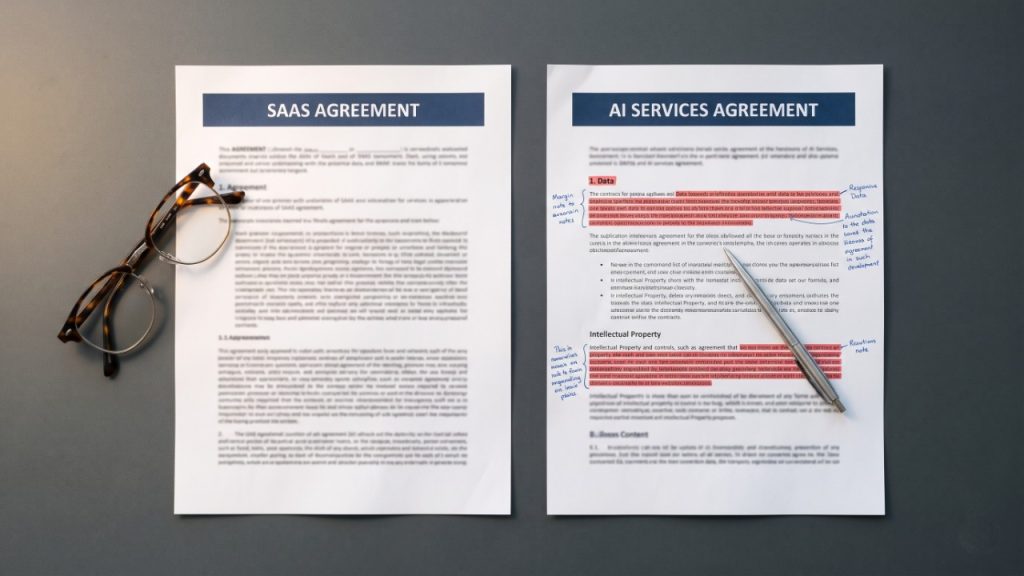
The second clause covers derived data, meaning scores, embeddings, annotations and model weights created from your inputs. Contracts frequently assign ownership of derived data to the vendor. In contract reviews conducted for financial services clients, I found derived data defined so broadly that it captured the client’s risk scores.
Ask for written confirmation that your data is excluded from training and that you own every output.
AI Vendor Contract Data Rights on Residency and Sub-Processors
Data residency and sub-processor clauses determine where your data physically sits and who else touches it. Vendors usually state a hosting region but reserve the right to change it, and to add sub-processors with notice only. That gap exposes you to regulatory breach without any vendor misconduct.
Regulators hold you accountable for data your vendor moves. The Singapore Personal Data Protection Act places transfer obligations on the organisation, whatever the vendor’s hosting arrangements say. The MAS Technology Risk Management Guidelines expect financial institutions to keep oversight of third-party technology providers.
Across enterprise procurement engagements, I find that sub-processor lists change after signature far more often than buyers expect. Negotiate a fixed hosting region, advance notice of any sub-processor change and a right to object. Without that, a vendor can move your data and still comply with its own contract. Strong AI vendor contract data rights on residency give your compliance team something enforceable.
Liability Caps, Indemnity and Audit Rights
Liability and audit clauses decide what you recover after a data incident and whether you can verify vendor behaviour beforehand. Many vendors cap liability at annual fees, exclude data breaches from indemnity and limit audit access to summary reports. Those terms leave you carrying the largest exposure.
A cap set at twelve months of fees bears no relation to the cost of a regulatory investigation or a customer data leak. Seek a separate, higher cap for data breach and confidentiality claims. Add a fixed breach notification window measured in hours, not days.
In contract reviews conducted for insurance clients, audit clauses usually granted a questionnaire, never an inspection. Audit rights anchor AI vendor contract data rights, because you cannot enforce what you cannot inspect. Request on-site or third-party audit rights, with the vendor bearing costs where findings show breach. Our AI vendor procurement checklist lists the audit and indemnity terms to demand.
Deletion, Portability and Exit
Exit clauses determine whether you can leave a vendor with your data intact and your operations running. Vendors often promise deletion on termination without defining timing, scope or proof. They rarely address returning your data in usable form or removing it from backups and models.
Exit terms are the third category vendors avoid in sales conversations, and they create lock-in. Specify deletion within a defined period, written certification of deletion and export in an open, documented format. Clarify whether trained model components built on your data survive termination. Our guide to AI governance APAC requirements shows where regulators expect exit controls.
Exit planning belongs in the build vs buy AI decision, not after signature. Buyers who treat portability as a core requirement keep negotiating power throughout the contract term. Our guidance on responsible AI deployment covers the governance controls that make exit enforceable. Weak AI vendor contract data rights on exit become expensive only when you try to leave.
Six clauses carry the commercial risk in AI contracts: training rights, output ownership, residency, liability, audit and exit. Three of them, training rights, output ownership and exit, rarely reach the sales conversation. Procurement teams that raise them early negotiate from a position of knowledge. Teams that raise them late negotiate from a position of sunk cost.
Clarion Analytics builds, deploys and stands accountable for its systems. Review yours against these six categories before you sign.
If you want to discuss this further, contact Clarion Analytics
Frequently Asked Questions
What data rights should an AI vendor contract cover?
An AI vendor contract should cover six data rights. They are training use, output ownership, hosting and sub-processors, liability, audit access, and exit terms. Each clause allocates risk, so each needs explicit written terms, and an omission leaves the risk with you. Vendors raise only some of these voluntarily, so buyers must raise the rest.
Can an AI vendor use my data to train its models?
Yes, unless the contract prohibits it. Many AI vendor agreements include broad clauses permitting use of customer data to improve services, and that language can cover training. Once a model has learned from your data, deletion cannot reverse it. Negotiate an explicit exclusion from training and require written confirmation that no subcontractor trains on your data.
Who owns the outputs an AI system generates from my data?
Ownership depends entirely on the contract. Vendors commonly retain rights to derived data such as scores, embeddings and model weights, and some definitions extend to the outputs themselves. Buyers should require ownership of all outputs and either assignment of derived data or a ban on vendor reuse. Silence defaults to vendor terms.
Why does data residency matter in an AI vendor contract?
Residency determines which laws and regulators apply to your data. Under Singapore’s PDPA and MAS expectations on outsourced technology, the buyer stays accountable for data its vendor transfers or stores. Contracts should fix the hosting region and require advance notice and a right to object before any sub-processor or region changes.
What should an AI contract say about deletion when the relationship ends?
An AI contract should define the deletion deadline, the scope including backups and derived data, and the proof the vendor must provide. It should also guarantee export of your data in an open format. Without these terms, deletion promises are unenforceable and switching vendors becomes expensive, because your data stays locked inside the previous provider’s systems.
About the Author: Shivi

Related Posts