Healthcare AI document automation is the application of natural language processing, large language models, and machine learning to capture, structure, and extract meaning from clinical text, including consultation notes, discharge summaries, imaging reports, and referral letters at scale and in real time. The output is machine-readable, coded patient intelligence that plugs directly into EHR workflows, clinical decision support systems, and population health platforms.
Why Southeast Asia Cannot Afford to Ignore This
The Asia-Pacific healthcare AI market was valued at $2.57 billion in 2024 and is projected to reach $100 billion by 2033, growing at a 50% CAGR according to Market Data Forecast (2025). Yet behind that headline number sits a quieter crisis. According to research published in PubMed Central (2025), 80% of electronic health records contain clinical notes as unstructured text data that no standard EHR query can retrieve.
That gap is the core problem for every health system in the region. Clinicians are generating enormous volumes of notes, and those notes are essentially invisible to analytics, to AI, and to downstream care teams. Healthcare AI document automation exists to close that gap.
Kearney and EDBI estimate that AI could contribute nearly $1 trillion to Southeast Asia’s GDP by 2030 with healthcare as one of the highest-potential sectors. IDC (2025) found that 47% of APAC healthcare organizations already rank health data platforms as their top investment priority, and integrating GenAI into EHR workflows for documentation automation is IDC’s single top recommendation for care providers in 2025.
“The bottleneck in Southeast Asian healthcare is not a shortage of data. It is a shortage of structured, queryable data.”
Five High-Impact Use Cases Across the Region
The five leading applications for clinical documentation AI are ambient scribing, discharge summary generation, multilingual chart review, de-identification for research pipelines, and ICD-10 coding automation. They share a common foundation: NLP models that read free-form clinical text and return structured, coded outputs.
Ambient Documentation and the Burnout Dividend
Physicians and clinical staff spend an average of 13 hours each week on prior authorizations alone, and burnout linked to EHR overload is now documented across the region. McKinsey (2025) projects that AI productivity tools could increase healthcare efficiency by 1.8-3.2% annually, equivalent to $150-260 billion per year globally. Ambient scribing tools listen during consultations and auto-generate SOAP notes, cutting post-visit documentation time by up to 20%.
Discharge Summaries and Cross-Border Referrals
Regional hospital networks operating across Thailand, Malaysia, and Singapore face a common problem: discharge summaries in three languages, each following a different clinical template. An LLM-based document automation layer can standardize these into FHIR R4-compliant resources in real time, removing the manual reformatting that delays cross-border referrals by days.
Multilingual Chart Review for Regional Networks
A qualitative study across Southeast Asian health systems (JMIR, 2025) found that AI readiness varies sharply across the region. Singapore and Malaysia lead; Indonesia, Vietnam, and the Philippines are mid-tier. This means the architecture must be tiered cloud-based LLMs for mature markets, lightweight rule-based NER for lower-connectivity settings.
The Reference Architecture
A production-grade clinical AI document system has five layers: data ingestion from EHR and FHIR sources, a PHI de-identification layer, an NLP/LLM inference engine, a structured output layer that writes back to the EHR, and a governance and audit module. Each layer has a distinct technical and compliance function; skipping any one creates downstream failures.
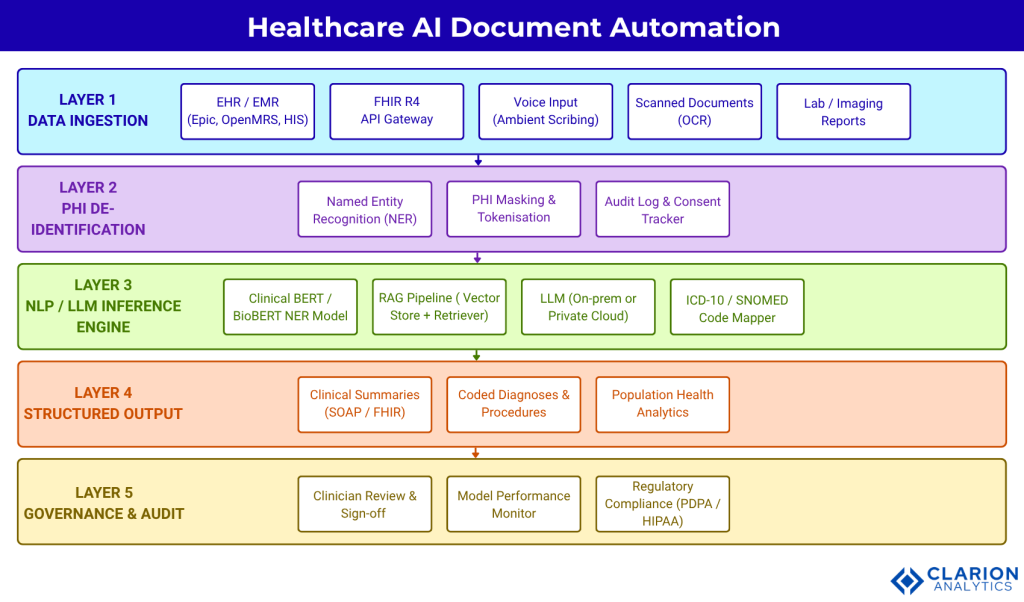
Figure 1: Five-layer reference architecture for healthcare AI document automation. Data flows from EHR ingestion (Layer 1) through PHI de-identification (Layer 2) into NLP/LLM inference (Layer 3), producing structured coded outputs (Layer 4) governed by clinician-review and regulatory audit (Layer 5).
“Getting the de-identification layer right is not a compliance checkbox. It is the technical precondition for everything that follows.”
Technology Stack: Three Approaches Compared
No single tool fits every SEA health system. The right approach depends on infrastructure maturity, data residency requirements, and the complexity of the clinical text being processed.
| Approach / Tool | Key Strength | Best Used When | SEA Fit |
|---|---|---|---|
| Rule-Based NLP (Regex + SNOMED dictionaries) | Highly predictable; explainable outputs; no GPU required | Structured forms, coded lab results, simple entity lookup | Lower-readiness markets; basic EHR installs |
| Clinical BERT / BioBERT Fine-tuned NER | High accuracy on complex clinical text; domain-adapted embeddings | Discharge notes, referral letters, ICU documentation | Singapore, Malaysia, Thailand with GPU infrastructure |
| RAG + On-Premises LLM (e.g., Qwen, Llama) | Handles free-form queries; no PHI leaves the firewall; high flexibility | Chart review, patient cohort search, multi-document synthesis | Private hospital networks, research institutions with on-prem infra |
| Ambient Scribing (cloud API + ASR) | Real-time documentation during consultation; lowest clinician effort | High-volume outpatient clinics; primary care | Urban centres with strong connectivity; PDPA data-residency caution needed |
Implementation: What Teams Building This Actually Find
Teams building clinical AI documentation systems in Southeast Asia consistently encounter three surprises. First, the model is rarely the hardest part. Connecting model output back into the EHR without disrupting the clinician workflow, matching note structure, field mapping, and sign-off requirements takes more engineering than the NLP layer itself.
Second, data quality is the real constraint. Training and evaluation sets that reflect local clinical language, abbreviations, and multilingual mixing (Singlish medical notes, Bahasa-English code-switching) are scarce. Budget for annotation time upfront.
Third, clinician trust is earned in stages. Start with a read-only suggestion panel alongside the existing note-entry interface. Let physicians see what the AI produces before any write-back to the EHR is activated.
Code Snippet 1 – Clinical NER Pipeline Source: JohnSnowLabs/spark-nlp-workshop, healthcare-nlp/01.0.Clinical_Named_Entity_Recognition_Model.ipynb
This five-stage Spark NLP pipeline tokenizes raw clinical text, generates BioBERT embeddings, and runs a pretrained clinical NER model to extract tagged entities (diagnoses, drugs, procedures) in a single distributed pass. Health IT teams can swap the pretrained model for a locally fine-tuned one without changing the pipeline structure.
“The hardest part is not the model. It is connecting the model output back into the EHR without disrupting the clinician’s existing workflow.”
Code Snippet 2 – PHI De-identification Source: JohnSnowLabs/spark-nlp-workshop, tutorials/Certification_Trainings/Healthcare/4.Clinical_DeIdentification.ipynb
Before any clinical text reaches an LLM, PHI (names, dates, MRNs, locations) must be masked or replaced with synthetic values. This de-identification pipeline runs on-premises, meaning no real patient data transits to an external API. It is a mandatory first step under Singapore’s PDPA, Malaysia’s PDPA, and Thailand’s PDPA frameworks.
Navigating Regulatory and Governance Requirements in SEA
Singapore operates under PDPA and the Ministry of Health’s AI in Healthcare framework. Malaysia is building a national EMR, while its PDPA governs the processing of health data. Thailand’s 2022 PDPA mirrors GDPR obligations. Indonesia and the Philippines each have emerging AI and health-data regulations. PwC’s 2025 Global Digital Trust Insights survey found that only 24% of healthcare leaders are confident in their AI regulation compliance, a gap that is even wider in markets still establishing frameworks.
The Deloitte Asia Pacific Health Institute (2025) recommends establishing a governance framework led jointly by clinicians, data scientists, legal experts, and patient safety officers before any GenAI goes into production. In practice, the minimum governance artefacts for a SEA deployment are: a data processing agreement with every EHR vendor, a clinical validation protocol for each NLP model, a model performance monitoring SLA, and a patient consent framework aligned to local PDPA requirements.
“Only 24% of healthcare leaders globally are confident their AI deployments comply with privacy regulations. In Southeast Asia, that number represents the single largest brake on adoption speed.”
Frequently Asked Questions
Q: What is healthcare AI document automation and how does it work in an EHR setting?
Healthcare AI document automation uses NLP and LLMs to read unstructured clinical text, consultation notes, discharge summaries, and imaging reports, and convert them into structured, coded data that writes back into an EHR. The system sits between the data source and the EHR, processing text in real time or in batch, without changing the clinician’s note-entry interface.
Q: How much clinical time can AI document automation realistically save?
Ambient scribing studies show up to a 20% reduction in post-visit documentation time. McKinsey (2025) projects a 1.8-3.2% annual healthcare productivity gain from AI tools. Results depend heavily on workflow integration quality; systems that require manual correction erode the gains quickly.
Q: Which Southeast Asian countries are furthest ahead in clinical AI adoption?
According to the Oxford Insights 2024 Government AI Readiness Index cited in PMC (2025), Singapore and Malaysia lead in AI readiness, followed by Thailand, Indonesia, Vietnam, and the Philippines. Singapore’s nine private hospitals all committed to national EHR data sharing in late 2024; Malaysia is building its national EMR; Thailand has a national AI action plan running to 2027.
Q: How do we protect patient data when running LLMs on clinical notes?
Run the de-identification layer on-premises before any text reaches an LLM. Use masking or synthetic obfuscation for names, dates, and MRNs. For maximum control, deploy open-weight models (Qwen, Llama, Mistral) on private cloud or on-premises GPU infrastructure so no PHI transits to a third-party API. Establish a data processing agreement with every vendor in the pipeline.
Q: What is the difference between ambient scribing, NER, and RAG for clinical records?
Ambient scribing captures speech during a consultation and generates a draft note. NER (named entity recognition) extracts and tags clinical concepts from existing text. RAG (retrieval-augmented generation) combines a vector search over past records with an LLM to answer specific clinical queries. All three are complementary: ambient scribing feeds NER, which feeds RAG, which powers patient record intelligence at scale.
What Health IT Leaders Should Do Next
Three insights define the opportunity. First, the APAC healthcare AI market is growing faster than any other region, 50% CAGR and clinical documentation is the highest-ROI entry point. Second, 80% of clinical data is currently invisible to analytics; fixing that with NLP and LLMs is the precondition for every downstream AI use case. Third, governance is not optional: the de-identification and compliance architecture must be built before the first model goes live.
The practical starting point is a de-identified sandbox pilot. Take three months of discharge summaries, run them through an NLP pipeline in an air-gapped environment, validate the entity extraction against physician annotations, then present the accuracy metrics and time-saving estimates to the clinical executive committee. That evidence base unlocks the board conversation.
The question is not whether healthcare AI document automation will transform clinical operations in Southeast Asia. The question is which health systems will build the infrastructure to capture that value first.
About the Author: Shivi

Related Posts