
Insurance technology leaders in APAC read vendor proposals full of model accuracy figures and roadmaps, then ask questions those proposals never answer. Their questions now fall into four categories: accountability, integration, production evidence and regulation. The gap between capability claims and deployment requirements explains why so many pilots stall. Most vendors fail on at least two categories across claims processing, underwriting and fraud detection.
This article shows what buyers now ask and where proposals fall short. It also explains how to run an insurance AI vendor evaluation that tests deployment reality. Use it to pressure test your next vendor shortlist.

Who Is Accountable When the Model Is Wrong?
Buyers want a named owner for every AI decision that touches a claim, a premium or a fraud referral. They expect audit trails, override rights and clear liability terms in the contract. Vendors that answer with model explainability slides miss the point. Accountability is an operating commitment, not a model feature.
In deployments conducted for enterprise clients across APAC, the first question from a CTO is rarely about accuracy. It is about who gets called when a declined claim reaches a regulator or a customer complaint reaches the board. Underwriting teams ask who owns a pricing decision the model influenced. Fraud teams ask who answers for a wrongful referral.
A credible proposal describes responsible AI deployment as a set of named roles, escalation paths and review cadences, not as a policy document. Buyers also ask for log retention terms, change notices and the right to audit model changes after go-live.
Accountability is an operating commitment, not a model feature.
How Does the Platform Connect to Core Systems and Legacy Data?
Buyers want proof that an AI system works inside their policy administration, claims and document platforms without a rebuild. They ask about integration effort, data quality dependencies and fallback behaviour when upstream systems fail. Proposals that assume clean data and modern APIs rarely survive technical due diligence at an established insurer.
Claims is where this gap shows first. Documents arrive as scanned forms, hospital bills and handwritten notes in several languages. Anyone automating insurance claims with AI must show how extraction, validation and routing connect to the existing claims system. Products built for insurance document workflows, such as InterPixels AI, start from this problem instead of adapting a generic tool.
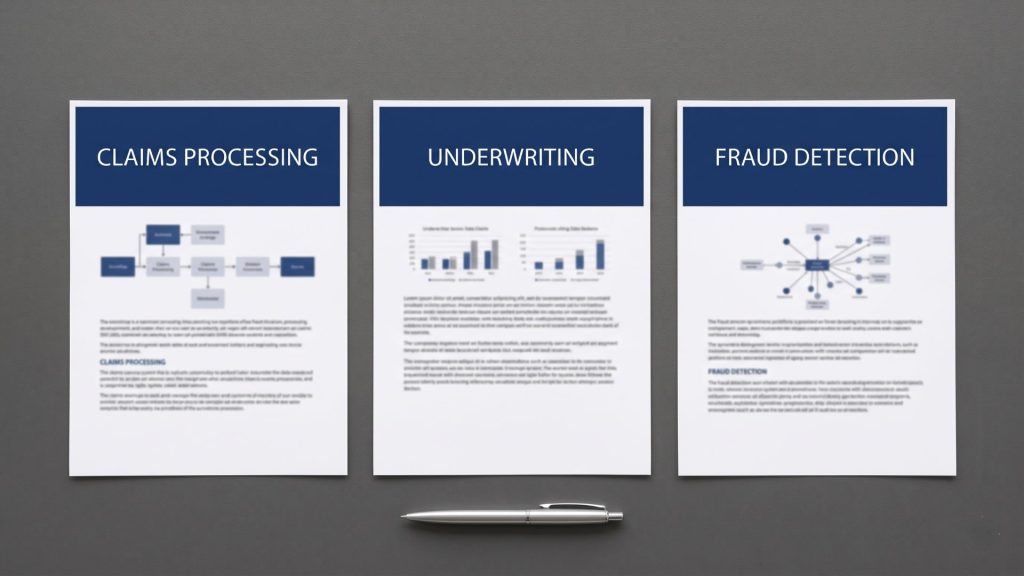
Underwriting raises a different test. Submissions mix broker emails, loss runs and surveys, and the output must land in the underwriter’s workbench. Fraud detection must return scores inside the claims workflow, not in a separate dashboard nobody opens.
What Production Evidence Belongs in an Insurance AI Vendor Evaluation?
Production evidence means results on the buyer’s own documents, volumes and edge cases, measured against a baseline the buyer agrees in advance. Demo accuracy on curated samples does not count. A sound insurance AI vendor evaluation asks for reference deployments, error handling data and a defined pilot success threshold before any commercial commitment.
Across client engagements in financial services and insurance, the strongest pilots shared one trait. The buyer supplied a messy, representative sample and the vendor reported failures openly. Weak pilots used cleaned data and reported only averages. Buyers now ask what happens to cases the model gets wrong.
They also ask how fast those cases reach a human and how feedback improves the system. Fraud detection makes this sharper, because false positives carry cost and customer harm. Industry research such as AI in Insurance, McKinsey and Company frames the opportunity, but reference calls with live insurers settle deployment questions.
Demo accuracy on curated samples does not count.
Which APAC Regulations and Data Rules Apply to the Deployment?
Buyers need to know where data is processed, which regulators expect what, and how the vendor handles model change across jurisdictions. APAC rules differ between Singapore, Malaysia, Indonesia, India and Thailand. Proposals written for one market and copied to another expose the insurer to compliance gaps it must then close itself.
Data residency comes first. Health and claims data often cannot leave the country, which affects hosting, model training and support access. Buyers also ask how a vendor tracks AI governance APAC requirements, from MAS and IMDA guidance to the EU AI Act. Contracts should state data location in plain terms.
Regulatory questions that arrive late tend to delay go-live, so insurers now raise them in the first meeting. Vendors should answer with documented controls, not assurances. Ask for monitoring reports as well as policies. For wider context on how carriers weigh technology investment, see Insurance and Technology, Deloitte Insights.
Insurance technology leaders ask about accountability, integration, production evidence and regulation because these areas decide whether an AI system survives real operations. Vendors that lead with model performance answer a question nobody is asking. Buyers should score every proposal in an insurance AI vendor evaluation against all four categories, in writing, before a pilot begins.
Vendors should show named owners, working integrations, results on messy data and documented compliance controls.
If you want to discuss this further, contact Clarion Analytics
Frequently Asked Questions
What are insurance technology leaders asking AI vendors now?
Insurance technology leaders in APAC ask four types of questions. They cover accountability for AI decisions, integration with core platforms, production evidence and regulation. They span claims, underwriting and fraud detection. Each category tests operational readiness, not model quality. Vendors that answer only with model accuracy figures miss how enterprises actually buy and deploy.
Why do most AI vendor proposals miss the point for insurers?
Most proposals describe model capability while buyers need evidence of deployment. Many vendors fail on at least two of the four categories buyers now test. A strong proposal names accountable owners, shows live integrations, reports results on messy data and documents regulatory controls. Capability claims alone do not show behaviour in live operations.
How should insurers structure an insurance AI vendor evaluation?
Insurers should score each vendor against accountability, integration, production evidence and regulatory fit. They should test on their own documents, agree success thresholds before the pilot and request reference calls with live insurers. Answers should come from the delivery team, not only sales. This turns a capability comparison into a deployment readiness check.
Why does data residency matter in APAC insurance AI?
Health and claims data often cannot leave the country of origin, so hosting location, model training and support access all matter. APAC jurisdictions apply different rules, and a proposal written for one market may not fit another. Insurers should require contracts that state where data is stored and processed, and who can access it.
What integration questions do insurers ask AI vendors?
Insurers ask how the AI connects to policy administration, claims and document systems. They also ask what happens when upstream data is poor and how outputs reach users. Claims teams want extraction and routing inside the existing workflow. Fraud teams want scores in the claims queue, not a separate dashboard.
About the Author: Shivi

Related Posts