
A model scores well in testing, leadership approves the rollout, and six months later the operations team has quietly stopped using it. We have seen this sequence repeatedly. This article shares five enterprise AI deployment lessons from our own early work, where assumptions we trusted failed in production.
Each failure produced a category of problem we now design against from the first week. You will get a plain account of what we believed, why it broke, and what we changed. The lessons suit CTOs, CDOs and Heads of AI who are accountable for results after launch, not only for demos.

Enterprise AI Deployment Lessons on Test Accuracy
Higher accuracy in testing does not guarantee better outcomes in production. Production data rarely matches the test set, and edge cases cluster exactly where the model was never evaluated. Accuracy measures performance on data you chose. Outcomes depend on data you did not choose.
Across client engagements in financial services and insurance, we saw models clear every acceptance threshold. Then they stumbled on a regional document format or an unusual claim type. The cause was distribution shift, which means the live data differs statistically from the data used to train and test the model. Our early test sets were clean and representative of the average case.
The unusual case dominates production. Edge cases now receive their own explicit targets. We now build evaluation sets from sampled live data, track performance by segment, and set escalation rules for low-confidence outputs. A single headline accuracy figure no longer appears in our acceptance criteria.
Executive Sponsorship Does Not Create Operational Adoption
Leadership buy-in does not produce adoption at the operational level. End-user workflow resistance is a separate problem, and it is often harder than winning executive sponsorship. A sponsor can approve a budget. Only the people doing the work can make a system part of the workday.
In deployments conducted for enterprise clients across APAC, we watched teams reroute work around a new system that added steps. The resistance was rational. The tool solved a problem the executive saw, not the one the operator had. We now map the operational workflow before design begins and involve frontline users in defining what the system should do.
Adoption targets sit in the project plan with named owners below leadership level. Our analysis of why enterprise AI in APAC fails covers this pattern in more depth. Training happens inside the live workflow, not in a classroom session. Early friction gets logged and fixed within days.
A Successful Pilot Does Not Scale on the Same Architecture
A successful pilot cannot be scaled on the same architecture. Pilot infrastructure assumes small data volumes, few users and tolerant timelines. Production breaks all three assumptions at once. Teams should plan to rebuild the serving layer rather than simply extend the pilot.
Pilots run on curated extracts, a single environment and a handful of patient users. Production brings full data volume, concurrent demand and integration with systems that were never designed for it. Latency, queueing and cost behaviour change completely. Concurrency exposed queue designs, database locks and model-serving limits that no pilot had ever stressed.
These failures are predictable and avoidable. We now design the production architecture during the pilot and test it under realistic load before scale-up begins. Our write-up on enterprise AI pilot to platform sets out why projects stall at this stage. In deployments for insurers, the pilot model was rarely the constraint; the surrounding infrastructure was.
Data Quality Is a Continuous Operation, Not a Gate
Data quality problems are not resolved before an AI project begins. They surface progressively through deployment, so they must be managed as a continuous operation rather than a pre-project gate. Treating data readiness as a one-time checkbox guarantees surprises after launch.
Across client engagements in financial services and insurance, we have seen clean data assumptions fail within weeks of go-live. New source systems, changed field definitions and upstream process changes all introduce fresh defects. Early audits catch only the problems that exist on audit day. We now run data quality monitoring as a permanent function with named owners, thresholds and remediation workflows.
Each defect type gets its own runbook, so the team fixes it the same way every time. We also recommend reading The Data Problem Stalling AI – MIT Sloan Review on this recurring cost. Our guidance on enterprise AI data quality explains how to budget for ongoing work.
Explainability Cannot Be Retrofitted After the Model Is Built
Explainability cannot be added after the model is built. Explainability requirements constrain which architectures are viable, so retrofitting usually means rebuilding. Decide what each decision must justify, and to whom, before selecting a model. Regulators and auditors will ask for the reasoning.
Our early projects treated explainability as a reporting feature to add at the end. In deployments conducted for enterprise clients across APAC, auditors and claims reviewers then asked why a specific decision was made. The chosen model could not answer that question. Rebuilding cost far more than designing for it would have.
We now capture explainability requirements in the first scoping workshop and select architectures that meet them. Each output links to its contributing features and source documents. Defensible decisions also support the business case, as covered in measuring enterprise AI ROI. This remains the costliest of our enterprise AI deployment lessons, and it is the one teams most often postpone.
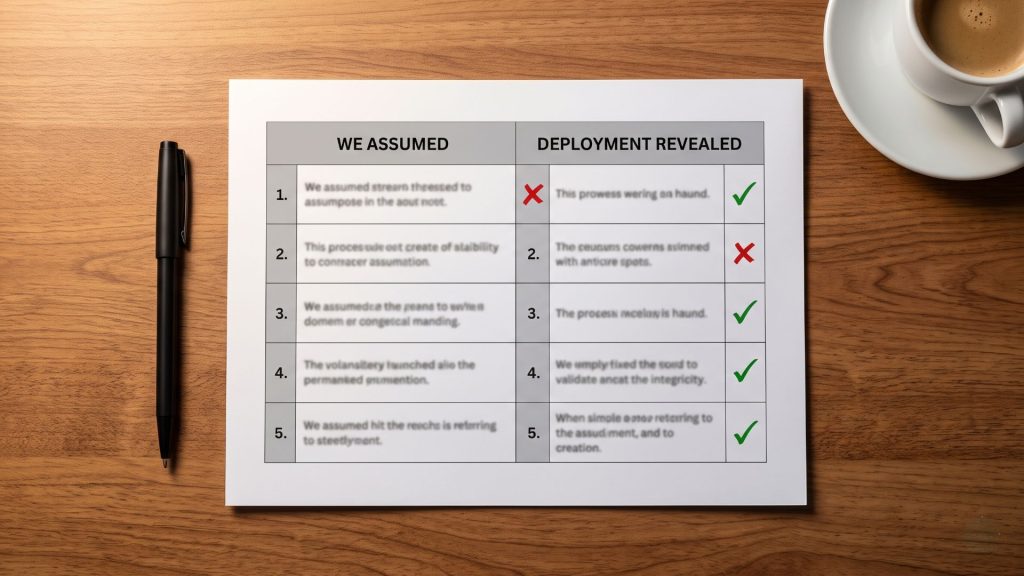
These five assumptions share one flaw. Each treated a deployment problem as a pre-launch problem that careful preparation could remove. Production does not work that way.
Our standard of Built, Deployed and Accountable means systems that hold up under real data, users and scrutiny. For wider adoption context, read The State of AI – McKinsey and Company. Apply these enterprise AI deployment lessons before the next pilot starts, not after it stalls.
If you want to discuss this further, contact Clarion Analytics at clarion.ai/contact.
Frequently Asked Questions
Why does model accuracy in testing not predict production performance?
Test sets represent data the team selected, while production data reflects every format, exception and anomaly the business actually produces. Edge cases tend to cluster where the model was never evaluated. Enterprises should evaluate on sampled live data, measure performance by segment, and define escalation rules for low-confidence outputs before go-live.
Does executive sponsorship guarantee that employees will use an AI system?
No. Executive sponsorship secures budget and priority, but adoption depends on whether the system fits the daily workflow of its users. Resistance at the operational level is a separate problem. Mapping workflows before design, involving frontline users early and assigning adoption owners below leadership level are the most reliable ways to reduce it.
Why can a successful pilot not simply be scaled up?
Pilots run on small data volumes, few users and forgiving timelines. Production introduces full data volume, concurrent demand and integration with legacy systems. Architecture choices that worked at pilot scale often fail on latency, throughput and cost. Teams should design the production architecture during the pilot and test it under realistic load.
Should data quality be fixed before an enterprise AI project starts?
Data quality should be assessed before a project starts, but it cannot be fully resolved then. New defects appear as source systems change and as the model meets live data. Enterprises should treat data quality as a continuous operation with monitoring, named owners and remediation workflows, rather than a one-time gate.
Can explainability be added after an AI model is built?
Not without rebuilding. Explainability requirements limit which model architectures are viable, so they must be defined during scoping. Retrofitting explanations onto a model that was not designed for them tends to produce weak justifications that auditors reject. Enterprises should specify who needs explanations, at what detail, and for which decisions before selecting any architecture.
About the Author: Shivi

Related Posts