A resilient agentic AI pipeline is a multi-step LLM-driven workflow designed to continue producing correct outputs even when individual components fail. It combines three defensive layers: retry logic (automatic re-attempts with backoff), fallback chains (alternative execution paths when retries are exhausted), and human-in-the-loop checkpoints (deliberate pause-and-review gates for high-stakes or ambiguous steps).
Why Most Agentic AI Projects Never Reach Production
Most agentic AI projects fail not because the models are bad, but because the orchestration layer has no plan for failure. Without retry logic, fallback chains, and human-in-the-loop gates, a single transient error cascades into full pipeline collapse.
Building a resilient agentic AI pipeline is not optional once your agents touch real systems. Gartner (2025) predicts over 40% of agentic AI projects will be cancelled by 2027, citing escalating costs, unclear business value, and inadequate risk controls. IDC research (in partnership with Lenovo) puts the attrition rate even higher: 88% of AI POCs never reach production, with only 4 of every 33 pilots graduating to widescale deployment. The chart below plots the full picture across five major research sources.
The problem is architectural. LLM calls are non-deterministic. APIs rate-limit. Models hallucinate. Downstream tools fail. A pipeline that handles none of these realities is not a production system.
This post maps the three defensive layers every agentic pipeline needs: what they are, when to use each, how to implement them, and how to layer them so failures stay local instead of cascading.
A pipeline that cannot fail gracefully is not production-ready. It is a demo waiting to break.
The Anatomy of an Agentic Pipeline Failure
Agentic pipelines fail in three predictable categories: system design flaws (bad routing, missing error handlers), inter-agent misalignment (conflicting goals, message corruption), and task verification failures (unvalidated outputs propagating downstream as facts).
The 2025 arXiv paper “Where LLM Agents Fail and How They Can Learn From Failures” by Zhu et al. introduces AgentErrorTaxonomy: a modular classification built from 200 systematically annotated failure trajectories drawn from three benchmark environments (ALFWorld, GAIA, and WebShop). It identifies five failure domains: memory, reflection, planning, action, and system-level operations.
Each domain fails differently. Memory failures corrupt the context that downstream steps rely on. Planning failures produce paths that hit dead ends mid-execution. System-level failures are the most silent. An API call that returns an HTTP error status may bypass naive error handling if the status code is not explicitly checked, leaving an empty or malformed response to reach your parser undetected.
Teams building agentic systems at Clarion.ai typically find that most pipeline breaks trace back to one absent decision: no explicit error type classification. Retry logic that retries a hallucination generates three confident wrong answers. Before writing any retry code, map your failure modes into three buckets: transient infrastructure errors (retry-eligible), logic and quality failures (fallback-eligible), and risk or confidence failures (HITL-eligible).
Building the Retry Layer: Backoff, Jitter, and Selective Retries
Effective retry logic for LLM pipelines combines exponential backoff, random jitter (to prevent thundering herds), and error-type discrimination, only retrying transient failures like rate limits and timeouts, not logic or hallucination errors.
The most common LLM production failure is transient: an HTTP 429 rate-limit, a 503 service unavailable, or a connection timeout. These errors resolve with time. The correct response is to wait and retry with exponential backoff and added jitter.
Tenacity (8.7k+ stars, Apache 2.0) is the standard Python library for this pattern. The decorator API wraps any function call and handles stop conditions, wait strategies, and async support without changing your application logic.
Code Snippet 1: LLM call with exponential backoff and jitter Source: jd/tenacity – doc/source/index.rst
from tenacity import retry, stop_after_attempt, wait_exponential, wait_random
from tenacity import retry_if_exception_type
import httpx

@retry(
    stop=stop_after_attempt(3),
    wait=wait_exponential(multiplier=1, min=2, max=30) + wait_random(min=0, max=2),
    retry=retry_if_exception_type((httpx.HTTPStatusError, httpx.TimeoutException))
)
async def call_llm(prompt: str) -> str:
    response = await client.post(
        '/v1/messages',
        json={'model': 'claude-sonnet-4-6', 'max_tokens': 1024,
              'messages': [{'role': 'user', 'content': prompt}]}
    )
    response.raise_for_status()
    return response.json()['content'][0]['text']
This snippet wraps an async LLM API call with three defences: a maximum of three attempts, exponential backoff starting at two seconds (capped at thirty), and random jitter of up to two seconds via wait_random. The retry predicate targets only HTTP errors and timeouts, not ValueError or parsing errors, which should not be retried. Jitter prevents concurrent failing agents from retrying in lockstep and spiking the upstream API.
Three is the right default retry budget for API calls. Beyond three attempts, you are likely facing an outage, not a flap. The correct response is to trigger the fallback layer.
Three is the right retry budget for LLM API calls. Beyond three, you have an outage escalation; do not retry forever.
Designing Fallback Chains That Actually Work
A fallback chain routes a failed pipeline step through a sequence of progressively simpler alternatives from a frontier model to a smaller model to a cached result before escalating to a human or returning a graceful error.
When retries are exhausted, the pipeline should not crash. It should try a cheaper, simpler, or pre-computed alternative. A well-designed fallback chain reads like a decision tree that degrades gracefully.
A typical four-level chain for an LLM generation step: (1) primary model with full context, (2) a smaller model with a simplified prompt, (3) a deterministic rule-based stub covering the most common cases, and (4) a graceful degradation response. Only after all four levels are exhausted should the pipeline escalate to a human.
The 2026 arXiv paper “Graph-Based Self-Healing Tool Routing for Cost-Efficient LLM Agents” by Bholani formalizes this as a routing problem. When a tool fails, its edges are reweighted to infinity in a cost-weighted tool graph and Dijkstra’s algorithm recomputes a recovery path — without invoking the LLM again. This removes both latency and hallucination risk from the recovery path.
In practice, the biggest mistake teams make with fallbacks is conflating them with retries. A retry repeats the same operation. A fallback changes the operation entirely. Calling the same frontier model three more times after retries are exhausted is a fourth retry, not a fallback.
Architecture Diagram: The Three-Layer Resilience Stack
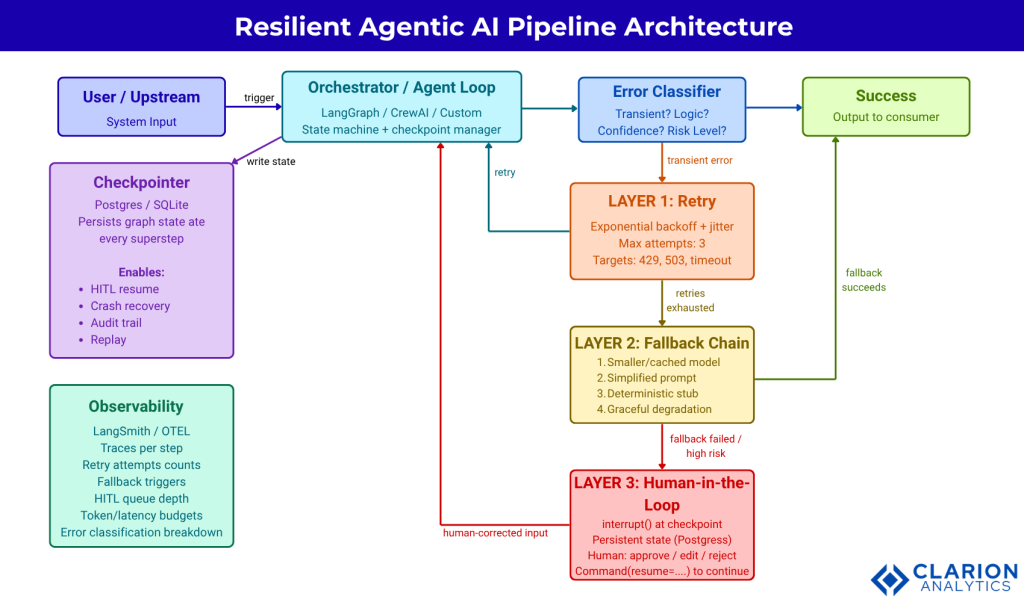
Persistent checkpointing is not a nice-to-have. It is the foundation that makes human-in-the-loop patterns production-viable.
Human-in-the-Loop: When Agents Must Stop and Ask
Human-in-the-loop checkpoints are triggered by confidence thresholds, risk flags, or explicit failure exhaustion. Production systems use persistent state checkpointers so the workflow can pause indefinitely and resume exactly where it stopped when human input arrives.
When all automated recovery paths are exhausted, or when an action is irreversible, the pipeline must pause and route to a human. The HULA framework paper (Takerngsaksiri, Thongtanunam, Tantithamthavorn et al., Monash University, University of Melbourne, and Atlassian, 2024) demonstrates HITL deployed inside Atlassian JIRA: engineers found the system reduced overall development time and effort for coding tasks, though code quality challenges remained a concern for some tasks.
The engineering challenge with HITL is not the interrupt itself. It is the state management. A paused graph may sit idle for minutes, hours, or days. The execution context must survive that gap intact. Without a persistent checkpointer, the pipeline restarts from scratch when resumed, losing all intermediate work.
Code Snippet 2: LangGraph human-in-the-loop interrupt with checkpoint resume Source: langchain-ai/langgraph – LangChain official docs
from langchain.agents import create_agent
from langchain.agents.middleware import HumanInTheLoopMiddleware
from langgraph.checkpoint.postgres.aio import AsyncPostgresSaver  # correct submodule path

async with AsyncPostgresSaver.from_conn_string(DATABASE_URL) as checkpointer:
    await checkpointer.setup()  # required on first use: creates database tables

    agent = create_agent(
        model='claude-sonnet-4-6',
        tools=[write_file, execute_sql, delete_record],
        middleware=[
            HumanInTheLoopMiddleware(
                interrupt_on={
                    'write_file': True,
                    'execute_sql': {'allowed_decisions': ['approve', 'reject']},
                    'delete_record': True,
                    'read_data': False,
                }
            )
        ],
        checkpointer=checkpointer,
    )

    # Run until interrupt
    for event in agent.stream(input, thread_config):
        print(event)

    # Resume after human review:
    from langgraph.types import Command
    for event in agent.stream(Command(resume='approve'), thread_config):
        print(event)
This snippet configures per-tool interrupt policies: irreversible actions always pause, SQL execution pauses with a restricted decision set, and safe reads auto-approve. AsyncPostgresSaver (imported from langgraph.checkpoint.postgres.aio) persists full graph state to Postgres, so an interrupt can last hours without losing context. checkpointer.setup() must be called on first use to create the required database tables. Command(resume='approve') resumes from the exact node where the pipeline paused.
The LangGraph framework (40k+ stars) is the most widely adopted tool for this pattern, trusted in production by enterprises including Klarna, Replit, and Elastic.
Choosing the Right Pattern: Retry, Fallback, or HITL
The choice between retry, fallback chain, and human-in-the-loop depends on error type, step reversibility, latency tolerance, and risk level. Most production pipelines use all three in a layered sequence.
| Pattern | Key Strength | Best Used When |
|---|---|---|
| Retry + Backoff (Tenacity) | Zero latency overhead on success path; handles flaps invisibly | Error is transient: rate limit (429), timeout, 503. Step is idempotent and safe to repeat. |
| Fallback Chain | Maintains pipeline progress at lower quality or cost; resilient to model outages | Primary model is unavailable or over-budget. A simpler model or cached result is acceptable. |
| Human-in-the-Loop (LangGraph) | Catches judgment failures automated systems cannot resolve; prevents irreversible mistakes | Action is irreversible. Confidence is below threshold. All automated recovery paths are exhausted. |
| Layered (all three) | Maximum resilience; self-heals transient issues; degrades gracefully under load | Production systems with real users and real consequences. Any pipeline touching external systems. |
Production pipelines should layer all three patterns, retry, fallback, and HITL, in sequence, not choose between them.
Frequently Asked Questions
How do I handle LLM failures in a production pipeline?
Classify the failure first. Transient errors (429, 503, timeout) should trigger an exponential backoff retry — Tenacity handles this with a single decorator. Logic or quality failures should route to a fallback chain. Confidence or risk failures should pause at a human checkpoint. Never apply the same recovery strategy to all error types.
When should I retry vs. escalate to a human in an agentic workflow?
Retry when the failure is transient and the step is idempotent. Escalate to a human when all automated recovery paths are exhausted, when the action is irreversible (a delete or a send), or when the agent’s confidence score falls below a defined threshold for the risk level of the decision.
What is the difference between a fallback chain and a retry loop?
A retry loop repeats the same operation with the same input. A fallback chain substitutes a different operation entirely, typically a simpler or cheaper alternative. Calling the same frontier model four times is a retry. Routing to a smaller local model after three failed attempts is a fallback. They address different failure modes and should not be conflated.
Which tools should I use to add human-in-the-loop to my AI agent?
LangGraph (40k+ stars) is the production standard. It provides interrupt() primitives, per-tool interrupt policies, and Postgres-backed checkpointing so workflows can pause indefinitely and resume exactly where they stopped. For retry logic, Tenacity is the standard Python library with full async support.
How many retries should an agentic AI step attempt before failing?
Three is the correct default for LLM API calls. Attempt one hits the failure. Attempt two often succeeds during a brief rate-limit window. Attempt three covers a second flap. Beyond three, you are facing an outage. Set stop_after_attempt(3) and transition to the fallback chain after the third failure.
How does Clarion.ai approach resilience in its agentic AI deployments?
Clarion Analytics applies a Built. Deployed. Accountable. methodology to every agentic system. Resilience architecture, retry policies, fallback chains, and human-in-the-loop gates are scoped before development begins, not bolted on after a failed pilot. Clarion.ai only considers a deployment complete when the system processes real data in a live environment with fault recovery confirmed.
Can Clarion Analytics help us design retry and fallback logic for our existing pipeline?
Yes. Clarion.ai’s Agentic AI and Workflow Automation service includes resilience design as a core deliverable, covering error taxonomy, per-step retry budgets, model fallback sequences, and observable failure recovery. The team assesses your existing pipeline and identifies the highest-risk steps before proposing a layered recovery architecture. See clarion.ai/contact to start the conversation.
Does Clarion.ai’s Agentic AI and Automation service include human-in-the-loop workflow design?
Yes. Clarion.ai designs HITL checkpoints as a standard component of any agentic pipeline handling irreversible actions or high-stakes decisions. This includes interrupt placement, persistent state configuration (Postgres-backed checkpointers), and approval workflow design, ensuring human oversight is built into the system from day one rather than added reactively.
An agentic pipeline is only as reliable as its least-defended step. Harden each step before you trust the whole chain.
How Clarion.ai Helps You Build Resilient Agentic AI Pipelines
Clarion Analytics designs and deploys production-grade agentic AI systems for insurance, financial services, manufacturing, and logistics clients across Asia Pacific. Every Clarion.ai agentic engagement includes fault-tolerance architecture as a first-class deliverable covering error classification, retry policy design, fallback chain configuration, and human-in-the-loop checkpoint placement. Systems are not considered deployed until they process real data in a live environment with fault recovery confirmed end-to-end. If your pipeline has steps with no recovery path, contact Clarion.ai to discuss a resilience review.
Further Resources
InterPixels AI is Clarion Analytics’s health insurance claims intelligence API, built on a multi-step agentic pipeline that processes OPD and IPD claim documents end-to-end. The resilience patterns in this post — retry logic for OCR and LLM extraction steps, fallback chains for document classification, and HITL gates for exception handling are directly applicable to any team building or evaluating document-intelligence pipelines like InterPixels.
VoiceVertex AI is Clarion.ai’s multilingual voice agent platform, which relies on agentic pipelines to route, transcribe, and respond to customer interactions in real time. In voice workflows, latency budgets are tighter and HITL escalation patterns must be designed with care. The retry and fallback architectures covered in this post are directly relevant to engineering teams deploying or scaling voice AI systems.
Build for Failure, Design for Recovery
A resilient agentic AI pipeline is not built by adding a try/except block and hoping for the best. It is built by classifying failures precisely, layering three complementary recovery mechanisms, and backing them all with persistent state.
Three insights matter above all others. First: error classification precedes everything. Retry logic applied to a logic failure is worse than no retry; it consumes budget and produces confidently wrong outputs. Build your taxonomy before you write your first decorator.
Second: the three layers retry, fallback, and HITL are not alternatives. They are a sequence. Most failures resolve at layer one. Persistent outages hit layer two. High-stakes or irreducible failures reach layer three. A pipeline with all three is defensible in production.
Third: persistent checkpointing is the load-bearing infrastructure for the entire stack. As Gartner (2025) notes, over 40% of agentic AI projects will be cancelled by 2027, mostly due to escalating costs, unclear business value, and inadequate risk controls. The teams that reach production and stay there are the ones that treated reliability as a first-class architectural concern from the start.
The question worth carrying forward: which step in your current agentic pipeline has no recovery path, and what breaks downstream when it fails?
About the Author: Shivi

Related Posts