Agentic AI security refers to the discipline of identifying, mitigating, and monitoring the unique threats that arise when LLM-based agents operate autonomously: executing multi-step plans, calling external tools, and taking actions with real-world consequences. Unlike traditional application security, agentic AI security must address a semantic attack surface where malicious instructions can be embedded in any data the agent reads.
Why Agentic AI Breaks Traditional Security Models
Agentic AI systems dismantle perimeter-based security because every data source the agent reads is a potential attack vector, not just authenticated API calls from known callers.
By 2028, Gartner predicts 25% of enterprise breaches will be traced to AI agent abuse from both external actors and malicious insiders. That is not a warning about future technology. It describes the systems many teams are shipping today.
Traditional security models assume threats arrive at defined perimeters: network edges, API endpoints, authenticated sessions. Agentic AI dismantles every one of those assumptions. An agent that browses the web, reads inbound emails, queries vector databases, and writes to downstream APIs has no perimeter. Its attack surface is everywhere it reads.
The shift is subtle but critical. A REST API receives structured input from a known caller. An LLM agent receives natural language from an unpredictable world, then decides what to do with it. The intelligence that makes agents powerful is the same property that makes them exploitable.
“By 2028, Gartner predicts 25% of enterprise breaches will be traced directly to AI agent abuse, both external and internal.”
Mapping the Four-Zone Agentic AI Attack Surface
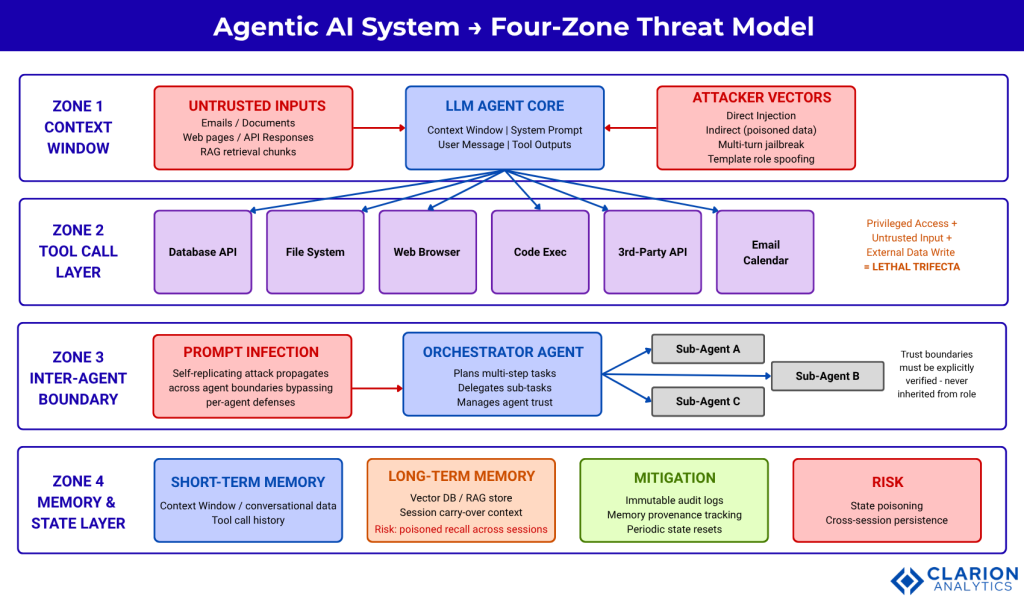
The agentic AI attack surface spans four primary zones: the context window, the tool-call layer, the inter-agent trust boundary, and the memory and state layer. Each zone has distinct threat profiles requiring different controls.
Zone 1 is the context window. Every string entering the LLM’s context, regardless of source, can contain instructions the model may follow. A document summary, search result, email, or API response can carry embedded directives. This is indirect prompt injection, and it is the primary attack vector in production today.
Zone 2 is the tool-call layer. Agents call external tools: databases, file systems, browsers, code interpreters, email clients. Security researchers describe a lethal trifecta here: the agent holds privileged access, processes untrusted input, and can write data externally. Any single property creates risk. All three together enable full system compromise from one injected instruction.
Research published on arXiv in 2024 by Lee and Tiwari introduced Prompt Infection: a self-replicating attack where malicious instructions injected into one agent’s context propagate to every agent it communicates with, bypassing per-agent defenses. Zone 4 is the memory and state layer. Poisoning a vector database or long-term memory store creates cross-session attacks that surface hours or days later.
Prompt Injection in Agentic Systems: Direct, Indirect, and Self-Replicating
Prompt injection embeds malicious instructions in external data to override agent tasks. In multi-agent architectures, Prompt Infection attacks self-replicate across agents, bypassing defenses designed for single-agent systems.
Direct injection is well-documented: an attacker controlling a user-facing input crafts a prompt that overrides the system prompt or redirects task execution. Most mature model providers have added some resistance to it. Indirect injection is far more dangerous in production.
When agents process external content, any text in that content can carry instructions the model treats as authoritative. A malicious actor who controls a single webpage, email template, or RAG document can redirect every agent that reads it. A February 2026 paper on reinforcement-learning-based prompt injection (AutoInject) demonstrated automated attack success rates of up to 58% against Gemini-2.5-Flash on the AgentDojo benchmark, substantially outperforming all hand-crafted template baselines across nine frontier models.
“In multi-agent systems, a single injected instruction can self-replicate across agents, turning one compromised tool call into full infrastructure access.”
Code Snippet 1: Prompt Injection Input Scanning with LLM Guard
Source: protectai/llm-guard, input_scanners/prompt_injection.py
from llm_guard.input_scanners import PromptInjection
from llm_guard.input_scanners.prompt_injection import MatchType

scanner = PromptInjection(threshold=0.5, match_type=MatchType.FULL)
sanitized_prompt, is_valid, risk_score = scanner.scan(prompt)

if not is_valid:
    raise ValueError(f"Injection detected. Risk score: {risk_score:.2f}")
Three lines of integration add a DeBERTa-based classifier between any user input and your LLM call. The scanner returns a sanitized prompt, a validity flag, and a numeric risk score. Set threshold=0.5 as a starting point and tune from there. Place this in your API gateway or agent entry point, before the input reaches the model context window.
The Lethal Trifecta: Why Agent Privileges Amplify Every Threat
Privileged access, untrusted input processing, and the ability to write data externally form a lethal trifecta. Any one property creates risk. All three together enable complete system compromise from a single injected instruction.
A 2026 analysis from Aembit found that only 10% of organizations have a well-developed strategy for managing non-human and agentic identities (per an Okta survey of 260 executives), despite credential abuse being the most common initial access vector in breaches according to the 2025 Verizon DBIR. Most security frameworks were never designed to handle identities that plan, remember, and act autonomously.
In practice, teams building agentic systems typically find that identity scoping falls through the cracks. The agent receives broad credentials because it was faster to set up that way during development. Those credentials move to production unchanged. An injected instruction then exploits them to exfiltrate data, delete records, or call external services the business never intended the agent to reach.
“Treat every LLM output as potentially adversarial. The agent that read an untrusted email five steps ago may now be about to write to your database.”
Comparison: Defensive Approaches for Production Agentic AI
| Approach / Tool | Key Strength | Main Limitation | Best Used When |
|---|---|---|---|
| Input Scanning (LLM Guard) | Detects known injection patterns at the context boundary; sub-millisecond ONNX inference | Signature-based; novel zero-day injections may evade detection | You need a drop-in detection layer before any external content reaches the model |
| Dual-LLM / CaMeL Pattern | Structural defense: injected instructions in the quarantined LLM cannot reach the privileged planning path | Higher latency and cost; requires architectural redesign | Building net-new agent pipelines where security must be enforced by design |
| Action-Scope Constraints | Prevents agents from executing arbitrary tasks outside a defined workflow envelope | Reduces agent flexibility; requires careful workflow modelling upfront | Agents in narrow, well-defined domains such as claims processing or code review |
| Continuous Red-Teaming (garak) | Systematic, automated scanning across 100+ injection probe types in CI/CD | Detects known weaknesses; does not block live attacks in real time | Pre-deployment gate and post-deployment regression testing on every model update |
| Least-Privilege Tool Scoping | Limits blast radius: a compromised agent cannot access out-of-scope resources | Requires ongoing access governance; permissions drift without active review | All production agentic systems, always; this is the minimum viable safeguard |
Production Hardening: A Layered Defense Playbook
Production hardening for agentic AI requires four layers: input scanning at the context boundary, least-privilege tool scoping enforced at infrastructure level, output validation before any downstream action, and continuous red-team scanning in CI/CD.
Layer one is input scanning. Deploy a classifier between every external data source and your agent’s context window. The LLM Guard snippet above handles this with sub-millisecond latency. Pair it with an InvisibleText scanner that strips Unicode private-use-area characters, a common steganographic injection vector that most teams overlook.
Layer two is least-privilege tool scoping. Every tool the agent calls needs a scope definition enforced at infrastructure level, not just in the system prompt. The tldrsec/prompt-injection-defenses catalog recommends rewriting LLM-generated SQL queries into semantically equivalent queries scoped only to the data the agent is authorized to access. Do not trust the model to self-enforce access control.
Layer three is output validation. Every agent response before a downstream action should pass through an output scanner. Verify the action type matches the task context, no PII is being written to unintended destinations, and no executable code patterns appear in the response. Layer four is continuous red-teaming.
Code Snippet 2: Continuous Vulnerability Scanning with NVIDIA garak
Source: NVIDIA/garak (~8.1k stars, actively maintained)
# Install
pip install garak

# Scan your agent endpoint for prompt injection vulnerabilities
python -m garak --target_type openai \
                --target_name your-agent-endpoint \
                --probes promptinject,encoding,dan \
                --report_prefix ./reports/pre_deploy

# Results output: ./reports/pre_deploy.report.jsonl
Run this as a pre-deployment gate in CI/CD. garak sends hundreds of structured probe prompts across known injection categories and reports pass/fail rates per vector in a JSONL file your pipeline can parse. A high failure rate on the promptinject probe before deployment is far cheaper than a breach after it.
Architectural Patterns That Reduce Injection Risk by Design
The Dual-LLM pattern and strict action-scope constraints reduce injection risk structurally. They do not rely solely on detection. They make whole classes of attack architecturally impossible.
The CaMeL defense (Debenedetti et al., 2025) applies Information Flow Control from traditional software security to LLM agents. A Privileged LLM plans actions. A Quarantined LLM executes against untrusted data. Injected instructions can corrupt the quarantined context but cannot reach the privileged planning path. The structural separation is the defense.
A complementary approach described in Design Patterns for Securing LLM Agents (Beurer-Kellner et al., 2025) constrains agent action scope so the agent is structurally incapable of executing tasks outside its defined workflow. An agent that cannot send arbitrary emails cannot be injected into sending one. Accepting that constraint, where the use case allows, eliminates an entire attack class.
Gartner’s April 2026 analysis recommends software engineering leaders reinforce agent security with authentication and authorization practices tailored specifically to AI agents, not inherited from human user roles. Tightly scope permissions to each agent’s function. Add content injection guards and tighten oversight of third-party MCP components.
“Security for agentic AI is not a model problem. It is a systems design problem, and the solution requires layers.”
How Clarion.ai Helps Enterprise Teams Secure Agentic AI
Clarion Analytics builds enterprise AI infrastructure designed for the compliance and operational demands of regulated industries. The same principles that govern agentic AI security, including least-privilege access, output validation, structured audit trails, and constrained agent action scope, are embedded in how Clarion.ai architects its AI systems.
For enterprise teams navigating the four-zone threat model described in this post, Clarion Analytics offers context-aware AI deployment guidance, structured evaluation frameworks for agentic workflows, and implementation support for the kind of layered security controls that prevent injection attacks from reaching privileged execution paths.
To discuss how these principles apply to your production environment, contact the team at Clarion.ai/contact.
Further Resources
InterPixels.ai: InterPixels AI is a health insurance claims intelligence API that uses structured data extraction and agentic workflows to process claims across TPAs in India, Malaysia, Indonesia, Singapore, Thailand, and the Philippines. The agentic AI security principles in this post, particularly input validation, least-privilege tool scoping, and constrained agent action scope, apply directly to production claims processing deployments built on InterPixels AI.
VoiceVertex.ai: VoiceVertex AI is a voice intelligence platform that processes real-time audio inputs through agentic pipelines. The prompt injection and context window attack patterns described in this post are equally relevant to voice-driven agentic systems, where transcribed speech becomes the untrusted external input entering the agent’s context. Production deployments should apply the same input scanning and output validation layers covered here.
Frequently Asked Questions
What is prompt injection in agentic AI and why is it dangerous?
Prompt injection is an attack where malicious text embedded in external data, such as documents, emails, or web pages, overrides an LLM agent’s original instructions. It is dangerous in agentic systems because agents act autonomously with privileged access to databases and APIs. A successful injection can cause the agent to exfiltrate data, delete records, or call external services without triggering alerts.
How is the attack surface for agentic AI different from traditional APIs?
Traditional API security defends defined perimeters against structured, typed inputs. Agentic AI systems read natural language from arbitrary external sources and make autonomous decisions based on that content. Every external data source the agent reads, every tool it calls, and every sub-agent it coordinates with is a potential attack surface. There is no perimeter.
What tools can I use to detect and block prompt injection in production?
For real-time detection, deploy LLM Guard’s PromptInjection scanner as an input gateway before any external content reaches the model context. For pre-deployment scanning, run NVIDIA garak against your agent endpoint with the promptinject and encoding probe suites as a CI/CD gate. The tldrsec/prompt-injection-defenses catalog provides a complete reference of additional techniques.
Is there an architectural way to prevent prompt injection rather than just detect it?
Yes. The Dual-LLM pattern (CaMeL) structurally separates a privileged planning LLM from a quarantined execution LLM. Injected instructions in external data can corrupt the quarantined context but cannot reach the privileged planning path. Combined with strict action-scope constraints, these patterns reduce injection risk without relying entirely on detection.
How do I red-team an agentic AI system before it goes live?
Install NVIDIA garak and run it against your agent endpoint as a pre-deployment gate. Use the promptinject, encoding, and dan probe suites at minimum. Integrate the JSONL output into your CI/CD pipeline and block deployment on critical failures. For multi-agent systems, also manually test trust boundary propagation: inject a payload into one sub-agent and verify it does not propagate to the orchestrator’s privileged context.
How does Clarion.ai approach agentic AI security for enterprise clients?
Clarion Analytics designs enterprise AI infrastructure with compliance and operational controls built in from the start, not added as an afterthought. This includes constrained agent action scoping, structured audit trails, and least-privilege access patterns tailored to regulated industry requirements. Teams deploying agentic workflows in sensitive environments can engage Clarion.ai for architecture review and implementation guidance.
Can Clarion Analytics help with multi-agent system security, not just single-agent pipelines?
Multi-agent systems introduce the Prompt Infection risk described in this post, where injected instructions propagate across agent boundaries. Clarion.ai’s enterprise AI frameworks account for inter-agent trust boundaries and include guidance on orchestrator-level validation controls. Clarion Analytics works with enterprise teams to map threat surfaces across both single-agent and multi-agent architectures.
Does Clarion.ai offer support for regulated industries that require stricter AI governance?
Yes. Clarion Analytics operates with a primary focus on regulated industries including insurance and financial services across Southeast Asia. Its AI deployment frameworks include the audit trail, access control, and output validation layers that enterprise security and compliance teams require. Contact Clarion.ai to discuss governance requirements specific to your industry and jurisdiction.
The Three Things Every Team Building Agents Must Get Right
The three most important investments in agentic AI security are: mapping your attack surface across all four threat zones before the first line of production code, enforcing least-privilege tool scoping at the infrastructure level rather than trusting model self-restraint, and running continuous automated red-teaming as a non-negotiable CI/CD gate.
Every team that ships agents at speed discovers the same gaps after the fact: credentials that were too broad, external data sources treated as trusted, and no systematic process to verify the agent behaves safely when adversarial content arrives. These are not model problems. They are engineering and governance problems.
The tooling exists today. The architectural patterns are documented and validated by current research. The question is not whether to invest in agentic AI security. It is whether you invest before or after the incident.
Are you treating the agent’s context window as the boundary it actually is, or still defending a perimeter that no longer exists?
About the Author: Shivi

Related Posts


Table of Content
- Why Agentic AI Breaks Traditional Security Models
- Mapping the Four-Zone Agentic AI Attack Surface
- Prompt Injection in Agentic Systems: Direct, Indirect, and Self-Replicating
- The Lethal Trifecta: Why Agent Privileges Amplify Every Threat
- Production Hardening: A Layered Defense Playbook
- Architectural Patterns That Reduce Injection Risk by Design
- How Clarion.ai Helps Enterprise Teams Secure Agentic AI
- Further Resources
- Frequently Asked Questions
- The Three Things Every Team Building Agents Must Get Right