Angular lifecycle hooks are methods Angular calls automatically at defined stages of a component’s existence from creation through every change-detection cycle to final destruction. Developers implement these hooks to initialize data, respond to input changes, read child-component state, and release resources. The nine hooks execute in a fixed sequence; understanding that sequence is the foundation of predictable, memory-safe Angular application development.
Why Lifecycle Hooks Are an Enterprise Concern
Angular lifecycle hooks give teams precise, documented control over component behavior at every phase of execution. Without them, complex applications devolve into race conditions, memory leaks, and UI inconsistencies that are nearly impossible to debug.
Angular commands 18.2% developer adoption across the Stack Overflow Developer Survey 2025, second only to React among all front-end frameworks. That figure has held firm at 17-18% for three consecutive years, reflecting the reality that Angular lives in enterprise codebases where thousands of components are created, updated, and destroyed every session. At that scale, a single misplaced subscription or a data fetch in the wrong hook is not a code smell. It is a production incident.
According to the State of JavaScript 2024, Angular is disproportionately used by large companies and teams where a change-detection bug surfaces across hundreds of component instances simultaneously. For CTOs evaluating frontend architecture and for engineers building it, Angular lifecycle mastery is table stakes.
Teams building this typically find that the biggest production bugs trace back not to logic errors, but to lifecycle errors; data fetched before inputs are ready, subscriptions alive after components are gone, and DOM queries executed before the view renders.
Memory leaks do not fail tests. They fail users 60 seconds into a session, on the device with the least RAM.
The Hook Execution Sequence – Every Stage Explained
Angular invokes hooks in a fixed order on every component instance. Knowing this order and why it was designed that way is the difference between a component that works and one that works correctly.
Constructor vs ngOnInit – The Critical Distinction
The constructor runs when Angular instantiates the class. At that moment, Angular has not yet resolved input property bindings. Use the constructor for dependency injection only, nothing else. The Angular Style Guide is explicit: avoid long or complex logic in lifecycle hooks, and keep constructors to one purpose.
ngOnInit runs once, after all @Input() bindings are initialized. This is the correct home for HTTP calls, FormGroup setup, and subscription start. In practice, treating ngOnInit as the component’s true entry point and the constructor as plumbing produces consistently cleaner code.
ngOnChanges – Reacting to Parent-Driven Input Updates
ngOnChanges fires before ngOnInit and again every time a parent updates an @Input() value. The SimpleChanges object it receives contains previousValue, currentValue, and firstChange properties, enabling conditional logic. Pair this hook with OnPush change detection to build components that update only when their inputs actually change, a meaningful performance gain at scale.
ngDoCheck – Custom Change Detection (Use Sparingly)
ngDoCheck runs every time Angular’s change-detection cycle runs, which can be dozens of times per second. According to the official Angular documentation, you should avoid defining this hook unless you have no alternative. When you must use it, keep the body as cheap as possible: a single reference comparison, never DOM reads or HTTP calls.
Content and View Hooks – AfterContent and AfterView
ngAfterContentInit fires once after Angular projects external content into the component’s ng-content slots. ngAfterViewInit fires once after the component’s own template, including all child components, has rendered. Both are the correct places to run logic that reads ViewChild or ContentChild query results. Attempting to mutate state in these hooks triggers the ExpressionChangedAfterItHasBeenCheckedError, one of Angular’s most common production warnings.
ngAfterViewInit is not a second ngOnInit. It is the first moment your component’s full visual tree exists, treat it as such.
ngOnDestroy – The Cleanup Imperative
ngOnDestroy runs just before Angular removes the component from the DOM. Every Observable subscription that is not backed by the async pipe must be unsubscribed here. Every event listener attached outside Angular’s zone must be detached here. The industry-standard pattern combines a Subject destroy$ with RxJS takeUntil to handle multiple subscriptions in a single ngOnDestroy call.
Real-World Use Cases with Code
Three patterns cover 90% of lifecycle hook usage in production Angular applications: data initialization in ngOnInit, input-reactive logic in ngOnChanges, and cleanup in ngOnDestroy.
Snippet 1 – Lifecycle interface contracts (source: angular/angular):
These interfaces enforce correct method naming. Implement them explicitly TypeScript will catch typos that would otherwise silently produce uncalled hooks.
Snippet 2 – The takeUntil pattern for memory-safe subscriptions:
This pattern handles any number of subscriptions in a single ngOnDestroy call. The Subject acts as a cancellation signal: when destroy$ emits, every pipe using takeUntil unsubscribes automatically.
One destroy$ Subject. Any number of subscriptions. Zero memory leaks. This is the pattern enterprise Angular teams standardize on.
System Architecture – How Hooks Fit the Change Detection Engine
Angular’s change detection engine, historically backed by Zone.js, now increasingly driven by Signals, traverses the component tree on every detection cycle. Lifecycle hooks are the developer’s insertion points into that traversal.
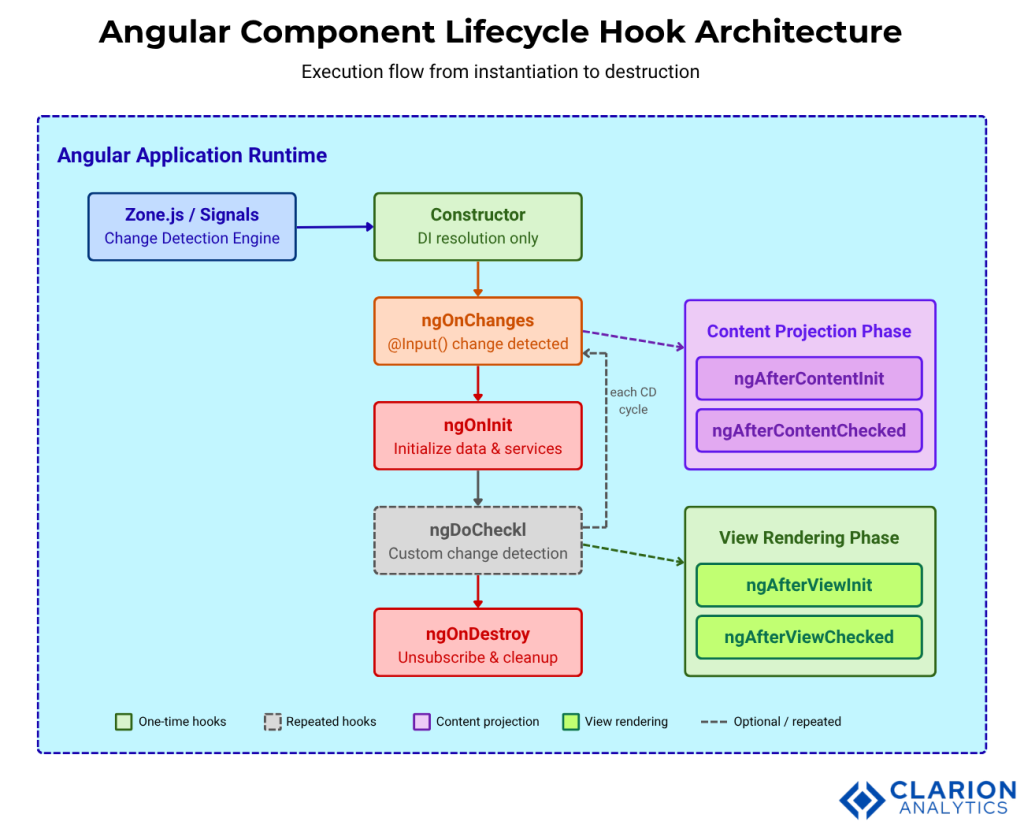
Figure 1 Caption: Zone.js or the Signals engine triggers change detection. The constructor fires first for DI only. ngOnChanges follows on every @Input() update, then ngOnInit once. ngDoCheck runs every cycle (use sparingly). Content hooks fire after ng-content projection; view hooks fire after the component template renders. ngOnDestroy closes the lifecycle before DOM removal. The dashed loop represents repeated change-detection cycles between initialization and destruction.
The introduction of Angular Signals, formalized in the Angular Signals RFC (2023) and stabilized in Angular 20 (2025), enables semi-local change detection. When a signal updates, only the components that read that signal are marked dirty, rather than the entire subtree. This changes the performance profile of lifecycle hooks: ngDoCheck becomes even less necessary, and ngOnChanges can be supplemented or replaced by computed signals.
Choosing the Right Hook – Comparison Table
Selecting the wrong hook is the leading cause of component lifecycle bugs. Use this table as a decision guide.
| Hook | Key Strength | Best Used When | Watch Out For |
|---|---|---|---|
| constructor | Dependency injection resolution | Receiving services via DI, nothing else | Any logic that depends on @Input() values (not yet set) |
| ngOnChanges | Reacts to @Input() changes with before/after values | Filtering, transforming, or validating parent-driven data | Running expensive logic on every change without diffing |
| ngOnInit | Safe initialization point, all inputs resolved | HTTP calls, FormGroup setup, subscription start | Placing logic that should be in a service or computed signal |
| ngDoCheck | Custom change detection algorithm | Detecting mutations that Angular’s default detection misses | Performance cost, runs on every single CD cycle |
| ngAfterViewInit | Full view tree available for query | Reading ViewChild/ViewChildren results, D3 chart setup | Mutating component state (triggers ExpressionChangedError) |
| ngOnDestroy | Last cleanup opportunity before DOM removal | Unsubscribing, detaching listeners, clearing timers | Forgetting to complete the destroy$ Subject |
If you are debating between ngOnInit and ngAfterViewInit, the question answers itself: do you need the view? Yes = AfterViewInit. No = OnInit.
Signals and the Future of Angular Lifecycle Management
Angular’s Signals API, stable since Angular 17 and enhanced through Angular 20, does not replace lifecycle hooks. It changes their context. ngOnInit remains the correct place to start subscriptions and HTTP calls. ngOnDestroy remains mandatory for cleanup. What Signals eliminate is the need to manually trigger change detection for state that components share reactively.
In a Signals-based component, a computed() value derived from a signal updates automatically in the template. There is no need to call markForCheck() in ngDoCheck. The component re-renders granularly only the binding that changed, not the full component tree. Teams adopting Signals typically find that their ngDoCheck usage drops to zero and their ngOnChanges implementations shrink, because input-reactive state is now managed by the Signals graph.
Zoneless Angular, available as experimental from Angular 18 and stabilizing in 2025 removes the Zone.js dependency that has historically triggered change detection after async operations. Without Zone.js, hooks like ngAfterContentChecked and ngAfterViewChecked run only when Signals or explicit calls to markForCheck() indicate a change is needed.
Frequently Asked Questions
What is the difference between constructor and ngOnInit in Angular?
The constructor runs when Angular instantiates the component class. It is limited to dependency injection, @Input() properties are not yet set. ngOnInit runs after Angular resolves all input bindings. Any initialization logic that reads inputs, calls services, or sets up subscriptions belongs in ngOnInit, not the constructor.
What is the correct order of Angular lifecycle hooks?
Angular calls hooks in this sequence: constructor, ngOnChanges, ngOnInit, ngDoCheck, ngAfterContentInit, ngAfterContentChecked, ngAfterViewInit, ngAfterViewChecked, then ngOnDestroy at the end. ngOnChanges, ngDoCheck, ngAfterContentChecked, and ngAfterViewChecked repeat on every change-detection cycle. The rest fire only once per component lifetime.
How do I prevent memory leaks in Angular lifecycle hooks?
Use the takeUntil(destroy)pattern:createaprivateSubjectnameddestroy) pattern: create a private Subject named destroy)pattern:createaprivateSubjectnameddestroy, pipe every subscription through takeUntil(this.destroy)inngOnInit,thencalldestroy) in ngOnInit, then call destroy)inngOnInit,thencalldestroy.next() and destroy$.complete() in ngOnDestroy. Alternatively, use the async pipe in templates — it subscribes and unsubscribes automatically, so no ngOnDestroy code is needed for those streams.
When should I use ngOnChanges vs ngDoCheck?
Use ngOnChanges when you need to react to @Input() reference changes, it gives you previousValue and currentValue with no performance penalty beyond the change itself. Use ngDoCheck only when you need to detect mutations inside an object or array that Angular’s default detection misses, such as a pushed item in a mutable array. ngDoCheck runs constantly, so keep its body to a single lightweight comparison.
Does Angular Signals replace lifecycle hooks?
No. Signals complement lifecycle hooks. ngOnInit, ngOnDestroy, and ngOnChanges remain the correct tools for initialization, cleanup, and input reactivity. Signals replace the need for manual change detection triggers, markForCheck(), Zone patching, and ngDoCheck-based diffing. In a fully Signals-based component, you write fewer lifecycle hooks, but the ones you write become cleaner and more intentional.
Conclusion
Angular lifecycle hooks are not a framework detail. They are the API through which developers govern every significant event in a component’s life. Three insights from this guide define the practice at production scale.
First, hook execution order is fixed and meaningful. Mixing up constructor and ngOnInit, or calling DOM queries in ngOnInit instead of ngAfterViewInit, produces subtle bugs that evade unit tests and surface under real usage conditions.
Second, every subscription opened in ngOnInit must be closed in ngOnDestroy. The takeUntil pattern is the industry standard for a reason. Memory leaks compound quietly until they become the performance regression in your CTO’s quarterly review.
Third, the arrival of Signals and zoneless change detection does not obsolete lifecycle hooks; it sharpens them. The hooks you keep writing become cleaner because Signal-driven state handles the reactive layer. ngOnInit, ngOnDestroy, and ngOnChanges remain as relevant in Angular 20 as they were in Angular 2.
The question worth sitting with: how many of your current components have a test that verifies their ngOnDestroy cleanup runs correctly?
About the Author: Imran Akthar

Related Posts