A worker safety model that performs well in a pilot can fail within weeks of going live on a platform. The cause is rarely the algorithm. AI worker safety oil and gas offshore deployments depend on three constraints that vendor capability sheets leave out. Those constraints are intermittent connectivity, explosion-proof hardware certification, and model retraining that accounts for crew rotation.
Teams in Indonesia and Malaysia have seen deployments fail after go-live because one of the three went unsolved. This article explains each constraint and gives HSE Directors, Operations Directors and Asset Managers questions to ask any vendor. It also shows how the three constraints interact.
Intermittent Connectivity Breaks Cloud-Dependent Safety Models
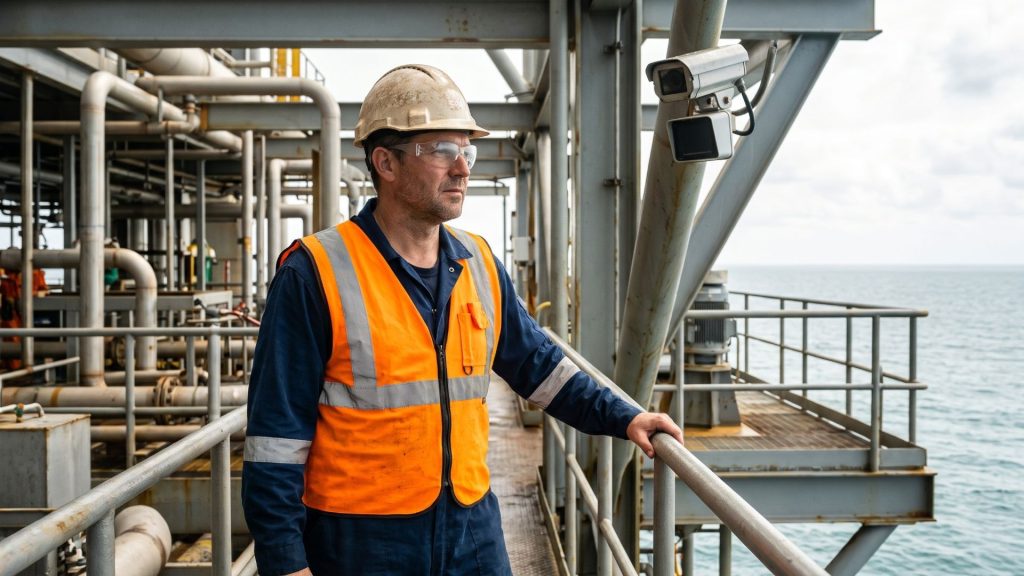
Offshore platforms rely on satellite or microwave links that degrade in storms, saturate under shared load and drop without warning. Worker safety AI must therefore run inference locally on the platform and treat the cloud as an optional sync layer. A model that needs a live connection to flag a hazard will miss the events that matter most.
For AI worker safety oil and gas offshore programs, local inference runs detection on hardware at the point of capture. Alerts then reach the control room in seconds, whatever the state of the link. Our guide to edge AI and real-time inference covers the architecture. Broader sector context sits in Digital Transformation in Oil and Gas, Deloitte.
In deployments conducted for enterprise clients across APAC, bandwidth was rarely the hardest question. The hardest question was what the system does during an outage lasting several hours. The platform must keep alerting on site, queue events locally and reconcile with central systems when the link returns. Ask every vendor to demonstrate this with the network disconnected.
A model that needs a live connection to flag a hazard will miss the events that matter most.
Hardware Certification for AI Worker Safety Oil and Gas Offshore
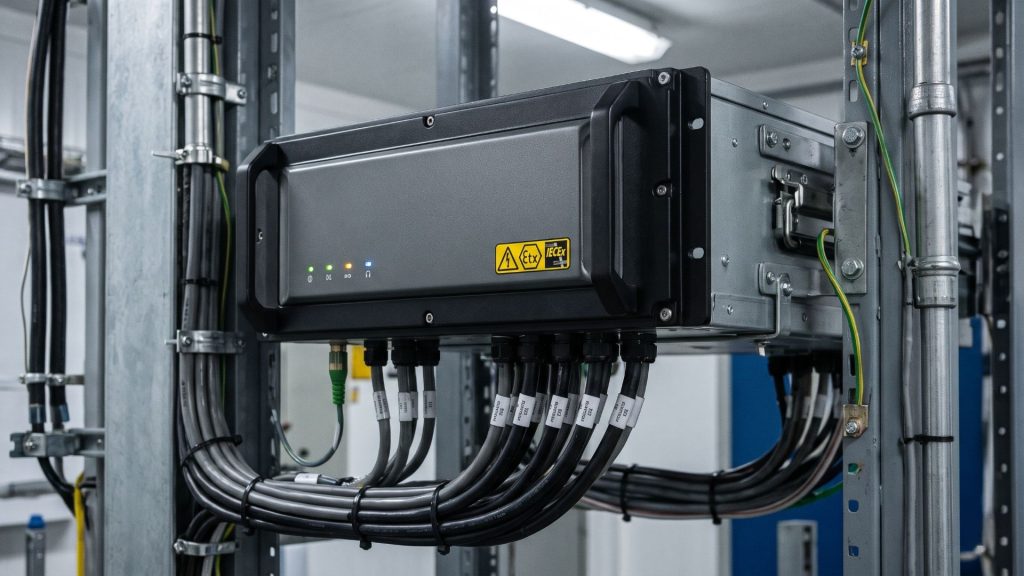
Any camera, sensor or edge computer in a hazardous area needs explosion-proof certification matched to that zone classification. The certification confirms that an enclosure contains any internal ignition and prevents it reaching the surrounding atmosphere. Standard industrial hardware fails this test. Certification lead times and thermal limits therefore shape deployment schedules and model size.
Thermal limits matter because a sealed enclosure traps heat generated by the processor. A model sized for a data center will throttle or fail inside it. Teams should size models to the certified enclosure, not the reverse. Purpose-built worker safety AI such as AegisVision is designed for industrial and offshore conditions from the start.
The framework in Process Safety Management, OSHA treats management of change as a core element, and new AI hardware triggers that process. Each camera location needs a documented review. In deployments conducted for enterprise clients across APAC, teams that began certification paperwork before model development avoided the longest delays.
Crew Rotation Changes the Population the Model Must Recognize
Offshore crews rotate on fixed schedules, so the contractors, roles and protective equipment a model sees change every cycle. A model trained once at go-live drifts as new contractors, uniforms and gear appear. Crew rotation-aware retraining schedules model updates around the rotation calendar and validates each update before the incoming crew arrives.
Retraining also needs a delivery plan. Updated models must cross the same constrained link described earlier, so teams compress packages and send them in low-traffic windows. Each update needs a rollback path if on-site validation fails. Every package also widens the attack surface, so securing AI systems in production applies to the model delivery pipeline.
Our article on computer vision for worker safety explains the detection approach in other industrial settings. The AI worker safety monitoring case study covers an oil and gas deployment in detail. Read together, they show why retraining cadence belongs in any AI worker safety oil and gas offshore contract, not in a later change request.
A model trained once at go-live drifts as new contractors, uniforms and gear appear.
These three constraints interact. Intermittent links limit how often models update, certified enclosures limit how large models can be, and crew rotation sets how often they must change. A vendor that addresses only one will fail on the other two.
Before contract signature, ask for a demonstration of offline operation, proof of zone-appropriate certification and a written retraining calendar tied to your rotation schedule. These three answers separate a deployable system from a capability sheet. If you want to discuss this further, contact Clarion Analytics at clarion.ai/contact.
Frequently Asked Questions
What infrastructure does offshore worker safety AI need?
Offshore worker safety AI needs three things. Local inference hardware must run without a network link. Enclosures must carry explosion-proof certification matched to the platform’s hazardous zones. A retraining process must follow crew rotation. Without all three, a system that passes a pilot can fail after go-live. Each should appear in the vendor contract as a testable commitment.
Why does connectivity matter for offshore worker safety AI?
Offshore satellite and microwave links degrade in bad weather and can drop for hours. A safety model that depends on the cloud cannot raise alerts during an outage. Running inference on the platform keeps detection and alerting active regardless of link state. The system then synchronizes once the connection returns.
What is explosion-proof certification and why does it affect AI hardware?
Explosion-proof certification confirms that equipment in a hazardous area cannot ignite a flammable atmosphere. Cameras and edge computers must carry the rating required for their zone. Standard industrial hardware does not qualify, so certified enclosures set the thermal limits, the lead time and the maximum model size for the offshore deployment.
Why does crew rotation require model retraining?
Offshore crews and contractors rotate on fixed schedules, so the people, roles and protective equipment a model observes change each cycle. A model trained once at go-live loses accuracy as site conditions shift. Retraining on a schedule tied to the rotation calendar, validated before each crew arrives, keeps detection stable across the deployment.
What should HSE and operations leaders ask vendors before signing?
Ask for a live demonstration of detection and alerting with the network disconnected. Request documented explosion-proof certification for every device in each hazardous zone. Ask for a written retraining calendar aligned to your crew rotation, including rollback procedures and security controls for model updates. These answers reveal whether a vendor has deployed offshore or only piloted onshore.
About the Author: Shivi

Related Posts


Table of Content
- What infrastructure does offshore worker safety AI need?
- Why does connectivity matter for offshore worker safety AI?
- What is explosion-proof certification and why does it affect AI hardware?
- Why does crew rotation require model retraining?
- What should HSE and operations leaders ask vendors before signing?