
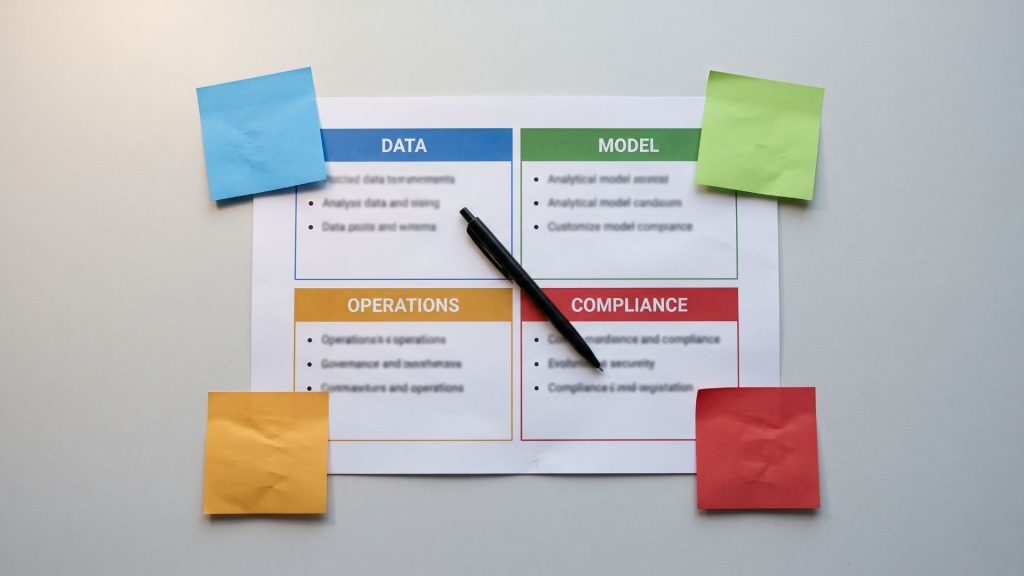
A claims engine goes live on a Monday, and by Wednesday a regulator, a customer and a board member have all seen it fail. The model tested well. The pipeline, the monitoring and the human override were not ready. This enterprise AI go-live readiness checklist sets out twelve checks across four categories: data, model, operations and compliance. Each check maps to a category of production failure that Clarion Analytics has observed or been called in to fix. If your programme cannot show evidence for all twelve, it is not ready. The gap between a pilot and a live system, covered in our guidance on moving from enterprise AI pilot to platform, is where these checks sit.

The Enterprise AI Go-Live Readiness Checklist for Data
Data readiness means the pipeline survives production load, you hold a recorded baseline for detecting change, and personal data is handled by design. Three checks cover this: pipeline integrity under load, a drift baseline and PII handling. Skipping any one is a common cause of a failed launch.
Pipeline integrity under load. Test ingestion at peak volume with late, duplicated and malformed records. In deployments conducted for enterprise clients across APAC, pipelines that passed functional tests still dropped records once real volumes arrived. Our analysis of enterprise AI data quality explains why that cost surfaces late.
Drift baseline. Record a drift baseline, the statistical profile of training data and early production inputs, so later change can be measured against it. Without one, monitoring has nothing to compare.
PII handling. Confirm where personal data enters, where it is stored and where it is masked. Then test that logs, prompts and exports do not leak it.
Model Checks That Hold Up on Live Traffic
Model readiness means proving performance where production pushes hardest, not on the average case. Test edge cases, calibrate confidence thresholds and define fallback behaviour before launch. A model that scores well on a test set but fails on rare inputs will produce your first public incident.
Edge case performance. Build a test set from the rare, ambiguous and adversarial inputs your business actually sees, and report results on that set separately. Across client engagements in financial services and insurance, headline accuracy hid weak results on the cases that carried the most cost.
Confidence threshold calibration. A confidence threshold is the score below which the system stops acting alone. Calibrate it against real outcomes, not vendor defaults.
Fallback behaviour. Decide what happens when the model is unsure or unavailable, and test that path as carefully as the main one. A fallback nobody has exercised is a guess.
Operations Checks Before the Switch Is Flipped
Operational readiness means you can see a failure, contain it and route it to a person within minutes. Monitoring must be live before go-live, rollback must be tested and the escalation path must name owners. Teams that build these after launch find the gaps during an incident.
Monitoring live before go-live. Alerts that appear in week two are not monitoring. Our guidance on LLMOps model monitoring and drift detection covers what to track from the first request.
Rollback tested. A rollback returns the system to its last known good state. Run it in staging, time it and record who can trigger it. See MLOps Best Practices, Google Cloud for the delivery pipelines that make this repeatable.
Escalation path defined. Name the on-call owner, the decision maker and the business contact before launch. Rehearse one incident end to end with all three present.
Compliance Checks That Protect the Business
Compliance readiness means regulators have been informed where required, every decision can be reconstructed, and a human can override the system. Verify regulatory notification, audit logging and the human override pathway before launch. These are conditions of operating in regulated sectors, not paperwork.
Regulatory notification. Confirm which supervisors must be told before an AI system affects customers, and keep proof that notice was given.
Audit logging. Log inputs, outputs, model version and any human action so each decision can be reconstructed later.
Human override pathway. A trained person must be able to stop or reverse a decision, and the process must work under time pressure. In insurance, we have seen override routes that existed only on paper, with no named approver on shift. This is the practical core of responsible AI deployment. For wider context on governance pressure, see the AI Project Failure Analysis, Gartner.
Go-live is the point where a programme stops being a project and becomes an operational commitment. The twelve checks in this enterprise AI go-live readiness checklist turn that commitment into evidence. Run them as a formal gate, assign an owner to each, and refuse to launch while any check lacks proof. Asking these questions costs days. Failing publicly costs far more. If you want to discuss this further, contact Clarion Analytics at clarion.ai/contact.
Frequently Asked Questions
What is an enterprise AI go-live readiness checklist?
An enterprise AI go-live readiness checklist is a set of verified conditions a system must meet before it serves real users. Clarion Analytics uses twelve checks across data, model, operations and compliance. Each check requires evidence, such as a load test result or a tested rollback, rather than assurance that the item is handled.
Who should own the go-live readiness review?
The programme manager should chair the review, and each check needs a named owner. The CTO or Head of AI should hold authority to stop a launch. Ownership matters because readiness gaps usually fall between teams such as data engineering, security and compliance, where each assumes another has verified the item.
When should the twelve checks be scheduled?
Schedule them at project start, not in the final fortnight before launch. Teams with monitoring, logging and testing built into delivery can verify most checks in a single gate review. Teams that treat them as afterthoughts must build the missing capability first, which is what delays launches.
What is the difference between a rollback and a fallback?
A rollback returns the whole system to a previous known good version after a failure. Fallback behaviour is what the system does in the moment when the model is unsure or unavailable, such as routing a case to a person. You need both, and each must be tested before launch.
Why does a human override pathway matter in regulated industries?
Regulated sectors such as insurance and financial services expect accountability for automated decisions. A human override pathway lets a trained person stop, review or reverse an AI decision, and the audit log records that action. Without it, an organisation cannot show a regulator that a person remained accountable for the outcome.
About the Author: Shivi

Related Posts