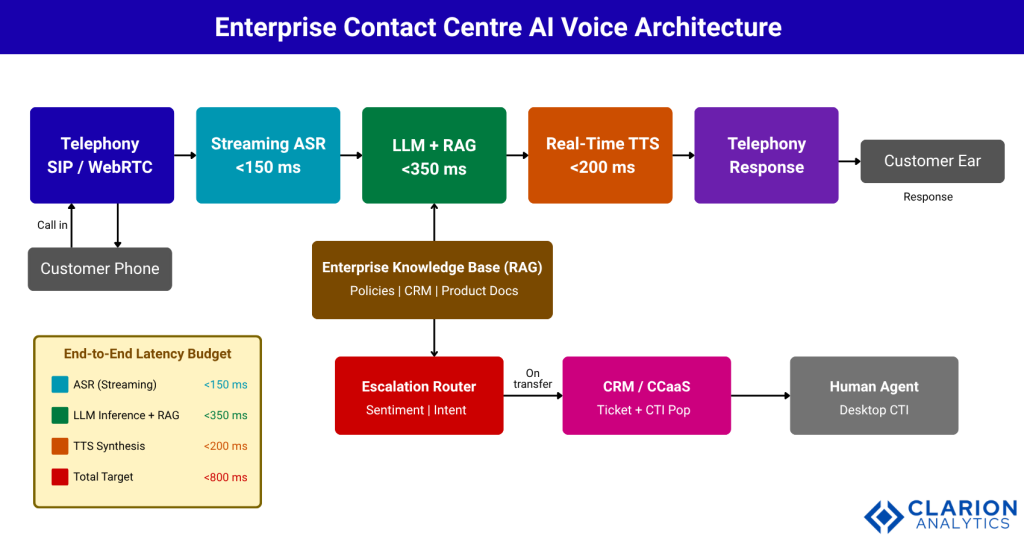
Contact centre AI voice refers to conversational AI systems that handle inbound and outbound telephone interactions autonomously, combining automatic speech recognition (ASR), a large language model (LLM) for dialogue management, and text-to-speech (TTS) synthesis. Unlike legacy IVR, these systems understand natural language, retrieve answers from enterprise knowledge bases, and escalate to a human agent when needed. They connect via SIP or WebRTC and operate at sub-second response latency.
The Cost of Standing Still
Conversational voice AI has moved from a pilot-stage curiosity to a board-level cost and experience decision. According to Gartner (December 2024), 85% of customer service leaders will explore or pilot a customer-facing conversational GenAI solution in 2025. Only 5% currently have a voice AI solution deployed. That gap is the opportunity.
Your customers are not waiting for the industry to catch up. A McKinsey survey of 3,500 consumers (March 2025) confirmed that live phone calls rank among the most preferred support channels across all age groups. Even among Gen Z customers aged 18 to 28, 71% believe live calls are the quickest and easiest way to reach customer care. Telephone volume is not dropping. The cost of staffing that volume with humans alone is rising.
Gartner (March 2025) projects that agentic AI will autonomously resolve 80% of common customer service issues by 2029, cutting operational costs by 30%. Labour can represent up to 95% of contact centre operating costs, according to Gartner. Automating even a fraction of tier-1 volume creates an outsized impact on the P&L.
“Eighty-five percent of contact centre leaders are exploring conversational AI. Only 5% have deployed a voice AI solution. That gap is where your competitive advantage lives.”
Five Use Cases Delivering ROI Right Now
The strongest early deployments are not experiments. They are production systems with verifiable outcomes. McKinsey (March 2025) documents a leading energy company that reduced billing call volume by approximately 20% and shaved up to 60 seconds off customer authentication by integrating an AI voice assistant into its back-end call workflow.
The five enterprise use cases with the fastest measurable payback are: tier-1 query containment for billing and account status; 24/7 outbound appointment confirmation and reminder calls; post-call summarisation that cuts after-call work by up to 50%; intelligent skills-based routing using real-time intent detection; and always-on FAQ handling for high-volume, low-complexity queries.
In practice, teams building this typically find the highest immediate ROI in after-call work automation. AI summarises the call, categorises the interaction, and updates the CRM record. The agent moves to the next contact immediately. That alone can return deployment costs within a single quarter.
Deployment Approach Comparison
| Approach | Key Strength | Best Used When |
|---|---|---|
| Legacy DTMF IVR | Zero AI infrastructure cost | Call volumes are low; queries are simple and fully predictable |
| Agent-Assist AI | Human judgment retained; AI surfaces answers in real time | Complex, regulated, or high-empathy interactions where AI governance is immature |
| Autonomous Voice AI | Fully automated tier-1 handling; 40-80% containment rate | High-volume, repeatable queries where IVR deflection has plateaued |
| Hybrid AI-first + escalation | Containment at scale with a human safety net | Enterprise deployments across regulated industries or multilingual markets |
How a Production Voice AI System Actually Works
A production contact centre AI voice system is not a single model. It is a four-component pipeline that must complete a full response cycle in under 800 milliseconds for the conversation to feel natural to the caller.
Research published on arXiv in 2025 by Ethiraj et al. demonstrates this in a live telecom context. Their pipeline integrates streaming ASR for real-time transcription, a quantised LLM for dialogue management, retrieval-augmented generation (RAG) for querying enterprise knowledge bases, and a real-time TTS synthesiser for voice output. End-to-end latency runs below one second on GPU-optimised infrastructure.
“The architecture decision you make today determines how quickly you can swap models, cut latency, or enter a new market tomorrow.”
The four components each require a technology decision: which ASR engine (Deepgram Nova-3, AssemblyAI, or a CCaaS-native model), which LLM, which TTS voice, and which telephony gateway (SIP trunk or WebRTC). Each layer is independently swappable. That composability is why open-source orchestration frameworks have become the default integration layer for enterprise teams.
Source: livekit/agents (13,000+ stars, August 2026)
The snippet below shows a LiveKit Agents session combining voice activity detection, speech-to-text, an LLM, and text-to-speech into a complete inbound call handler. Every component in the AgentSession constructor is independently swappable, which is how enterprise teams iterate on model choice without re-architecting the telephony layer. Note: check the latest LiveKit Agents documentation for current API syntax, as the framework is actively developed.
from livekit.agents import Agent, AgentSession, JobContext, WorkerOptions, cli
from livekit.plugins import deepgram, elevenlabs, openai, silero

async def entrypoint(ctx: JobContext):
    await ctx.connect()
    agent = Agent(
        instructions=(
            "You are a helpful customer support agent. "
            "Resolve billing and account queries. "
            "Escalate if the customer is distressed or the issue is unresolved."
        ),
    )
    session = AgentSession(
        vad=silero.VAD.load(),
        stt=deepgram.STT(model="nova-3"),
        llm=openai.LLM(model="gpt-4o-mini"),
        tts=elevenlabs.TTS(),
    )
    await session.start(agent=agent, room=ctx.room)

if __name__ == "__main__":
    cli.run_app(WorkerOptions(entrypoint_fnc=entrypoint))
Build, Buy, or Hybrid: Choosing Your Platform
Enterprises face three structural choices, and the wrong one is the most common reason voice AI programmes stall after the pilot phase.
Build on open source using frameworks such as pipecat-ai/pipecat (14,500+ stars) or livekit/agents gives engineering teams full control of data residency, model selection, and latency tuning. In practice, enterprises typically invest 3 to 6 months in platform engineering before handling live production calls on this path. It suits organisations with large engineering teams, strict data sovereignty requirements, or a strategic intent to differentiate on the voice experience itself.
Buy from a CCaaS vendor compresses time-to-value to 8 to 12 weeks with out-of-box CRM and ticketing integrations. The trade-off is limited model choice and per-minute pricing that erodes margins at scale.
Hybrid is where most large enterprises are landing. The telephony and CCaaS layer stays with the existing vendor. The AI orchestration layer sits on a custom-built framework, giving teams control of the LLM, the RAG knowledge base, and the escalation logic. Clarion.ai helps enterprises evaluate and design this layer so that architecture choices align with long-term operational and data strategy.
Source: pipecat-ai/pipecat
The Pipecat snippet below shows the composable, event-driven pipeline pattern. Swapping CartesiaTTSService for another provider or replacing the transport layer with a SIP telephony integration changes a single line, which is how hybrid deployments stay maintainable as the technology evolves.
from pipecat.pipeline.pipeline import Pipeline
from pipecat.pipeline.task import PipelineTask
from pipecat.pipeline.runner import PipelineRunner
from pipecat.services.cartesia import CartesiaTTSService
from pipecat.transports.services.daily import DailyParams, DailyTransport
from pipecat.frames.frames import TextFrame

async def main():
    transport = DailyTransport(
        room_url="<ROOM_URL>",
        token="",
        bot_name="Support Agent",
        params=DailyParams(audio_out_enabled=True)
    )
    tts = CartesiaTTSService(api_key="<KEY>", voice_id="<VOICE_ID>")
    pipeline = Pipeline([tts, transport.output()])
    runner = PipelineRunner()
    task = PipelineTask(pipeline)

    @transport.event_handler("on_first_participant_joined")
    async def on_joined(transport, participant):
        name = participant.get("info", {}).get("userName", "there")
        await task.queue_frame(TextFrame(f"Hello {name}, how can I help today?"))

    await runner.run(task)
The Implementation Roadmap: Three Horizons to Full Deployment
McKinsey (August 2024) found that ING, a global European bank, deployed a gen-AI customer-facing chatbot that eliminated wait times for approximately 20% of contact centre requests within seven weeks. The organisation picked one contained use case, built the minimum viable agent, and measured aggressively before expanding. That sequence is not optional.
“Teams that skip the 60-day pilot underestimate integration complexity every time. The pilot is not a delay. It is the fastest path to scale.”
Horizon 1 (0 to 60 days): Deploy on one high-volume, low-complexity call type, such as billing balance inquiries or store-locator requests. Target 40% containment. Track transcript quality, ASR error rate, and NPS delta on every session.
Horizon 2 (3 to 6 months): Expand to 4 to 6 call types. Integrate the enterprise knowledge base via RAG. Connect CRM data for personalisation. Target 55 to 65% containment across covered call types.
Horizon 3 (12 to 18 months): Retire the legacy IVR and replace with AI-first routing. Add dynamic escalation logic driven by real-time sentiment detection. Target 70%+ containment with measurably improved CSAT on AI-handled contacts.
Note: Containment rate benchmarks above reflect industry practitioner targets. Actual results will vary by call complexity, knowledge base quality, and integration maturity.
Measuring What Matters: CSAT, Containment, and Cost-Per-Contact
The executive dashboard for a voice AI programme needs exactly three metrics. Everything else is noise until you have these three moving in the right direction.
“Containment rate, cost-per-contact, and CSAT trajectory are the only three numbers your board will ask about twelve months after go-live.”
Research by Brynjolfsson, Li, and Raymond (NBER, 2023), widely cited by McKinsey, found that gen-AI-enabled agents in a study of 5,179 customer support agents at a Fortune 500 software firm achieved a 14% increase in issue resolution per hour and a 9% reduction in average handle time. Using an illustrative cost-per-call of $3.50 (industry estimates range from $1.50 to $8.00 depending on call complexity and market), a 9% AHT reduction on 10 million annual calls represents approximately $3.15 million in annual savings before any containment gain is counted.
Academic research by Kaewtawee et al. (2025) confirms where today’s AI performs best and where it still needs human support. Voice AI approaches human performance on routine interaction criteria. It underperforms in persuasion and complex objection handling. That boundary should directly define your escalation rules and containment ceiling expectations.
CSAT on AI-handled calls improves when escalations are handled cleanly. NICE (2026) reports that mature agentic AI deployments are achieving up to 20% CSAT improvements. The handoff from AI to human agent is the highest-risk moment in any voice AI deployment and deserves as much engineering effort as the AI pipeline itself.
Frequently Asked Questions
What is the difference between contact centre AI voice and traditional IVR?
Traditional IVR uses fixed DTMF menus and pre-recorded prompts. Contact centre AI voice uses natural language understanding to interpret caller intent, retrieve context from enterprise systems, and respond in natural speech. AI voice handles unscripted, multi-turn conversations that DTMF menus cannot accommodate, reducing caller frustration and abandoned calls.
How long does it take to deploy voice AI in an enterprise contact centre?
A contained pilot on one call type can be live in 6 to 8 weeks using an open-source framework or a CCaaS-native AI module. Full IVR replacement covering multiple domains typically takes 12 to 18 months across three deployment horizons. Measurable ROI from the first pilot is typically visible within the first 90 days of go-live.
What ROI should I expect from contact centre AI voice automation?
Research on 5,179 agents (Brynjolfsson et al., NBER 2023) documents a 9% average handle time reduction and a 14% resolution improvement per hour. One enterprise reduced billing call volume by approximately 20% within months, per McKinsey (2025). Containment rates of 40 to 70% on covered call types are achievable within 6 months, depending on query complexity and knowledge base quality.
How does voice AI handle accents and noisy call environments?
Modern ASR engines are trained on large, accent-diverse, multilingual datasets. Research by Wei et al. (2024) on cross-modal contextual speech recognition demonstrates meaningful accuracy gains in conversational settings. Real-time noise cancellation is now available as a pre-ASR processing step in major voice agent frameworks.
When should a voice AI agent escalate to a human?
Escalation triggers should be deterministic rules, not LLM judgment. Build triggers for: detected customer distress or sentiment shift, intent types outside the AI’s trained domain, explicit requests for a human agent, and regulatory triggers such as fraud claims or medical queries. Review and update escalation logic as your containment data matures.
How does Clarion.ai support contact centre AI voice deployment?
Clarion.ai helps enterprise teams design and integrate AI voice systems that align with existing data infrastructure and compliance requirements. Clarion Analytics brings the analytical layer needed to evaluate deployment options, map call data to business KPIs, and build the measurement framework that connects voice AI outcomes to enterprise ROI reporting.
Can Clarion Analytics integrate with my existing CCaaS or telephony stack?
Clarion Analytics is built to work alongside existing enterprise technology stacks, including CCaaS platforms and telephony infrastructure, rather than replacing them. The platform helps teams connect voice AI call data, CRM records, and operational metrics into a single view, making it easier to identify containment gaps, escalation patterns, and cost-per-contact trends without a full stack migration.
What does Clarion.ai offer that helps measure voice AI ROI?
Clarion.ai provides the analytical infrastructure enterprises need to track the three metrics that matter most: containment rate, cost-per-contact, and CSAT trajectory. Teams working with Clarion Analytics can establish baseline measurements before deployment, track changes at the call-type level, and produce board-ready ROI reports that connect voice AI investment to P&L impact.
How Clarion.ai Helps
Deploying contact centre AI voice at enterprise scale requires more than a model and a microphone. It requires a clear view of call data, integration architecture, and measurable business outcomes. Clarion.ai and Clarion Analytics help enterprise CX and operations teams design AI voice programmes that connect to existing systems, define the right containment and escalation logic, and build the measurement framework that makes ROI visible to the board. Whether your team is evaluating its first pilot or scaling across multiple call types and geographies, Clarion.ai provides the analytical foundation that turns deployment data into operational decisions. Contact Clarion.ai to discuss your deployment.
Further Resources
Interpixels.ai specialises in AI-powered intelligence for insurance and healthcare claims processing, an adjacent domain where contact centre voice AI and document understanding frequently converge. If your contact centre handles claims intake or policy queries, Interpixels.ai offers purpose-built tooling for that intersection.
Voicevertex.ai provides AI receptionist and voice automation products designed for organisations that need to deploy voice AI quickly across inbound call flows. For enterprises evaluating a fast-start voice AI capability alongside a longer-term enterprise platform build, Voicevertex.ai is worth exploring.
The Decision That Cannot Wait
Three insights define the state of enterprise contact centre AI voice in 2026. First, the technology is production-ready: peer-reviewed research and mature open-source frameworks have closed the gap between prototype and enterprise deployment. Second, the ROI is real, but requires phased discipline: documented case studies show measurable handle-time and containment gains only for organisations that ran a contained pilot before scaling. Third, the architecture decision has long-term consequences: open-source orchestration keeps your options open, while CCaaS-native AI modules trade flexibility for speed.
The question every CXO should put to their team before the next budget cycle: if your highest-volume call types are still handled by a DTMF IVR twelve months from now, what does that cost you in customer satisfaction, operational efficiency, and competitive positioning relative to the peers who moved first?
About the Author: Shivi

Related Posts



Table of Content
- The Cost of Standing Still
- Five Use Cases Delivering ROI Right Now
- How a Production Voice AI System Actually Works
- Build, Buy, or Hybrid: Choosing Your Platform
- The Implementation Roadmap: Three Horizons to Full Deployment
- Measuring What Matters: CSAT, Containment, and Cost-Per-Contact
- Frequently Asked Questions
- How Clarion.ai Helps
- Further Resources
- The Decision That Cannot Wait