
Your pilot passed in English. Then the Bahasa claims summaries came back incoherent, Thai documents lost their endings, and inference costs overran forecast. The root cause is LLM tokenisation Southeast Asian languages cannot escape: tokenisers learned from mostly English text.
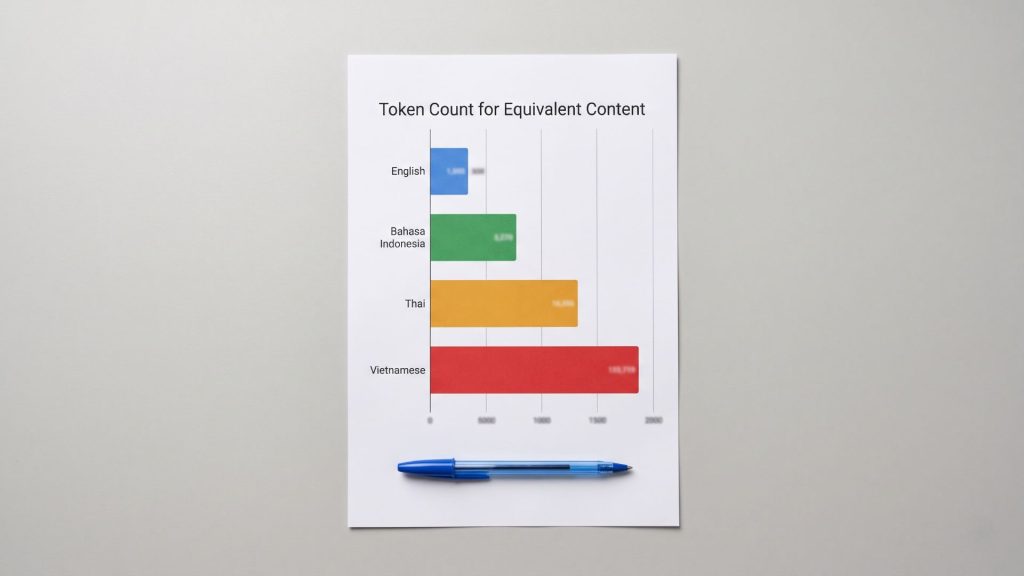
Bahasa Indonesia, Thai and Vietnamese split into far more sub-word pieces, typically two to four times the token count of equivalent English content. That inflates cost, degrades coherence and truncates long documents. Prompt engineering cannot fix it.
This article explains why the gap exists, how it appears in production, and which architectural options reduce it. It is written for teams that already run LLMs in production.

Why the Tokenisation Gap Exists
The gap exists because tokenisers learn their vocabulary from training text, and that text is mostly English. Frequent English words earn single tokens. Bahasa Indonesia, Thai and Vietnamese words appear less often in the corpus, so tokenisers split them into smaller fragments. Fewer vocabulary slots mean more tokens per word.
Most modern tokenisers use byte-pair encoding, which merges the most frequent character sequences into vocabulary entries. Whatever the corpus favours, the vocabulary stores. English wins that contest by volume.
English wins that contest by volume.
LLM tokenisation Southeast Asian languages problems differ by script and morphology. Bahasa Indonesia relies on heavy affixation, so one word can carry a root plus several prefixes and suffixes. Thai has no spaces between words, which removes boundaries a tokeniser could learn from. Vietnamese uses Latin script, but its stacked diacritics often break into several byte-level pieces.
The result is high token fertility, meaning more tokens per word than English needs. For background on how those pieces become vectors, read our primer on LLM fundamentals word embeddings. For a general reference, see Tokenization in NLP (Wikipedia).
How LLM Tokenisation Southeast Asian Languages Affects Production Output
Excess tokens cause three production failures: higher inference cost, weaker output coherence and truncated context on long documents. Every failure traces to the same cause. The model spends its token budget on fragments instead of meaning. Equivalent content uses two to four times the tokens and fits less reasoning into each window.
Cost is the visible effect. API pricing is per token, so a Thai claims document costs more to process than its English equivalent. Coherence degrades because the model must relate more fragments across the same span. Our explainer on the attention mechanism LLM shows why longer sequences strain that process.
The model spends its token budget on fragments instead of meaning.
Truncation is the silent failure. A long Bahasa policy document can exceed the context window while looking short on screen. In deployments conducted for enterprise clients across APAC, truncation surfaced before cost did. Summaries dropped exclusions that sat in the final pages, and reviewers caught it late.
Architectural Options to Reduce the Gap
Four options reduce the gap. Choose a multilingual-optimised tokeniser, extend the vocabulary with continued pretraining, chunk per language, or route by language to specialist models. None removes the problem entirely. The right choice depends on document length, volume and accuracy tolerance.
Tokeniser selection is the cheapest lever. Models with larger multilingual vocabularies produce fewer tokens for the same text. Benchmarking LLM tokenisation Southeast Asian languages on your own documents shows the real multiple before you commit. Across client engagements in financial services and insurance, that token-count test changed the model decision more often than any leaderboard score.
None removes the problem entirely.
Vocabulary extension adds tokens for target languages and continues pretraining, which costs more but lasts. Per-language chunking keeps retrieval inside the context window. Routing sends Thai to one model and Bahasa to another when no single model performs acceptably.
Our guide to multilingual voice AI APAC covers voice workloads, which add another layer. Our work on multilingual AI customer service covers text channels. Current research on under-resourced languages sits in the Low-Resource NLP (ACL Anthology) literature.
The tokenisation gap is structural. It starts in the tokeniser vocabulary, shows up as cost, incoherence and truncation, and cannot be prompted away. Enterprises deploying LLMs across Southeast Asian markets should measure token counts on real documents before selecting a model.
They should then match an architectural option to document length and accuracy tolerance. Vendors who demo only in English are showing you a best case. Test in the languages your customers use, and budget for the gap you find.
If you want to discuss this further, contact Clarion Analytics.
Frequently Asked Questions
Why does Thai need more tokens than English in an LLM?
Thai text contains no spaces between words, and Thai script is underrepresented in the data used to train most tokenisers. The tokeniser therefore learns few Thai word-level tokens and splits text into small character or byte fragments. The result is a higher token count per sentence than English, which raises inference cost and consumes more of the context window.
Can prompt engineering fix poor LLM performance in Bahasa Indonesia?
Prompt engineering cannot fix tokenisation. The tokeniser splits text before the model reads any instruction, so a better prompt still arrives as the same fragmented pieces. Prompts can improve tone, format and task framing. They cannot reduce token count, restore truncated context or change how the model represents split words. Structural problems require model, vocabulary or architecture changes.
How much more does an LLM cost to run in Bahasa, Thai or Vietnamese?
LLM tokenisation Southeast Asian languages typically produces two to four times the token count of equivalent English content. Because API providers price per token, processing cost rises in proportion. The exact multiple varies by model, language and document type, so enterprises should measure token counts on their own documents before forecasting budgets. Self-hosted models shift the cost to compute rather than removing it.
What is context window truncation and why does it affect long documents in these languages?
Context window truncation happens when input exceeds the model’s token limit and the system drops or ignores the excess. Fragmented languages consume the limit faster, so a document that looks short in Thai or Bahasa may still overflow. Insurance policies, contracts and claims files face the highest risk because critical clauses often appear near the end.
What architectural options reduce LLM tokenisation problems in Southeast Asian deployments?
Four options exist. Select a model with a multilingual-optimised tokeniser, extend the vocabulary through continued pretraining, chunk documents per language, or route each language to a specialist model. Many deployments combine more than one. Each option trades cost against accuracy. Benchmarking token counts on representative documents is the first step, because it shows which option the workload needs.
About the Author: Shivi

Related Posts