
Most insurance retrieval systems fail in the same place. A team builds one ingestion pipeline and points it at every document. Then answers degrade on policies, claim forms or adjuster notes. A sound RAG architecture insurance documents strategy starts from a different premise.
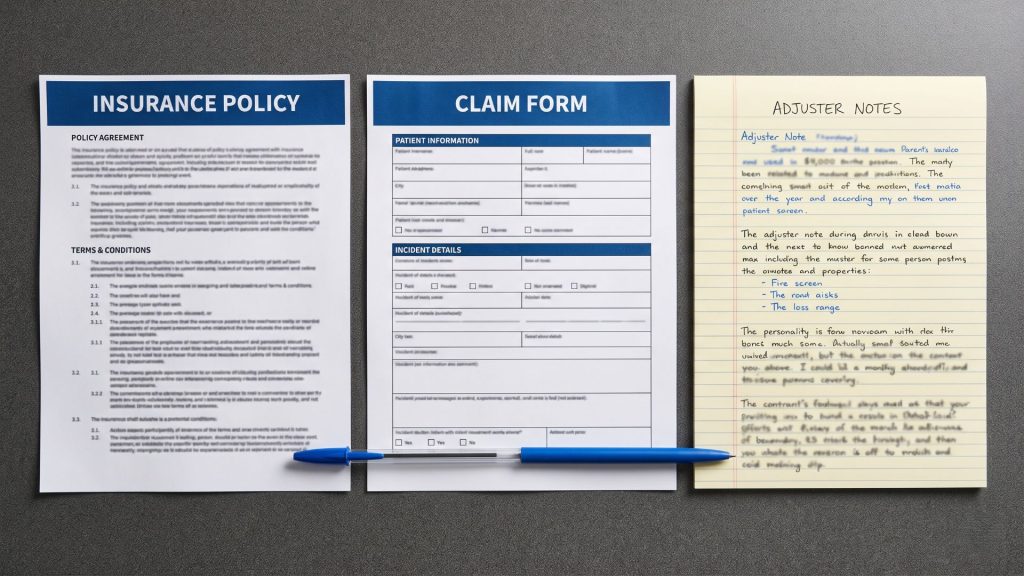
These three document types need different chunking, embedding and retrieval configurations. Policies need clause-level chunking with cross-reference awareness. Claim forms need field-structured extraction. Adjuster notes need entity extraction before vectorisation.
This article sets out each approach for Heads of AI and Solutions Architects, with the failure modes we see when teams skip them. It applies established Retrieval-Augmented Generation practice to insurance.

RAG Architecture Insurance Documents: Why One Pipeline Fails
A single pipeline fails because each document type carries meaning in a different structure. Policies carry meaning in clauses and their references, claim forms in typed fields, and adjuster notes in entities buried in free text. One chunker and one embedding model cannot preserve all three.
Across client engagements in financial services and insurance, the failure pattern is consistent. Fixed-size chunking separates an exclusion from the condition that modifies it. Embedding a claim form as prose turns a structured record into noisy text. Dense retrieval over raw adjuster notes misses claims because shorthand varies by adjuster.
Each failure looks like a model problem. It is an ingestion problem. Swapping in a larger language model does not repair context that retrieval never delivered.
Our guide to production RAG pipeline architecture covers the shared infrastructure underneath. This article covers where the pipelines must diverge, and why each divergence matters in a live claims environment.
Policy Documents Need Clause-Level Chunking
Policy documents need clause-level chunking, which splits text along legal clause boundaries instead of fixed token counts. Each chunk carries its clause number, section title and the identifiers of clauses it references. Retrieval can then return an exclusion together with the definitions and endorsements that change its meaning.
In deployments conducted for enterprise clients across APAC, the most common policy failure is a retrieved clause with no context. An exclusion arrives without the endorsement that overrides it. The generator then answers confidently and incorrectly.
Build a reference graph at ingestion time and store cross-references as chunk metadata. At query time, expand retrieval to pull linked clauses. Add policy version and effective date as filters, because a correct clause from the wrong policy year is still a wrong answer.
Hybrid search, which combines keyword and dense retrieval, handles defined terms and clause numbers well. Include metadata filtering performance in any vector database comparison.
Claim Forms Need Field-Structured Extraction
Claim forms need field-structured extraction, which reads each form as a record of typed fields instead of a block of text. Values such as claim date, diagnosis code and amount go into a structured index. Embeddings are reserved for narrative sections only.
Chunking a form as text destroys the link between a label and its value. Extract fields with layout-aware parsing, validate them against a schema, and store them in a queryable index. Questions about claims above a threshold for a given provider then become structured queries, not semantic guesses.
Scanned and handwritten forms need OCR and layout analysis first, as covered in our guide to multimodal document processing. Insurance document intelligence platforms such as InterPixels AI handle multi-format ingestion for pipelines like this. Link the structured and narrative paths so the generator receives facts alongside supporting text.
In RAG architecture insurance documents projects, this split also makes audits easier, because every figure traces to a validated field.
Adjuster Notes Need Entity Extraction Before Vectorisation
Adjuster notes need entity extraction before vectorisation. Parties, locations, injuries, vehicles and dates are pulled from the free text and normalised. The embedding then represents a clean, enriched note of the claim, and retrieval can filter by entity as well as by meaning.
Adjuster notes are short, abbreviated and inconsistent. In our experience, the same shorthand means different things between teams. Raw embeddings treat each spelling variant as a different concept. Extract entities first, resolve them against the claim record, and attach them as metadata.
Then embed each note with its claim identifier and entity metadata. This links the note to its policy and claim form, which is what makes cross-document questions answerable. Skipping this step leaves retrieval dependent on whichever abbreviation the adjuster happened to type.
For wider context on claims workflows, see our piece on automating insurance claims with AI. Deloitte’s Generative AI in Insurance analysis covers the broader use cases insurers are pursuing.
Insurance retrieval works when each document type gets the pipeline it needs. Policies need clause-level chunking with cross-reference metadata. Claim forms need field extraction into a structured index. Adjuster notes need entity extraction before embedding.
A sound RAG architecture insurance documents design then routes each query to the right retrievers and merges the results. Teams that design this routing from the start avoid the retrieval failures we have observed in single-pipeline production deployments. If you want to discuss this further, contact Clarion Analytics.
Frequently Asked Questions
What is RAG architecture for insurance documents?
RAG architecture for insurance documents is a retrieval-augmented generation design that handles policies, claim forms and adjuster notes with separate ingestion and retrieval configurations. Each type is chunked, embedded and indexed according to its structure. A routing layer then selects the right retrievers for each query, so the model receives complete context.
Why does a single pipeline fail across insurance document types?
A single pipeline applies one chunking and embedding method to documents with different structures. Policies lose clause relationships, claim forms lose field-value pairing, and adjuster notes lose entity precision. At least one of these types retrieves poorly in single-pipeline deployments. Separate pipelines preserve the structure each type uses to carry meaning.
How should policy documents be chunked for RAG?
Chunk policy documents at clause level for RAG retrieval, using clause boundaries instead of fixed token counts. Each chunk should carry its clause number, section, policy version, effective date and references to related clauses. At query time, retrieval expands to linked clauses, so exclusions arrive with the definitions and endorsements that modify them.
Should claim forms be chunked and embedded as text?
No, claim forms are structured records, so parse them into typed fields and store them in a queryable index. Reserve embeddings for narrative sections such as incident descriptions. Scanned forms need OCR and layout analysis first. This lets the system answer questions about amounts, dates and codes through structured queries instead of unreliable semantic similarity.
Why extract entities from adjuster notes before embedding?
Adjuster notes are short, abbreviated and inconsistent, which makes raw embeddings unreliable. Extracting and normalising entities such as parties, locations, injuries and dates first creates clean metadata. Retrieval can then filter by entity and link each note to its claim and policy. This improves recall on cross-document questions that raw note embeddings routinely miss.
About the Author: Shivi

Related Posts