
A claims triage model returns near-total confidence on a document it has never seen anything like, and the wrong answer flows straight into a payout decision. Financial services and insurance teams meet this failure after go-live, not before it. Model confidence scores are uncalibrated softmax outputs, not probabilities, and they overstate certainty exactly where enterprise systems break.
Leading teams now add a second architecture layer that intercepts every model output, applies domain rules, and routes risky results to human review. This post explains why scores mislead, how LLM output verification enterprise architecture works, and which triggers should send an output to a person.

Why Confidence Scores Mislead Enterprise Teams
Confidence scores mislead because they are softmax outputs that sum to one, not measured probabilities of being correct. A model can assign high confidence to a wrong answer when the input sits outside its training distribution. The score reflects relative preference among options, not the likelihood that the answer is true.
A calibrated system that reports 80 percent confidence is right about four times in five. The concept comes from statistics, and the Calibration in Statistics – Wikipedia entry covers it well. Neural models often fall short of that standard, and they fall shortest on rare inputs.
In deployments conducted for enterprise clients across APAC, we saw the same pattern repeatedly. Models handled the common document types used in testing, then met scanned forms, mixed-language claims and unusual policy wordings in production. Confidence stayed high while accuracy dropped. Research summarized in The Hallucination Problem in AI – Stanford HAI describes the same gap between fluent output and reliable output.
What LLM Output Verification Enterprise Architecture Looks Like
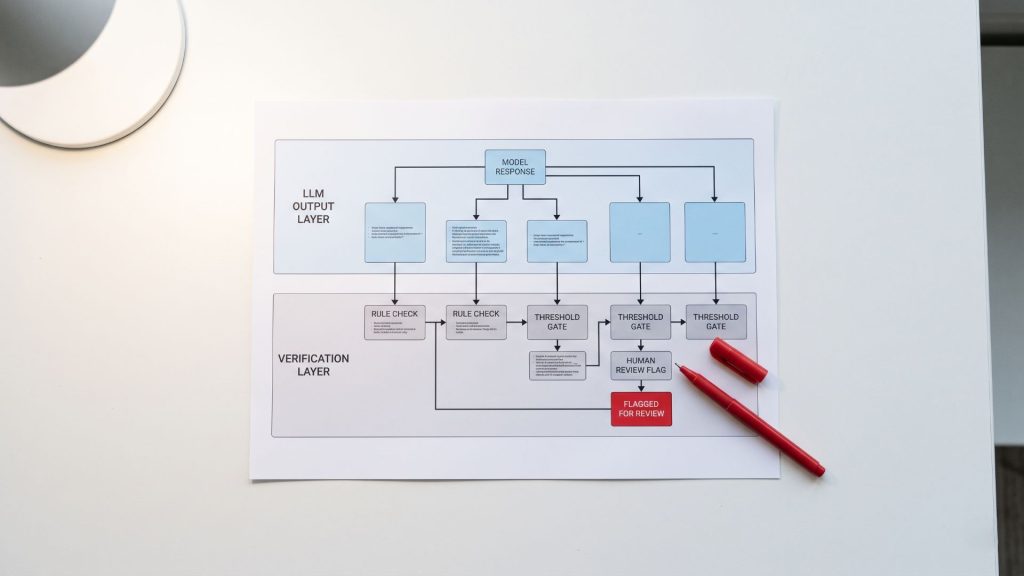
An output verification layer sits between the model and the business system. It intercepts each output, checks it against domain rules and source evidence, and assigns a routing decision: release, repair or escalate. The model proposes, the layer disposes, and no output reaches a business decision unchecked.
The layer runs several independent checks. Schema checks confirm the output has the required fields and valid formats. Business rule checks test values against policy limits, such as whether a claimed amount exceeds a coverage cap. Grounding checks compare each claim to the retrieved source passages, which depends on a sound production RAG pipeline architecture.
Teams also add a cross-check, such as a second model or deterministic extractor that must agree with the first. Disagreement becomes a signal that no softmax score can provide. Across client engagements in financial services and insurance, we have found that these independent signals catch errors the original confidence score never flagged. Teams building this layer should also review techniques for mitigating LLM hallucination at the model level.
Triggers That Should Route Outputs to Human Review
Route an output to human review when the stakes are high, the evidence is weak or the checks disagree. Four triggers cover most enterprise cases: financial thresholds, failed grounding, input drift and cross-check disagreement. Each trigger is a rule written in advance, so reviewers see a defined queue instead of a random sample.
Financial thresholds send any decision above a set value to a person, whatever the model reports. Failed grounding sends outputs containing claims that no retrieved source supports. Input drift flags documents that differ from the training and test distribution, such as a new form layout or an unfamiliar language mix. Cross-check disagreement escalates when two independent methods reach different answers.
Reviewers need context, not just a flag. Show them the source passages, the rule that fired and the proposed output, so they can decide quickly and record why. These decisions also support explainability in regulated industries, because each override leaves an auditable trail. LLM output verification enterprise programs that log reviewer decisions can also tune thresholds over time.
Confidence scores describe how a model ranks its options, not how often it is right. Teams that treat them as probabilities push errors into business decisions. A verification layer closes that gap with rules, evidence checks and defined human review triggers.
Clarion Analytics builds, deploys and stays accountable for systems like this, and the case for AI without hallucination in enterprise settings rests on the same principle: outputs earn trust through checks, not assertions. Start any LLM output verification enterprise program with your highest-stakes workflow. If you want to discuss this further, contact Clarion Analytics at clarion.ai/contact.
Frequently Asked Questions
Are LLM confidence scores real probabilities?
No. Most LLM confidence scores come from softmax normalization, which forces values to sum to one across options regardless of whether any option is correct. The result shows relative preference, not the measured likelihood of being right. Unless a team has tested calibration against real outcomes, it should not treat a score of 0.9 as a 90 percent chance of accuracy.
What is an LLM output verification layer?
An LLM output verification layer is a component placed between a language model and the business system that consumes its output. It checks each output against schemas, business rules and source evidence, then releases, repairs or escalates it. The layer gives enterprises a controllable decision point that does not depend on the model’s own reported certainty.
When should an enterprise route AI output to human review?
Route output to a person when the decision carries high financial or regulatory stakes, when no retrieved source supports a claim, when the input differs from known data, or when independent checks disagree. Write these triggers as explicit rules before go-live. Defined triggers give reviewers a focused queue and give auditors a clear record of why each case escalated.
Why do confidence scores fail on out-of-distribution inputs?
A language model’s softmax output must distribute certainty across the options it knows, so it still produces a confident-looking answer for inputs unlike its training data. The model has no reliable built-in signal that says the input is unfamiliar. Edge cases such as unusual document layouts or rare policy terms therefore receive high scores exactly when the model is least reliable.
Does a verification layer remove the need for human reviewers?
No. A verification layer reduces the volume of outputs that need review, but it does not replace judgment on high-stakes or ambiguous cases. Automated checks handle routine, verifiable outputs at speed, while people handle exceptions. LLM output verification enterprise programs work best when reviewer decisions feed back into the rules and thresholds.
About the Author: Shivi

Related Posts