A vendor shows your HSE team a PPE detection demo with near-perfect results, and the pilot on your own floor starts missing helmets within the first week. The gap is not your site’s fault. PPE detection accuracy manufacturing CV figures in demos come from controlled lighting, sparse crews and clean camera angles, and no live plant offers those. This post explains where accuracy falls in production, names the four failure modes that cause most missed detections, and sets out what to test in a proof-of-concept and how to place cameras. You will leave with questions that expose real performance before you sign a contract.
Why PPE Detection Accuracy Manufacturing CV Figures Fall After the Demo
Vendor accuracy figures describe model performance under ideal conditions, not production performance. Demos use controlled lighting, few workers per frame and cameras with clear sightlines. A manufacturing floor offers none of these, so accuracy falls once the system meets real shifts, real crowding and real equipment.
In deployments conducted for enterprise clients across APAC, we saw the same pattern repeatedly. A model that looked flawless on curated footage began missing detections within days of live operation. A single headline number hides this, because it averages easy frames with hard ones. Ask every vendor for accuracy broken down by lighting, worker density and camera position.
Computer vision interprets what the camera sees, so Computer Vision in Manufacturing performance depends on image quality at the point of capture. Our guide to computer vision for worker safety covers the wider system around the model. A missed helmet is an uncounted exposure, so recall matters more than any averaged score.
The Four Failure Modes Behind Most Missed Detections
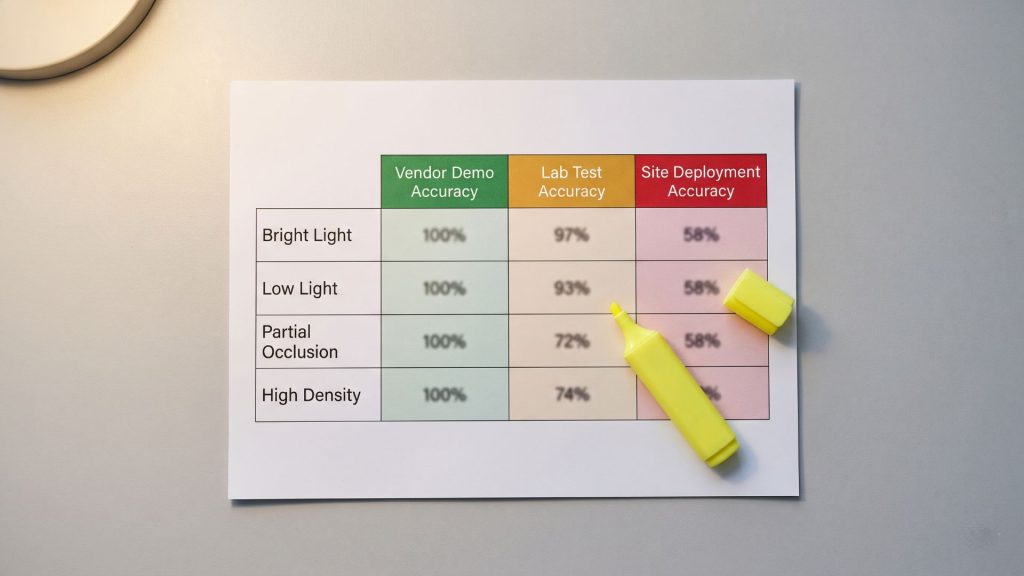
Four failure modes account for most missed detections in production: shift-change crowding, partial occlusion, low-light zones and non-standard PPE colours. Each one appears rarely in demo footage and constantly on a working floor. Vendors seldom name them, so buyers discover them after deployment instead of before.
Shift-change crowding puts many workers in one frame, so bounding boxes overlap and the model drops individuals. Occlusion is any object blocking part of a worker or their PPE from the camera, and pallets, machinery and other workers cause it constantly. A vest half behind a forklift mast often goes undetected.
Low-light zones, such as shaded bays and night shifts, reduce contrast and push PPE detection accuracy manufacturing CV results down. Non-standard colours, including contractor gear, fall outside the training data. Across client engagements in manufacturing and logistics, we found colour mismatch caused more confusion than teams expected. Our comparison of real-time object detection YOLO vs transformers covers how model choice shapes detection under these conditions.
What to Test in a Proof-of-Concept
Test the system on your own site, across a full shift cycle, with your own PPE. Require accuracy reported separately for each failure mode, not as one blended score. Count missed detections against ground truth that your HSE team labels, because vendor self-reporting can favour the model.
Run the pilot through at least one shift change and one night shift. Label a sample of footage by hand, then measure recall for each PPE class and report false alarms per camera per day. Judge PPE detection accuracy manufacturing CV on your own footage, never on the vendor’s reference set. Confirm that inference runs on site, because edge AI real-time inference latency decides whether an alert reaches a supervisor in time.
Tie the acceptance criteria to your safety management system. Sites certified to ISO 45001 already document hazard controls, so the pilot report should map each detection class to a documented control and a named owner.
Camera Placement Considerations
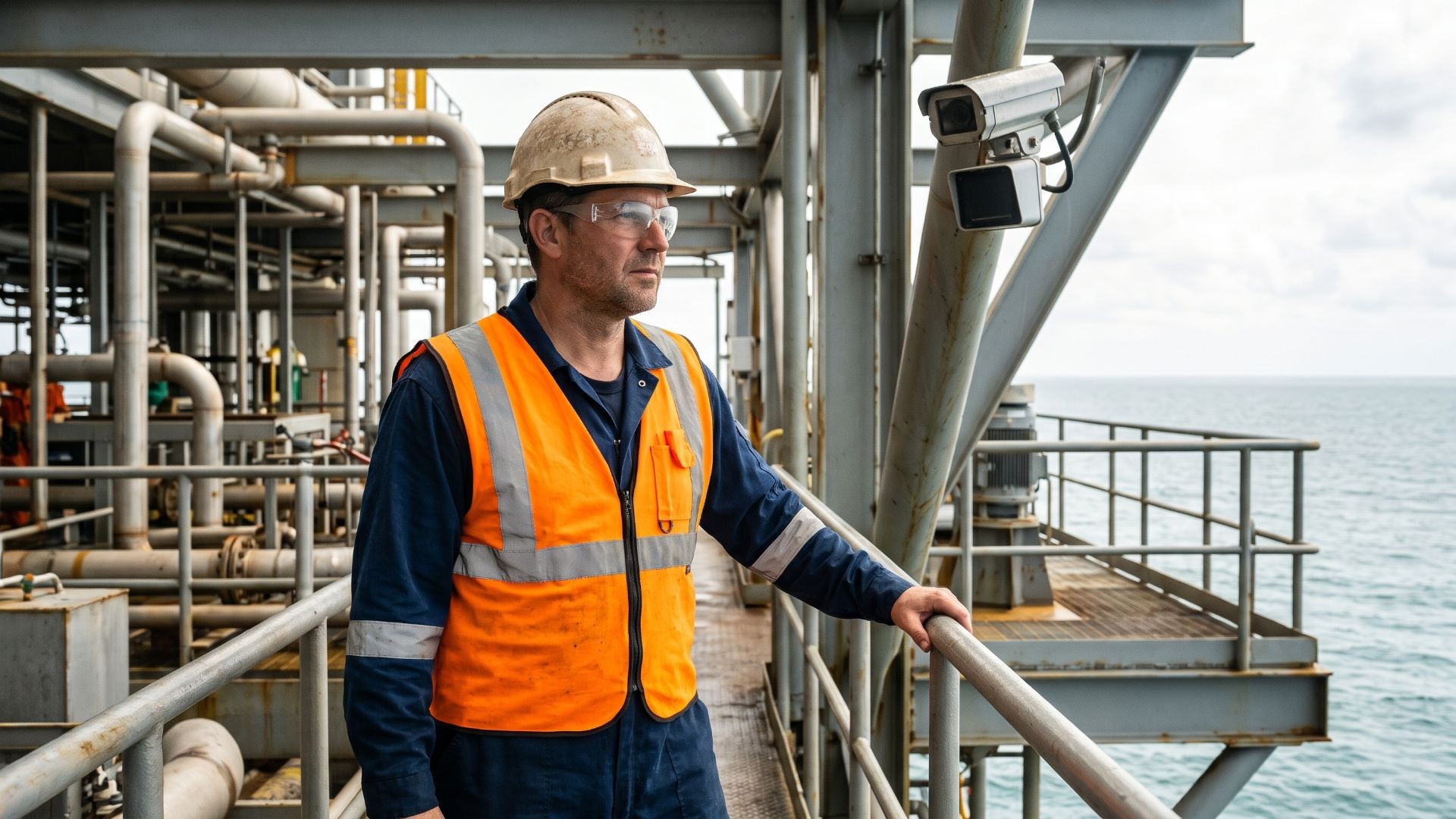
Camera placement determines detection accuracy as much as the model does. Mount cameras high enough to see over equipment, angle them to limit overlap between workers, and keep them out of direct glare. Choose positions from the actual walking paths and entry points, not from the mounting points that are easiest to wire.
Place cameras at entry gates and corridors where workers pass in single file, because crowding hurts accuracy least there. Add overlapping coverage in zones with heavy machinery so one camera covers another’s blind spots. Light low-visibility bays with fixed illumination instead of relying on the model to compensate. Our overview of smart manufacturing APAC computer vision describes how these placement choices carry across quality control and safety deployments.
Clarion Analytics builds AegisVision as purpose-built worker safety AI with PPE detection designed for real manufacturing site conditions. Re-test accuracy after every camera move, because a small angle change alters what the model sees.
Demo accuracy tells you how a model performs in ideal conditions, not how it performs on your floor. Shift-change crowding, occlusion, low light and non-standard PPE colours cause most missed detections, and camera placement influences how often they occur. Test PPE detection accuracy manufacturing CV on your own site, across full shifts, with failure modes reported separately. Set pass criteria before the pilot begins. A vendor that welcomes this test has measured its own system honestly. If you want to discuss this further, contact Clarion Analytics.
Frequently Asked Questions
What is a realistic PPE detection accuracy in manufacturing?
No single figure applies, because accuracy depends on lighting, worker density, camera angle and PPE type. Demo numbers come from controlled scenes and overstate production performance. Ask vendors for recall and false alarm rates for each condition, then verify them on your own site footage during a proof-of-concept across full shifts.
Why does PPE detection fail during shift changes?
Shift changes put many workers in the same frame at once. Bounding boxes overlap, bodies block each other and the model drops individuals or merges them into one detection. Systems tested only on sparse scenes never show this. Include a recorded shift change in every proof-of-concept so you see how the system handles real crowding.
How many cameras does a manufacturing site need?
Camera count depends on floor layout, equipment height and walking paths, not on floor area alone. Start from where workers enter hazard zones and where machinery blocks sightlines. Add overlapping coverage where occlusion is likely. A site survey before purchase gives a defensible count, and a pilot confirms it with measured results.
Does low light really reduce PPE detection accuracy?
Yes. Low light reduces contrast and image detail, so models trained mostly on well-lit footage miss helmets and vests in shaded bays and during night shifts. Fixed lighting, low-light camera hardware and night-shift training footage all improve results. Test every zone at its darkest operating hour before you accept any accuracy claim.
Can PPE detection support ISO 45001 compliance?
It can support monitoring and evidence activities within an ISO 45001 safety management system, but it does not replace supervision or documented controls. Detection data helps you find repeated non-compliance by zone and shift. Your safety team still owns corrective action, and the system must be validated on site before you rely on its records.
About the Author: Shivi

Related Posts